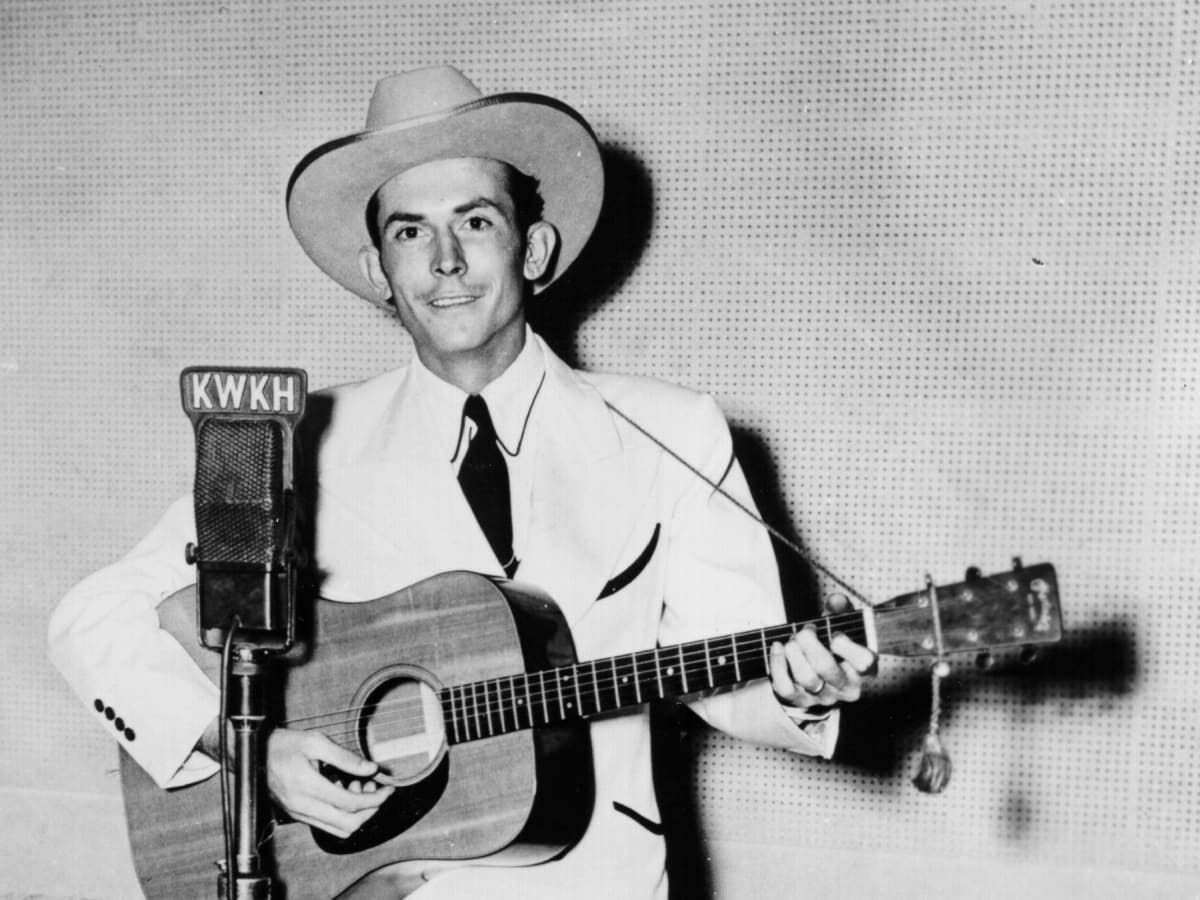
#4. Move It On Over
Move It On Over was one of Hank Williams’ earliest works still in circulation.
Recorded in 1947, the song is often cited as a precursor to the rock’n’roll genre, due to its twelve-bar blues structure, fast pacing, and rebellious lyrics. Hank’s first session at MGM proved to be a success, producing some of his classics, with Move It On Over being Williams’ first major hit single, earning him a placement in the Louisiana Hayride.
With a fast pace, the song has defiant lyrics of a husband in the “dog house” both literally and metaphorically. Each verse ends with the same form, telling her to “move” it on over, using various synonyms in the same lexical field, before declaring himself to be more empowered as a “mad dog”, “big dog”, etc., no longer playing the role of a worn-down husband.
The song is somewhat of a novelty anthem although was popular due to the relatability of the themes sung about in the song, resonating with others feeling neglected by their partners.
The song features a prominent steel guitar to give the song a more gritty and raw feel, adding to the outlawish nature of the song, backed by a stark violin.
A legendary Williams line is planted in the song too: “She warned me once, she warned me twice, but I don’t take no one’s advice.”
#3. I’m So Lonesome I Could Cry
Perhaps no Hank Williams’ song is more famous than 1949’s I’m So Lonesome I Could Cry.
Williams scored a high-charting single with this song. Yet Williams did not even write the track, with credit attributed to the uncelebrated Paul Gilley, named after another upcoming MGM single. On top of that, it was originally set to be spoken word. Moreover, it was only originally a B-side, with faster, more jovial songs favored for radio play.
Despite its rather bizarre origins, the single is highly regarded, attracting global acclaim. The song’s atmosphere is compounded by famous lyrics of birds, elsewhere depicted as chirpy features of the natural environment, sounding blue and forlorn. About the lyric: “Did you ever see a robin weep, when leaves begin to die?”, Bob Dylan said: “Even at a young age, I identified with him. I didn’t have to experience anything that Hank did to know what he was singing about. I’d never heard a robin weep, but could imagine it and it made me sad.”
Angus Batey of The Guardian describes how “The idea of narrative is abandoned for a series of bleak visions of desperate, aching loneliness, almost all involving sights from nature – a train passes through, but the only human soul we sense in this desolate landscape is the writer.” It is further added that the lyrics are ambiguous, with us never learning who the song is aimed at. He continues: “Williams’ taut, resilient performance compels because you can hear the efforts he’s making to keep alive the faintest hope that the situation might yet be resolved.”
With a single guitar, the eerie quietness of the solitary man in the studio adds to the allusion that Williams is a man singing into the distance with sheer hope keeping him alive, singing to no one. The emotions post-abandonment are so great a grown man can cry, an emotion that creeps through to even a macho audience. Williams expresses intense personal feelings with such a directness which utilises his atmosphere – largely through personification – to get across a simple point as poignantly as possible.
Of all people, it was perhaps Elvis Presley who best summed up the song on his Aloha From Hawaii NBC special, commenting I’m So Lonesome I Could Cry was the “saddest song I’ve ever heard.”
Leave a Reply