Hello and welcome back to another edition of Lace ‘Em Up’s Presidential Election series for today we will be going over the Election of 1816. James Monroe wants to become the new president, but he has to deal with the Federalists Party’s Rufus King to make that happen.
Ending The War of 1812

After narrowly getting re-elected to a second term, President James Madison still had to contend with the War of 1812 which wasn’t showing any signs of ending as evidenced by the infamous moment where in August of 1814 British soldiers set the White House on fire. This led to the president, his wife Dolly and the rest of the White House staff to exit the building all while the First Lady was able to save a very important painting of George Washington.
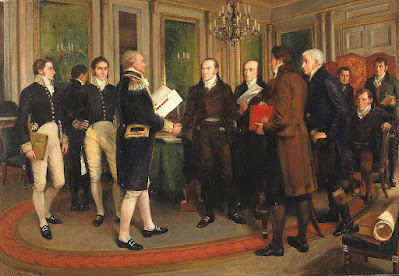
By December of 1814, the ‘Treaty of Ghent’ was signed by both the British and the U.S. which put an end to the war once and for all. Even though the U.S. didn’t emerge victorious in the War of 1812, many Americans were pleased with how they were able to defend themselves against the British forces.
This would soon begin a period of patriotism and American Pride throughout the nation often referred to as ‘The Era of Good Feelings’.
James Monroe

Much like Washington and Jefferson before him, James Madison decides to walk away after two terms and allows his Secretary of State from Virginia, James Monroe to get the nomination after failing to do so back in 1808.
Monroe was just one of several names who considered or thought about running for president under the Democratic Republicans as former Secretary of War John Armstrong Jr. and Secretary of the Treasury William Crawford also made bids for the oval office.
Armstrong looked like a worthy contender for the presidency, but his time as the Secretary of War saw the U.S. suffer a defeat in the Battle of Bladensburg and the aforementioned burning of the White House. Madison forced Armstrong to resign from his position in September of 1814 which was soon given to Monroe.
Crawford on the other hand, wasn’t going to be easy to beat as he was a favorite amongst high ranking officials within the party. Despite some being annoyed with the “Virginia Dynasty” aka all the presidents (except John Adams) coming from Virginia, Monroe would narrowly defeat Crawford to get the nomination and his bringing the Governor of New York, Daniel D. Tompkins as his running mate in order to satisfy the Northern wing of the Democratic-Republicans.
The Hartford Convention

Following two failed attempts in 1804 and 1808, plus the fact they didn’t officially nominate a candidate in 1812, the Federalists have been on a downward spiral which went from bad to worse thanks to the Hartford Convention.
The Federalists were staunchly against the United States going to war with Great Britain and many members of the party decided to meet in Hartford Connecticut to discuss a number of issues including America’s involvement in the war, getting rid of the Three-Fifths Compromise and some even talked about seceding from the United States.
When these and several other demands were sent to Washington D.C., the Federalists Party became even more of a laughingstock as news of Andrew Jackson’s victory in the Battle of New Orleans coupled with the signing of the Treaty of Ghent made the Federalists looked even more foolish as a result.
Despite this, the remaining members of the party decided to nominate New York Senator Rufus King, who had run in the previous elections in some form or another for the Federalists and his running mate in this election is John Eager Howard, the former Senator of Maryland.
The Election of 1816: The Results

An important fact to mention is that Indiana’s votes were a point of contention in this election. Indiana was technically still a territory and not a state when the votes were cast, but they wanted their votes to be counted and after reaching a compromise their votes would end up getting counted.
However, it didn’t make much of a difference as James Monroe easily won to become the fifth President of the United States. Monroe received 183 electoral votes and 68.2% of the popular vote to Rufus King’s 34 electoral votes and 30.9% of the popular vote.
This election would become the final death blow for the Federalists Party as the Democratic-Republicans under Madison and Monroe have already begun to adopt the more popular ideas of the Federalists Party as the ‘Era of Good Feelings’ continues onward.
If you like this kind of content, be sure to leave your thoughts down below and be sure to follow Lace ‘Em Up on Twitter @laceemupoffice and you can follow me also on Twitter @hakeemfullerton and I’ll see you in the next article.
Leave a Reply