To recite and oft-quoted J.R.R. Tolkien line, “Welsh is of this soil, this land, and the senior language of the men of Britain; Welsh is beautiful.” Indeed, Wales has produced much for Britons to be proud of, from musical acumen from Super Furry Animals to Tom Jones, writers such as Dylan Thomas and Bertrand Russell, and actors such as Richard Burton and Anthony Hopkins. The land of the dragon-adorned flag has made a huge cultural impact over the last century – with the names thrown up there barely scratching the surface of socially significant figures.
In the world of politics, the country has produced some of the most significant political names of the 20th century. The following are five of the most significant Welsh political figures, from ministers to party leaders to a prime minister.
Note we are exclusively counting WELSH, as in born in/raised in Wales, politicians. Although it would be remiss to discount the important roles played by the likes of Keir Hardie, James Callaghan, and Michael Foot, they do not qualify for this list as although they were politicians representing Welsh constituencies, they themselves were not from Wales.
#5. Gwynfor Evans

Not a household name, Evans is by far the least known name on this list, which is not to say his role was minimal.
In 1966, a by-election in the parliamentary seat in Carmarthen opened. Winning the seat, Evans became the very first Plaid Cymru MP to enter Westminster.
After the closure of Welsh coal mines, solidly Labour-supporting regions, Plaid Cymru had started to make an increasing noise, aided by opposition to the Labour Party’s increasing closure of coal mining, a decision that would have an adverse effect on communities with large coal mining industries.
During his tenure as an MP, Evans influenced both greater Welsh language reforms such as the Welsh Language Act 1967 (having failed to take the parliamentary oath in Welsh upon entering the Commons) and the creation of the Kilbrand Commission, which would recommend national governments, an idea later brought to fruition in the late ‘90s.
Yet perhaps his most impactful role was in 1980, after his time as an MP had come to an end. That year, the Conservative Party reneged on an election manifesto pledge to create a Welsh-language TV station. In retaliation, Evans – then nearing septuagenarian status – threatened to go on hunger strike in a so-called fast to death. According to For The Sake of Wales: The Memoirs of Gwynfor Evans, the threatened strike’s publicity grew week by week, covered by major British papers, with some sympathetic to the Welsh cause. The publicity was not contained within the UK, with Evans commenting: “It may be that the coverage given by the foreign press did as much as anything to shake the Government.”
A devolved government may have only been voted for by 12% of the electorate in 1979, but by the late 1990s, devolution had over 50% support, growing further by 2011.
In the words of First Minister of Wales Rhodri Morgan after Evans’s death in 2005: “There is no gainsaying his massive contribution to Welsh public life, and particularly in raising the profile of Wales and Welsh issues throughout his long career in Welsh and British politics.”
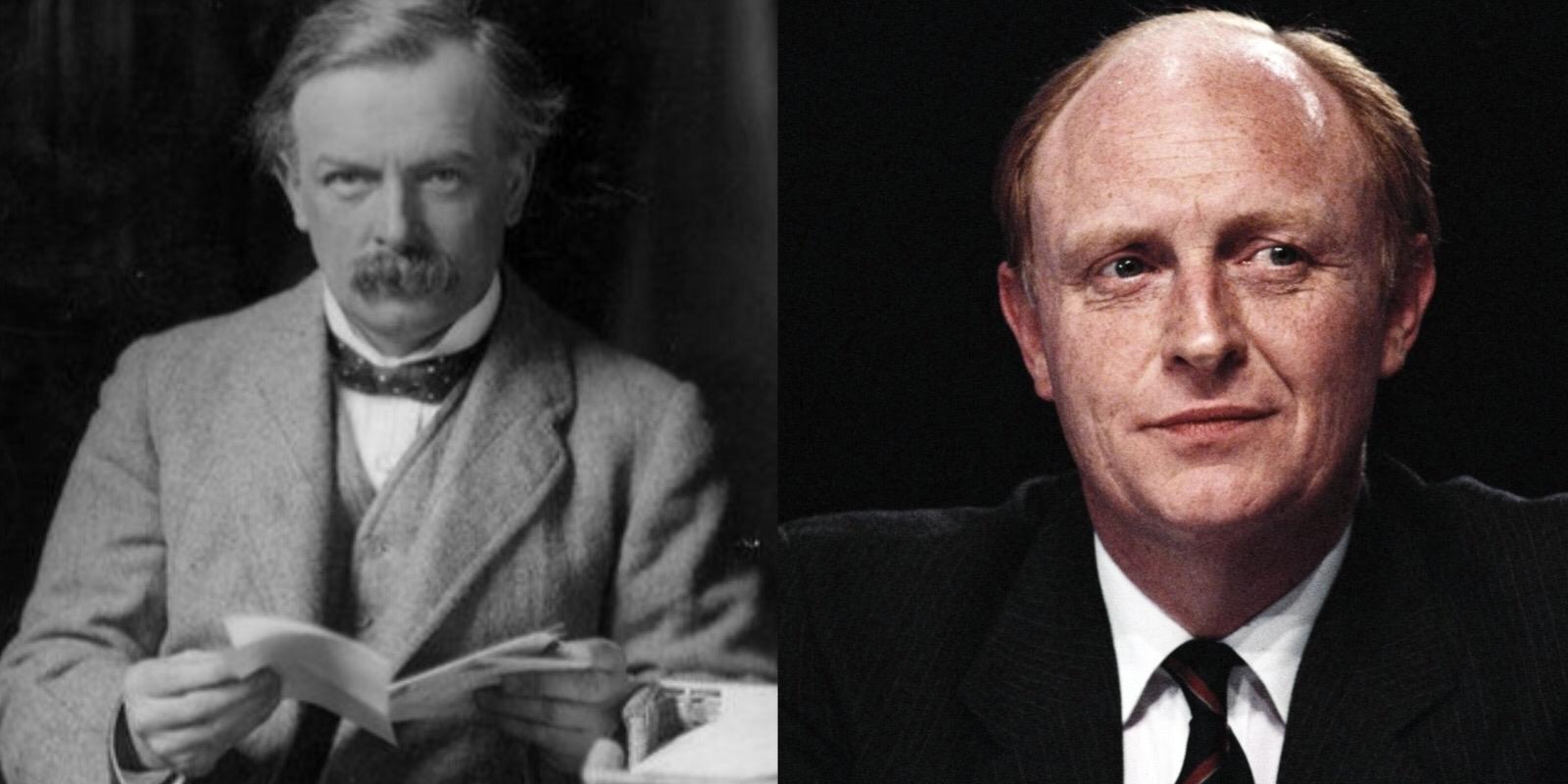
#4. Neil Kinnock

Although Tony Blair often gets praise or condemnation for – depending on your political perspective – the rejuvenation of the Labour Party via New Labour, another hugely important figure in the party’s shift on the political spectrum was Neil Kinnock.
By the time Neil Kinnock took over in 1983, Labour had been in disrepair for nearly half a decade, with clashes within the party as the socialists faced the moderates. The divisions were best highlighted by the breakaway of a right-wing bloc of ex-Cabinet ministers when the Gang of Four (Roy Jenkins, David Owen, Shirley Williams, Bill Rodgers) set up the Social Democratic Party in 1981.
With nearly three-quarters of the vote, Neil Kinnock won the leadership election after Foot’s resignation, tasked with making the dire party electable again.
After shutting out the militant leftist elements, he helped Labour modernise its image, as demonstrated by his public denouncing of violent strikers, such as the National Union of Mineworkers from 1984-1985. Dropping commitments to nuclear disarmament and nationalisation, the party moved to the centre where they saw greater electoral success.
Able to somewhat improve the party’s electoral performance in 1987, by 1989, Labour had taken over from the Conservatives in opinion polls. From June 1989 until Margaret Thatcher’s resignation in November 1990, Kinnock’s Labour Party were able to win in every poll, winning by double-digit margins in the weeks before Thatcher’s government fell.
With the Conservatives unpopular and Kinnock’s more voter-friendly image, it was predicted that there would be a hung parliament or small Labour majority at the 1992 election.
However, in the end, the Conservatives emerged with a tight but workable majority of 21 MPs.
After a decade on top, Kinnock resigned in 1992. Although unable to become prime minister, the Tredegar-born Kinnock was nonetheless able to put the party into a far greater electoral position than when he first took over; a short-term loss but long-term gain for the party. His work has been referred to as providing “much of the groundwork to make the New Labour project possible” by the BBC.
#3. Roy Jenkins

The political scientist Vernon Bogdanor has categorised Roy Jenkins’s political acumen into three successes: his work as Home Secretary, his support for European integration, and a realignment of the political left-wing.
In 1965, the son of a Monmouthshire miner was made Home Secretary. The youngest occupier of the role since Churchill, Jenkins embarked on the creation of a so-called “Civilised Society”. Jenkins’s tenure saw him push through legislation decriminalising homosexuality, liberalising abortion laws, and introducing bans on racial discrimination. Often considered the greatest Home Secretary of the 20th century, the ever-reliable Jenkins was moved into the position of Chancellor in 1967.
He too was a long-standing supporter of greater European integration. He led a bloc of 69 MPs to support EEC entry in 1971. Once a member in 1973, he was a large presence in the remain campaign in the 1975 EEC referendum. In the campaign, he was quoted as remarking: “I care very much about the influence of Britain in the world, and also about our capacity to control our own destiny. To me, that is much more important than the legalistic definition of sovereignty.” The move perhaps sabotaged any chance he had of becoming Labour leader. In 1977, he left parliament to become President of the European Commission.
Amidst the Labour Party’s left-ward jolt under Michael Foot, Jenkins was one of the “Gang of Four” who established the Social Democratic Party, described by Thames TV as “the first major political birth in Britain since the Labour Party in 1900.” A centre-left organisation, grandee Jenkins re-entered Parliament whilst the party’s 25% of the vote share in the 1983 election was the highest of any third party in decades, polling just two percentage points behind the well-established Labour Party.
Jenkins was universally beloved. Even political opponents regarded him, with the right-leaning newspapers The Telegraph and The Daily Mail calling him “manifestly the best man for the premiership” and “the best Labour prime minister we’ve never had” respectively. After his death, former Liberal Democrat leader Paddy Ashdown added: “Probably no person outside the rank of Prime Minister has done more for British politics in our time than Roy Jenkins.”
#2. David Lloyd George

Only one Welshman has been prime minister: David Lloyd George.
Although actually born in Manchester, biographer Roy Hattersley contends in David Lloyd George: The Great Outsider that George was “certainly the most famous and perhaps the greatest Welshman of all time…[his] state of mind was Welsh. Blood and upbringing shaped his character, not the accident of birth which made him officially English.”
At the turn of the 20th century, the Welsh-speaking Pembrokeshire native made a name for himself as a prominent New Liberal, an ardent opponent of the Boer War and an avid supporter of women’s suffrage.
After the Liberal Party took power in 1905, George became a Cabinet minister. Upon Prime Minister Henry Campbell-Bannerman’s resignation, George was pushed up to Chancellor.
Described by GOV.UK as “one of the 20th century’s most famous radicals”, his 1909 “People’s Budget” drew out plans for a far more progressive taxation to fund social welfare programmes. Vetoed by the House of Lords, a constitutional crisis arose, forcing the government to seek an election. The Liberals stared down the Lords, passing the budget and 1911 Parliament Act, prohibiting the chamber from vetoing money bills.
1911 also beckoned the National Insurance Act, a move cited by many as establishing a blueprint for the welfare state alongside the previously George-backed Old Age Pensions Act. His welfare policies were inspired by a visit to Germany in 1908.
After serving as a reforming Chancellor, he was made prime minister in 1916 amidst the First World War. After victory in 1918, he was a war hero, holding power until 1922. In that time, he negotiated Germany’s post-war fate and secured a free Irish state.
He proved crucial in the history of the Liberal Party. In 1918, the party split and they did not reconcile until 1923, by which time the party had been overtaken by Labour, throwing the party into permanent third-party status.
The historian Martin Pugh writes:
“[Lloyd George] made a greater impact on British public life than any other 20th-cent. statesman. He laid the foundations of what later became the welfare state, and put a progressive income tax system at the centre of government finance.”
#1. Aneurin Bevan

Perhaps no man in British history can boast a contribution as great to society as Aneurin Bevan. As Minister of Health, Bevan was the central figure in the establishment of the National Health Service, with 77% of Britons today believing the institution is “crucial to British society.”
Bevan was born to a working-class Monmouthshire family. The son of a coal miner, he was a union boss at the time of the 1926 General Strike in which he played a sizable role within Wales.
In 1945, the Labour Party were swept to power, setting out an unprecedently radical agenda.
In 1946, he set about establishing universal and free-of-charge medical services for the war-stricken nation, latter proclaiming: “No society can legitimately call itself civilised if a sick person is denied aid because of lack of means.”
It was built on three key principles: the services meet the needs of everyone, it is free, and that it is based on need rather than the ability to pay.
Bevan’s plans saw backlash from the Conservative Party and the British Medical Association as well as scepticism from within his own party.
Nonetheless, Bevan was able to negotiate in order to make what many thought were socialist fantasies into a beloved reality.
In 1951, when the Attlee government introduced prescription charges for dental and visual care for greater military expenditure, Nye – alongside fellow ministers John Freeman and Harold Wilson – resigned.
In the 1950s, he was the source of rebellions, infighting, and division. Throughout the decade, Bevan became an outspoken opponent of many government policies. Sometimes blamed for costing the party elections in 1955 and 1959, Bevan fought the leadership on matters such as participation in NATO and nuclear disarmament. In 1955, the whip was withdrawn from him.
His Bevanite faction successfully defeated Labour leader Hugh Gaitskell’s attempts to reverse the party’s Clause IV.
In 1959, he became Labour Deputy Leader under Gaitskell, although this would be short-lived as he would pass away the next year.
In tribute, ardent rival Hugh Gaitskell reflected: “Easily the most eloquent and impressive speaker in the House of Commons, he was a tower of strength to us in opposition…[He] will always be remembered as the architect of the National Health Service.”
In 2002, the Welsh public voted Bevan as the greatest Welshman in history.
GRIFFIN KAYE.
Leave a Reply