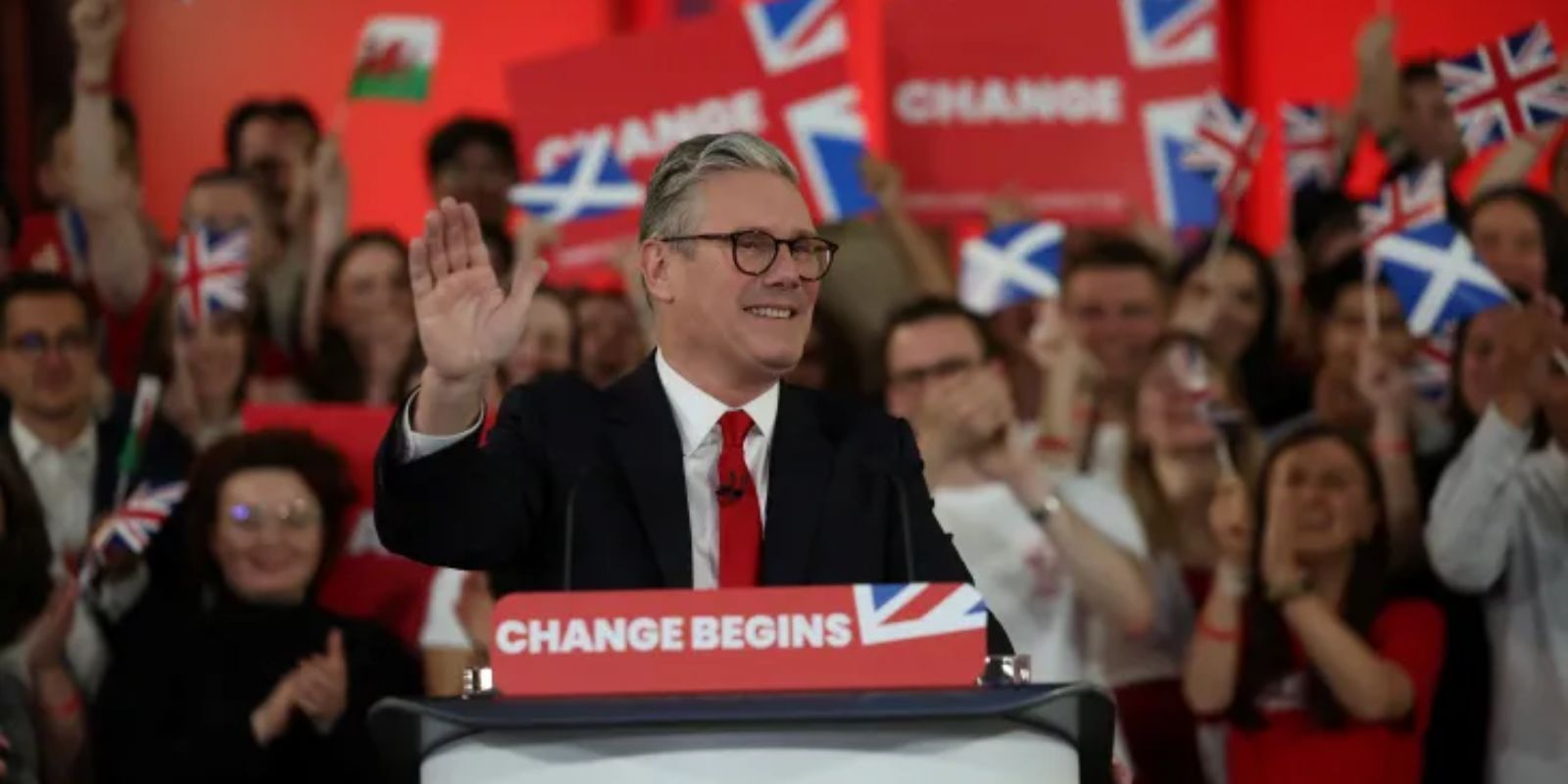
2024 saw Labour win a remarkable – albeit not unexpected – landslide but that is far from the only story to come out of this result. Join us now as we take a look at the figures that made this election so unique.
0: In this election, no Conservative MPs were elected in Wales. Despite the Conservative Party winning 14 seats in 2019, in just five years, Wales again became Tory-free for the first time since 2001. The Tory vote collapsed to its lowest level in over a century, winning just 18% of the vote. Of the 32 Welsh seats, 27 were won by Labour, four by Plaid Cymru, and one by the Liberal Democrats. Among the notable Tories ousted were Welsh Secretary David TC Davies and Chief Whip Simon Hart.

1: Despite the Conservative Party’s strong results in 2019, 2024 saw just one solitary seat where the Conservatives won more than 50% of the vote: Harrow East, where Tory incumbent Bob Blackman won 53.3%.
4: Two progressive parties won their highest ever total of seats, four, at this election: the Green Party and Plaid Cymru. The Greens saw its co-leaders elected to Parliament for the first time with Carla Denyer making an impact by taking Bristol Central from Shadow Cabinet Minister Thangam Debbonaire. Plaid Cymru meanwhile were able to become the official Opposition in the Welsh Senedd.
Also, the constituencies of the previous four Conservative prime ministers were lost, meaning every PM’s seat since 2010, with the exception with the incumbent, has been lost. The old seats of David Cameron in Whitney, Theresa May in Maidenhead, and Boris Johnson in Hendon were all won by the Liberal Democrats whilst Labour won Boris Johnson’s former Uxbridge and South Ruislip seat and took seat of incumbent MP Liz Truss in South West Norfolk.
Keir Starmer’s remarkable victory made him only the fourth Labour leader to lead his party to a parliamentary majority after Clement Attlee, Harold Wilson, and Tony Blair. More surprising is the fact that with the appointment of Hilary Benn as Secretary of State for Northern Ireland, a member of the Benn family has served in each Cabinet of a Labour majority government.
5: The Labour campaign focussed heavily on the idea of 14 years of Tory chaos. This includes five different prime ministers in 14 years. A win would have meant the fifth consecutive Conservative win under the current Tory regime – the longest continuous term in government in modern history.
Additionally, five Reform MPs were elected. Despite being down from the exit poll prediction of 13, it was nonetheless an impressive start for a newly-formed political party, who had never won a seat at a general election before. Party leader Nigel Farage was elected in Clacton, Chairman Richard Tice won in Boston and Skegness, and current MP Lee Anderson held onto Ashfield whilst the party too picked up Great Yarmouth and South Basildon and East Thurrock.
Also numbering at five were the amount of Independent MPs sent to Parliament, the highest tally since 1945. The most prominent of these is Jeremy Corbyn, sure to be a strong socialist voice in Parliament and a thorn in the side of the Labour Party that disowned him; he retained the Islington North seat held since 1983, beating the Labour candidate by over 7,000 votes.

7: Despite the scale of their victory, seven Labour incumbents lost their seats. As mentioned, the Greens defeated Thangam Debbonaire in Bristol Central whilst Leicester East was won by the Conservatives after the progressive vote was split by expelled Labour member and Independent incumbent Claudia Webbe (supported by George Galloway’s Workers Party), and former Labour MP Keith Vaz. A number of seats too were lost to pro-Gaza activists over the party’s stance on the Israel-Gaza conflict. Most notably was Shockat Adam in Leicester South, who managed to topple Shadow Cabinet minister Jonathan Ashworth, boosted perhaps by comments Ashworth had made about deporting Bangladeshi citizens.
9: In its worst performance since 2010, the Scottish National Party catastrophically crashed down to Earth, falling from 48 seats to a mere nine. It thus no longer has the majority of MPs in Scotland, which it has had ever since its 2015 landslide where they won 56/59 seats. It is an even worse result than in October 1974, when they picked up 11 seats.
11: According to the website LabourList, 11 Labour MPs have returned to Parliament. The most noteworthy comeback being that of Douglas Alexander in top Scottish target seat Lothian East. A former New Labour Cabinet minister and later Shadow Foreign Secretary, he has been made a Minister of State at the Department for Business and Trade. Another notable is Dan Norris who managed to unseat Jacob Rees-Mogg in North East Somerset and Hanham.
11.8: The percentage drop in the safest seat in the country. Liverpool Walton saw Labour pick up a majority of 30,520 on 84.7% of the vote, a nearly 75% majority. Instead, 2024 saw Labour win 70.6% of the vote, a drop of 11.8%. This is largely due to Reform, who won 15% – more than the 2019 total of the Conservatives, Greens, and Liberal Democrats combined.
12: A record of 12 Cabinet ministers lost their seat in this election. Among the big names gone were Defence Secretary Grant Shapps, Education Secretary Gillian Keegan, and Leader of the House of Commons (and future Tory leader favourite) Penny Mordaunt.

14: 14 years of Tory rule came to an end. This makes it the second longest period of continual government since the Second World War behind the Thatcher-Major years of 1979-1997. Events such as the disastrous mini-budget, Partygate, and the austerity years gave Labour an attack base to galvanise support.
14.3: Percentage of the popular vote won by the new populist Reform Party. The far-right party were able to split the right-wing vote and distort the results by hindering Conservative efforts. It was a lower percentage of the vote than previous polls had demonstrated, with some even showing Reform having overtaken the Tories.
15: The closest result of the night was in Hendon, where the Labour Party won by a margin of just 15 (0.04%) votes.
19.9: The fall in percentage of vote share for the incumbent Conservative Party, denoting the largest drop off from the previous election in modern UK history.
22: The new Baby of the House – the term given to the youngest MP in the House of Commons – goes to Labour’s Sam Carling. Aged just 22, he is the second youngest legally-elected Baby of the House elected to Parliament in a general election since the Second World War.
26.2: The swing to Labour in the South West Norfolk seat, enough to unseat former prime minister Liz Truss. It is the largest ever recorded swing from Conservative to Labour, helping defeat Truss, who had a 26,000-strong majority on nearly 70% of the vote in 2019.

33.7: The popular vote total that Labour were able to win on. It is the lowest vote share a party has ever been elected to government on, a record previously held by Tony Blair, who won a 66-seat majority on 35%. It is an often-repeated statistic that Labour won two-thirds of the seats in Parliament on one-third of the vote
37: Labour won 37 seats in Scotland, their highest total since 2010. This counts for nearly two-thirds of Scottish parliamentary seats, 28 clear of closest rivals the SNP, despite the two parties being separated by only 5.3% of votes.
41: Data from YouGov reveals that only 41% of those aged 18-24 voted Labour. This figure accounts for the lowest Labour voters in this age bracket since 2010. Instead, many defected to the Green Party, who were the second most voted for at 18%. Labour’s highest vote share amongst an age demographic was 46% amongst 30–39-year-olds.
44: At 44, Rishi Sunak made history as the youngest prime minister to ever lose an election, taking over the mantle from John Major, aged 54 in 1997.
45.1: The historically unprecedented swing from Conservative to Reform in the Clacton constituency. Won by leader Nigel Farage, the Conservative Party vote in this seat fell by 44%, the biggest vote collapse on record whilst the new Reform Party obtained nearly 50% of the vote.

47: 47 different constituencies broke the previous general election swing record, which was 18.8%. This includes all four new seats won by Reform, as well as several high-profile gains for Labour, the Liberal Democrats, and Greens.
57.7: The vote total of both major parties, the Conservatives and Labour, combined. It indicates the lowest total for the two parties in modern history. For reference, in 2019, it was 75.7% – itself a fall from 82.3% in 2017.
59.9: The turnout for this election was just 59.9%, down from 67.3% in 2019. With the increasing closeness of the parties and polls perhaps causing such a reduction, it marks a historically low level of participation in a general election. (see 1885)
61: Although an overlooked fact, Sir Keir Starmer has become the oldest sitting prime minister in decades at age 61. You have to go back to James Callaghan in 1976 to find an older individual at the point when they became premier. Considering he has spoken of a decade of national renewal; this means he would be well past being an old age pensioner.
72: Aside from Labour, perhaps the biggest winner of this election was the Liberal Democrats, who – despite some important by-election wins – were hovering between the single and double figures prior to the election. Sir Ed Davey’s party were able to win over 60 seats, knocking down the blue wall, helped undoubtedly by tactical voting. Their final 72-seat tally is not only the highest in the party’s history but also the best performance by any third party since 1923.

75: A record 75 Conservative MPs stood down in 2024, surpassing the 72 who did so in 1997. Theresa May, Michael Gove, Dominic Raab, Savid Javid, Nadhim Zahawi, John Redwood, Kwasi Kwarteng, and Ben Wallace were just some big names to announce they would not seek re-election.
80: With Bill Cash standing down, Roger Gale, Herne Bay and Sandwich MP since 1983, is the oldest MP in the Commons aged 80.
89: 89 MPs of ethnic backgrounds were elected, composing nearly 14% of the intake, having passed 10% in 2019. This includes the election of the first ethnic MP for Wales, Kanishka Narayan. Sunder Katwala, the director of the think tank British Future remarked: “The 2024 election is a landmark for representation, with record diversity in our parliament, closer than ever to that of the electorate,” adding “In the space of 40 years we have gone from zero to nearly one in seven MPs being from an ethnic minority background.”
113: A grand total of 113 seats (17.4%) were decided by less than 5% of the vote. Those narrowly unseated on less than 5% of the vote include big names such as Liz Truss, Penny Mordaunt, Damian Green, Therese Coffey, and Michael Fabricant. Comparatively, potential Tory leader Kemi Badenoch won by under 5%, Chancellor Jeremy Hunt won by under 1,000, and Party Chairman Richard Holden won by 20 votes. Moreover, despite their landslide win, some Labour MPs were close to being defeated, with Jess Phillips and Wes Streeting winning by less than 1,000 votes over pro-Gaza candidates.
121: 2024 saw the worst-ever Conservative electoral performance as they won a miserable 121 seats. Winning just 23.7% of the vote, it overtook their disastrous 1906 performance where they won 156 seats in the Liberal landslide, losing all of their usually safe seats in Cornwall, Derbyshire and Oxfordshire.
140: Of the top 150 target seats for Labour, they were able to win 140 constituencies, including taking back the majority of red wall seats the Conservatives won in 2019.
174: The scale of Labour’s win can be summed up by their 174-seat majority. It is the second largest majority in the post-war era, five seats behind Tony Blair’s 1997 landslide. That said, in 2024, the Opposition Tory Party has far less seats and the Lib Dems, likely to co-operate with the Labour Party, effectively gives them a larger majority.

251: 251 Conservative MPs were unseated at this election, twice as many as now remain. As referenced earlier, Liz Truss, Penny Mordaunt, Grant Shapps, Gillian Keegan, and Jacob Rees-Mogg rank amongst the most high-profile Tories to lose their seat.
263: A record 264 female MPs were elected to Parliament, the first time the number of women in the Commons has passed 40%.
335: More than half of the MPs winging their way to the House of Commons will be new to the House. The Guardian noted that 76.1% of these will be Lib Dems whilst 56.4% will be Labour MPs. Notable who still be strolling into the Palaces of Westminster for the first time include Reform’s Nigel Farage, the Green co-leaders Carla Denyer and Adrian Ramsay, and TV writer, disability campaigner, and now Labour MP Alison Hume.
411: 411 Labour MPs (excluding Speaker Lindsay Hoyle) were elected. This is eight short of the 418 elected in 1997 and one short of the 412 won in 2001 but nonetheless a huge number that means Labour hold 63.2% of parliamentary seats.
510: 510 of those elected were from centre, centre-left, or left-wing parties, making up nearly 80% of Parliamentary seats. Perhaps aided by tactical voting, this figure includes members of the Labour Party, Liberal Democrats, Scottish National Party, Sinn Fein, Plaid Cymru, Green Party, Social Democratic and Labour Party, and Alliance Party of Northern Ireland).
803: With the win, Shadow Chancellor Rachel Reeves was given a mandate to become Chancellor, making her the first female Chancellor in the 803-year history of the job.

1885: The 2024’s aforementioned meagre 59.9% turnout means it has the second lowest turnout of any election since 1885.
1945: The last time a general election was announced for July, it was 1945, where Labour swept to power in a landslide. Premonition, much?
1983: The new Father of the House, Sir Edward Leigh, was first sworn in in 1983. In Worthing West, incumbent Father of the House Peter Bottomley was defeated, not only making him the first individual in the role to lose his seat but the oldest Tory MP to have ever lost his seat in modern history. Bottomley’s defeat means there are no longer any MPs in the Commons who served during the 1970s or earlier.

2005: Keir Starmer’s party won the endorsement of The Sun for the first time since 2005. Perhaps the most-read newspaper in the country, it has backed the successful election winner every cycle since 1979.
4,515: This election saw a record 4,515 candidates stand for Parliament.
18,884: This was the amount of votes won by prime ministerial hopeful Keir Starmer in his Holborn and St Pancras seat. Although still obtaining nearly 50% of the vote, it is a marked decrease since 2019, when he won 36,641 votes. Despite running as an Independent, Jeremy Corbyn won 5,000 votes more than his successor.
21,983: The biggest majority in the country was obtained in the safe Labour seat of Bootle, in Merseyside. Here, the Labour candidate Peter Dowd won by over 20,000 votes. Again, this is far less than 2019 when the Knowsley was won by a near-40,000 majority.
400,000: As many as 400,000 potential voters may have been impacted by the provisions of the Elections Act 2022, which made photo ID compulsory for voting. At the local elections earlier in the year, as many as 14% were unaware of this rule whilst even the prime minister who introduced it, Boris Johnson, was turned away from a polling booth for failing to comply.
9,731,363: The Labour Party received under 10 million votes nationwide in this election. This is over three million less than Jeremy Corbyn obtained in his 2017 gambit and still less than 2019, when Labour won just over 200 seats. Despite winning over half a million votes less than 2019, they won double the amount of parliamentary seats.
GRIFFIN KAYE.
Leave a Reply