It has been debated that the Supreme Court is a political institution. However, on occasion, justices of all political philosophies come together to form a collective decision, a number of which have had a sizable historical impact.
1. Marbury v. Madison
- Year: 1803
- Subject Matter: Judicial power
- Constitutional Passage Concerned: Article III
- Ruling: 4-0

(Photo: Politico/Business Insider)
Had it not been for the decision in the 1803 case Marbury v. Madison, many of the cases following may never have been heard. As it turned out, this vital decision was unanimous.
This case has its origins in the 1800 election in which Thomas Jefferson won the presidential election over John Adams. Prior to leaving office, Adams appointed Federalist allies to several judiciary posts although the necessary commissions for them to take office had not been completed before Adams’s term came to an end.
One such stalled appointee was that of William Marbury, who took the case to the Supreme Court asking for them to issue writs of mandamus (a court order ordering an official to fulfil its duties) to new Secretary of State James Madison to confirm his appointment.
In February 1803, the Supreme Court heard the case before deciding it later that same month.
The outcome is a complex one.
Justices William Cushing and Alfred Moore did not hear the case but the others voted 4-0 in favour of Marbury, although they could not force Madison to confirm him.
More crucially, in their opinion, the Court struck down Section 13 of the Judiciary Act 1789 which had allowed Marbury to petition the Supreme Court for the writs of mandamus. The first time an Act had ever been ruled unconstitutional, it gave the Court more power than expressed in the Constitution.
It both singlehandedly cemented the Constitution as the paramount source of US law whilst establishing the concept of judicial review, which gives the Court the power to judge the constitutionality of the actions of the legislative (and later executive) branch.
Chief Justice John Marshall – himself a post-election loss Adams appointee – wrote that “it is emphatically the province and duty of the judicial department to say what the law is. Those who apply the rule to particular cases must of necessity expound and interpret that rule.” He added: “a law repugnant to the Constitution is void.”
The idea reflected the ideas espoused by Founding Father Alexander Hamilton in his The Federalist Papers, although fellow Founding Father and then-President Thomas Jefferson feared it may make the judiciary a “despotic branch.”
A case that laid the foundation for the Supreme Court today, current Chief Justice John Roberts has called it an “important insight into how the Constitution works” and “the secret to [the Court’s] success,” quoting Marshall’s decisions in a number of his own opinions.
Today it is commonly cited as the most important Supreme Court case of all time.
2. McCulloch v. Maryland
- Year: 1819
- Subject Matter: Congressional power, states rights
- Constitutional Passage Concerned: Article I
- Ruling: 6-0

In the midst of economic turmoil after the War of 1812, President James Madison signed into law the Second Bank of the United States.
A branch in Baltimore was subject to Maryland legislation which imposed taxes on banknotes by banks not chartered within the state. When bank cashier James McCulloh was issued a $110 fine, he refused to pay it, and was taken to court. The state appeals court ruled that the Second Bank itself was unconstitutional as there was no explicit Constitutional allowance for its creation.
The case went before the Supreme Court in February 1819.
In a landmark ruling, it was decided 6-0 that both the Bank was constitutional, but the tax was not.
The opinion, written by Chief Justice Marshall, argued that under the “Necessary and Proper Clause” of Article I of the Constitution provided that Congress had implied powers. He reasoned: “there is no phrase in the instrument which, like the articles of confederation, excludes incidental or implied powers; and which requires that everything granted shall be expressly and minutely described.”
Notably, the Second Bank had the support of Attorney General William Wirt. Daniel Webster, who represented the Bank in the case, was quoted in Marshall’s opinion in which the Justice wrote “the power to tax is the power to destroy.” Webster also played a sizable role in the landmark case Gibbons v. Odgen (1824).
The implied powers that the Court ruled Congress had paved the way for the expansion of the federal government. As Sky History noted: “Without McCulloch v. Maryland, Congress wouldn’t have been able to create the New Deal or Social Security in the 1930s, or enact legislation such as the Civil Rights Act of 1964 and the Patient Protection and Affordable Care Act in 2010.”
3. Schenck v. United States
- Year: 1919
- Subject Matter: Freedom of speech
- Constitutional Passage Concerned: First Amendment
- Ruling: 9-0

(Photo: University of Alabama School of Law)
Jumping forward a century, 1919’s Schenck v. United States was a case that defined some of the perameters to free speech, indicating there were some restrictions.
Shortly after the US entry into the First World War, Congress passed the Espionage Act 1917, which aimed to prevent insubordination of military orders or disloyalty to the nation’s war effort. In a previous State of the Union speech, President Wilson had remarked of anti-war campaigns: “Such creatures of passion, disloyalty, and anarchy must be crushed out.”
General Secretary of the Socialist Party Charles Schenck was charged under the law for publications seen to violate this legislation. He had printed and mailed 15,000 leaflets to Pittsburgh, Pennsylvania’s citizens, advising them to dodge the military draft. One section read: “a conscripted citizen is forced to surrender his right as a citizen and become a subject.”
In March 1919, the Supreme Court made their judgement although by this point, the war was already over. They unanimously ruled that the Espionage Act was constitutional, upholding Schenck’s conviction.
Although they would regularly be protected, the provisions of war meant speech was allowed to be more controlled.
The opinion, written by Justice Oliver Wendell Holmes, reads: “the words used are used in such circumstances and are of such a nature as to create a clear and present danger that they will bring about the substantive evils that Congress has a right to prevent.” This established the”clear and present danger” doctrine, used as a litmus test for when free speech crosses the line.
He too famously wrote an analogy of yelling fire in a packed theatre, noting the dangerous effect that speech could have in that scenario. It too was used to justify that not all speech was protected.
The case was followed by two similar rulings a week later. The Court unanimously ruled in line with their findings in Schenck in both Frohwerk v. United States (1919) and – more famously – Debs v. United States (1919).
The decision in Schenck has been much-maligned over the years, with Christopher Hitchens criticising its “fatuous verdict.”
Today, the Espionage Act is still in place and has been used to charge the likes of Pentagon Papers publisher Daniel Ellsberg, WikiLeaks founder Julian Assange, and National Security Agency whistleblower Edward Snowden.
4. Brown v. Board of Education of Topeka
- Year: 1954
- Subject Matter: Civil rights, racial segregation
- Constitutional Passage Concerned: Fourteenth Amendment
- Ruling: 9-0

In 1951, Oliver Brown filed a class-action suit against the Board of Education of Topeka, Kansas, where his daughter was prohibited from entering an all-white elementary school.
Even in the post-Civil War era, African-American rights had been severely hampered, with the case Plessy v. Ferguson (1896) commonly cited as an example of this. Establishing the “separate but equal” doctrine, it allowed the existence of segregated black and white facilities.
In the case, Brown was supported by an amicus brief by the American Civil Liberties Union whilst the National Association for the Advancement of Colored People’s Thurgood Marshall, a future Supreme Court Justice (and the first African-American to hold the role).
The case seemed in jeopardy of setting back African-American rights still, with the justices divided over the decision. However, in 1953 Chief Justice Fred Vinson passed away, with President Eisenhower filling the space with new Chief Justice Earl Warren. The Truman Administration’s Department of Justice also supported overturning the 1896 law in a rare intervention from the organisation.
The new Chief Justice worked diligently to unify the Court on what he knew would be a crucial case. In his book on the subject, James T. Patterson notes: “[Justice Warren] much wanted the Court to reach a unanimous opinion, or, if [Justice] Reed held out, to announcea decision with only one dissent. He labored especially assiduously to woo the argumentative [Justice] Frankfurter, and he regularly sought Reed out for lunch. He assured Reed that he would in the end ‘ready do the best thing for the country.’”
The Court ruled 9-0 that the racial segregation in schools was unconstitutional under the Equal Protection clause of the Fourteenth Amendment.
Warren wrote against the “seperate but equal” ruling, writing that racial segregation “generates a feeling of inferiority as to their status in the community that may affect their hearts and minds in a way unlikely to be undone.”
It vindicated John Marshall Harlan, the lone dissenter in the 1896 case. In his dissent, he penned: “In my opinion, the judgment this day rendered will, in time, prove to be quite as pernicious as the decision made by this tribunal in the Dred Scott case.”
The case did not immediately end racial segregation as many southern forces met the ruling with resistance. In 1957, the so-called Little Rock Nine needed the aid of President Eisenhower federalising the National Guard to get them to school. Virginia Democrat Harry F. Byrd created the Massive Resistance movement to block desegregation whilst Alabama Governor George Wallace (famous for his phrase “segregation now, segregation tomorrow, segregation forever”) stood in front of an entrance to University of Alabama to block black schoolchildren’s’ entry.
Nonetheless, it helped get the ball rolling on a series of reforms over the next decade which aimed to eradicate racial discrimination.
It is seen as perhaps the most important Court decision of the 20th century and one of the first true cases of judicial activism.
5. Gideon v. Wainwright
- Year: 1963
- Subject Matter: Legal rights
- Constitutional Passage Concerned: Sixth Amendment
- Ruling: 9-0

In 1961, drifter and career criminal Clarence Earl Gideon was arrested for breaking and entering into a property in Panama City, Florida.
When charged, Gideon was not wealthy enough to afford legal protection for himself, as counsel was only issued for capital offences (since the decision in Powell v. Alabama (1932)). When he attempted to represented himself, a jury found him guilty, sentencing him to five years in prison.
There, he petitioned the Florida Supreme Court for a writ of habeas corpus (the right to appear before a judge to determine whether an imprisonment is lawful). He also wrote to the United States Supreme Court to rule on his case, which they would.
The states of Alabama and North Carolina filed an amicus brief supporting Florida, arguing the right to counsel would be “socialism,” with only those “warranted morally or are feasible financially” deserving of those protections.
Gideon’s case was that his Sixth Amendment rights – applied to the states in the Fourteenth Amendment – to counsel were being violated.
In the case, he was represented by future Supreme Court Justice Abe Fortas, whose case before the Court was described by Justice William O. Douglas as “probably the best single legal argument” in his 36 years on the bench.
The Court ruled 9-0 in Gideon’s favour, with Justice Hugo Black writing the opinion. He noted that the assistance of counsel was “one of the safeguards of the Sixth Amendment deemed necessary to insure fundamental human rights of life and liberty.” Black added: “Lawyers in criminal courts are necessities, not luxuries.”
The ACLU has remarked that the Gideon case “establish[ed] a fundamental legal protection for people accused of crimes. The decision resulted in meaningful change…Thriving public defense systems strengthen our constitutional order, an interest that we all share.”
6. New York Times Co. v. Sullivan
Year: 1964
Subject Matter: Freedom of speech, freedom of the press
Constitutional Passage Concerned: First Amendment
Ruling: 9-0

New York Times v. Sullivan (1964) came about after a 1960 full-page ad, paid for by the Committee to Defend Martin Luther King and the Struggle for Freedom in the South, criticising police actions against civil right protestors.
MLK was wanted for perjury in Montgomery, Alabama, when The New York Times published the article, which noted that, among other things, “truckloads of police armed with shotguns and tear-gas ringed the Alabama State College…[students’] dining hall was padlocked in an attempt to starve them into submission.”
Despite not being mentioned himself, Montgomery police commissioner L.B. Sullivan sued for libel, feeling defamed by the painting of the police officers’ actions as violent and racist. The piece did contain a number of inaccuracies in its reporting, some of which may have harmed the police’s reputation.
In a state court, Sullivan won $500,000 in damages. After the state Supreme Court upheld this, The Times went to the US Supreme Court.
The highest court in the land ruled unanimously in favour of The New York Times.
Authored by Justice William Brennan, the opinion noted how the newspaper’s comments were protected under the First Amendment’s right to freedom of speech. Brennan wrote: “against the background of a profound national commitment to the principle that debate on public issues should be uninhibited, robust, and wide-open, and that it may well include vehement, caustic, and sometimes unpleasantly sharp attacks on government and public officials.”
Too, he noted that although there were errors, “erroneous statements honestly made” did not contribute to libel. The case helped establish the principle of “actual malice” in libel cases, in which comments only were defamatory if they were made “with knowledge that it was false or with reckless disregard of whether it was false or not.”
A win for free speech, the case is today largely regarded with praise. 50 years after the ruling, The New York Times has praised the decision for its relevance to this day in the technological age and has called it: “revolutionary because the court for the first time rejected virtually any attempt to squelch criticism of public officials—even if false—as antithetical to ‘the central meaning of the First Amendment.’”
7. Loving v. Virginia
- Year: 1967
- Subject Matter: Civil rights
- Constitutional Passage Concerned: Fourteenth Amendment
- Ruling: 9-0

In 1958, Caucasian Richard Loving married Mildred Jeter, a woman with Native American and African-American ancestry. Wed in Washington, D.C., they moved back home to Virginia, where they would be arrested in the middle of the night, charged with breaking the state’s Racial Integrity Act 1924, which barred interracial marriage.
Forced into self-exile to avoid prosecution, Mildred wrote to Attorney General Robert Kennedy, who referred the case to the ACLU.
The appellants argued that the anti-miscegenation legislation were “slavery laws, plain and simple.” The Lovings did not appear before the Court but Richard passed on the message: “I love my wife, and it is just unfair that I can’t live with her in Virginia.”
The Court struck down the law by a unanimous 9-0, ruling that it violated both the Due Process clause and Equal Protection clause of the Fourteenth Amendment.
Chief Justice Earl Warren delivered the powerful opinion, concluding that it was purely written to “maintain white supremacy.” He added that “marriage is one of the ‘basic civil rights of man,’” and “one of the vital personal rights essential to the orderly pursuit of happiness by free men.”
“Under our Constitution, the freedom to marry, or not marry, a person of another race resides with the individual and cannot be infringed by the state.”
It repealed interracial marriage bans in 16 states. It was kept on the books in some states although unenforceable; Alabama was the last to overturn such legislation, doing so in 2000.
Used to justify later rulings on same-sex marriage – most famously in Obergefell v. Hodges (2015) – interracial marriage was codified in 2022 with the President Biden’s signing of the Respect for Marriage Act. Attitudes have changed in the half-century since; in 1967, only 3% of marriages were interracial and less than 20% of Americans approved of such marriages but in 2022, the number has jumped to 20% of marriages with 94% approving.
Today June 12th is celebrated as Loving Day. In a rare public statement, Mildred Loving wrote: “I am proud that Richard’s and my name is on a court case that can help reinforce the love, the commitment, the fairness, and the family that so many people, black or white, young or old, gay or straight, seek in life. I support the freedom to marry for all. That’s what Loving, and loving, are all about.”
8. Lemon v. Kurtzman*
- Year: 1971
- Subject Matter: Separation of church and state
- Constitutional Passage Concerned: First Amendment
- Ruling: 8-0
*Philadelphia case (#89) only

1971’s ruling in the case Lemon v. Kurtzman upheld the separation of church and state as enshrined in the Establishment Clause of the First Amendment.
1968 saw Pennsylvania pass the Non-Public Elementary and Secondary Educational Act that provided funding for private schools, paying the cost of school equipment for secular teachings. Notably 95% of those at private school were Roman Catholic, meaning those in Catholicism schools were the main benefactor.
Local resident Alton Lemon was urged to take up the case after a passionate speech against the statute at an ACLU meeting. Himself a father, he thought sending public money to private schools could hinder public education, especially for minority groups.
After a federal court ruled 2-1 against Lemon, he appealed.
The Supreme Court came to the decision 8-0 that the Pennsylvania law did not meet the criteria of the Establishment Clause of the Constitution, which reads that lawmakers “shall make no law respecting an establishment of a religion.” Justice Thurgood Marshall did not participate in the decision.
A similar Rhode Island law was struck down 8-1, with Justice Byron White the lone dissenter.
Chief Justice Warren Burger stated that “The Constitution decrees that religion must be a private matter for the individual, the family, and the institutions of private choice, and that, while some involvement and entanglement are inevitable, lines must be drawn.”
The case helped create the so-called Lemon Test. This ruled that laws would have to meet the following bases: to serve a secular purpose, to not advance or inhibit religion in its primary purpose, or create “excessive government entanglement” with religion.
9. United States v. Nixon
- Year: 1974
- Subject Matter: Presidential power
- Constitutional Passage Concerned: Article I
- Ruling: 8-0

Prior to President Nixon’s landslide re-election victory in 1972, five men were arrested for breaking into the Democratic National Committee in the Watergate building.
The Washington Post’s Bob Woodward and Carl Bernstein, aided by an FBI informant nicknamed “Deep Throat”, crucially exposed connections between President Nixon and the burglars, especially the Campaign for the Re-Election of the President (CRP). This included a paper trail from the CRP to the intruders.
Post-election, the break-in – one fobbed off by the White House as a “third-rate burglary” – became, in the words of White House Counsel John Dean, “a cancer on the presidency.”
In March 1974, the so-called “Watergate Seven”, featuring a number of high-profile Nixon aides, were indicted by a grand jury. In reaction, special prosecutor Leon Jaworski (himself the second prosecutor after original appointee Archibald Cox was fired in the infamous Saturday Night Massacre) subpoenaed White House recordings of Nixon’s conversations with the charged individuals but Nixon refused, citing his executive privilege.
After Judge Sirica of the United States District Court for the District of Columbia ruled against the president, the case went to the Supreme Court.
The most recent Supreme Court appointee, Justice William Rehnquist recused himself, having recently served in the Nixon Administration and forging close ties with many of those indicted.
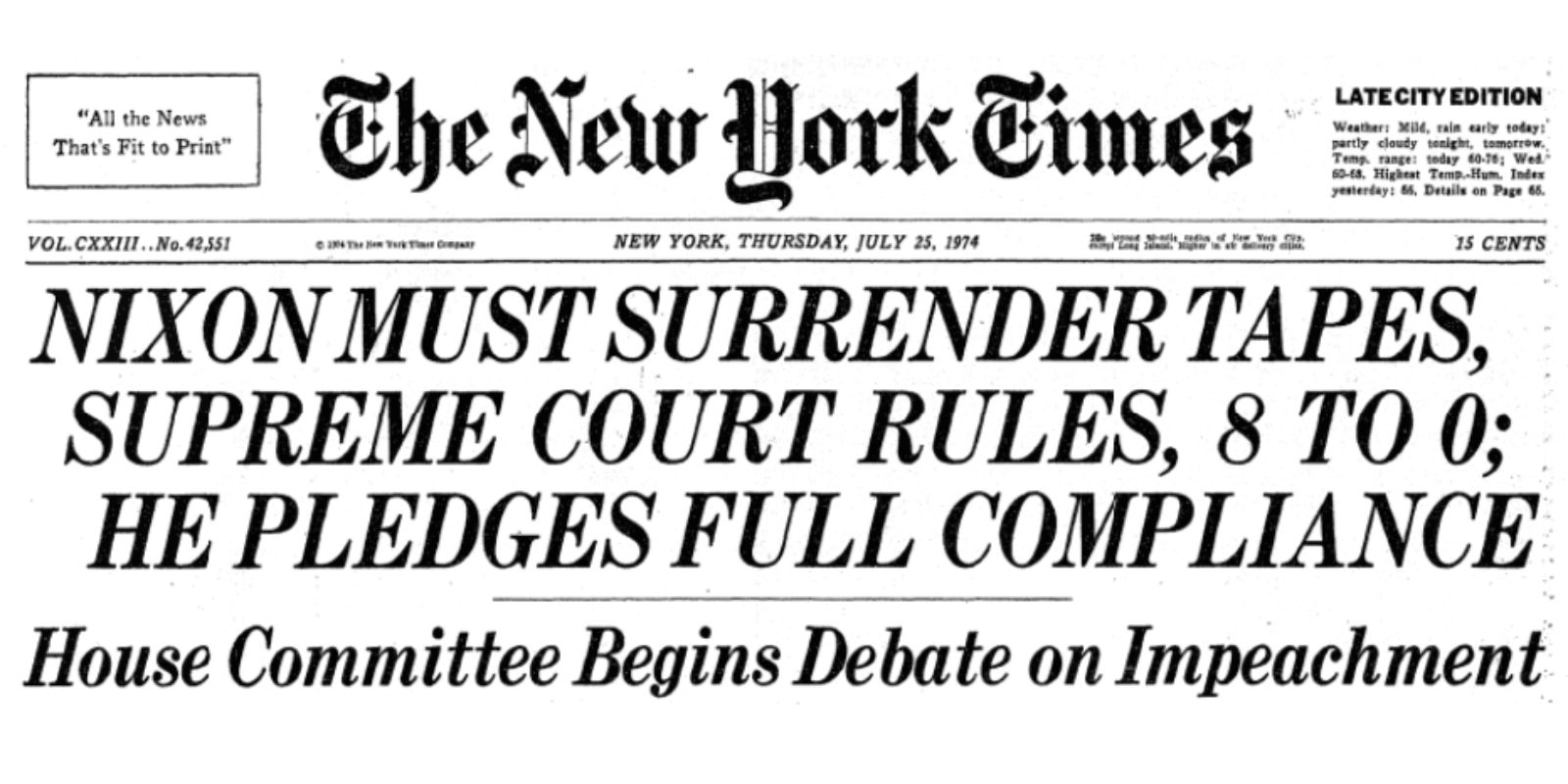
In an 8-0 ruling, the Court rejected Nixon’s claim to “absolute, unqualified Presidential privilege of immunity from judicial process under all circumstances.” It stated that presidential power took a backseat to the “demonstrated, specific need for evidence in a pending criminal trial.”
Notably, three of the justices ruling against Nixon – Burger, Blackmun, and Powell – were appointed by him.
The forced handover of the tapes saw the release of the “Smoking Gun” recording, which revealed Nixon had tried to pressurise the CIA to get the FBI to shut down the case. More crucially, this revealed Nixon had been in on the criminal activity the whole time but had lied to cover it up.
Shortly after the decision, Nixon was gone.
The House of Representatives charged Nixon with three articles of impeachment: obstruction of justice, abuse of power, and contempt of Congress. Facing almost certain impeachment in the Senate, Nixon instead resigned – the only president to ever do so.
16 days after the Court’s ruling, Nixon was out of office. As such, the National Constitution Center has called it “the Supreme Court decision that ended Nixon’s presidency.”
10. Trump v. Anderson
- Year: 2024
- Subject Matter: Power of states to remove candidates
- Constitutional Passage Concerned: Fourteenth Amendment
- Ruling: 9-0

In December 2023, the Supreme Court from the state of Colorado ruled that Republican presidential candidate and former President Donald Trump was to be struck from the ballot in the upcoming presidential primary.
The Court, who ruled 4-3, justified the decision citing Section 3 of the Fourteenth Amendment. Under the ‘insurrectionist clause’, no “officer of the United States” may serve after having “engaged in insurrection or rebellion” against the state.
Passed after the Civil War in regards to Confederate defectors, in this case it was linked to President Trump’s actions on January 6th.
This case marked the first time a presidential candidate had been prohibited from running due to this clause.
Having lost the 2020 presidential election to Joe Biden, the outgoing incumbent led his supporters towards the Capitol building on January 6th, before they stormed the building. Trump had convinced his followers that the election had been rigged and continuously used violent rhetoric that could be considered a call for violence to prevent the certification of the electoral results.
Policeman and Congressional lawmakers have stated that during the siege, they feared for their lives while many of the insurgents yelled out to “hang Mike Pence.”
After office, Trump escaped the most bipartisan impeachment result in US history but his eligibility to run remained ambiguous in the years afterwards.
In September 2022, New Mexico County Commissioner Couy Griffin was barred from public office for his involvement with January 6th – the first such removal of an elected official in over 100 years – opening the door to a similar ruling against Donald Trump.
The matter of disqualification under the Fourteenth Amendment was brought to the fore in part by 2024 Republican presidential candidate Asa Hutchinson, who referenced the ‘insurrectionist clause’ in the first Republican debate.
After the December Colorado Supreme Court ruling, two more states banned Trump from their states’ ballots: Maine and Illinois.
The Supreme Court moved swiftly to hear the case in Trump v. Anderson, hearing oral arguments in February.
Considering the 6-3 conservative majority on the Court (with three justices appointed by Trump himself), the case seemed like it would always favour Trump. Amicus briefs for Colorado included form high-profile former circuit judge J. Michael Luttig whilst over 180 Republican Congressional lawmakers opposed the move, as did several Republican organisations. Even some Democrats voiced opposition to the move, such as California Governor Gavin Newsom.
Justices expressed scepticism at the description of the president as an “officer of the United States,” whilst an 1869 decision in the case In re Griffin (also known as Griffin’s case) in which justice Salmon P. Chase had ruled that only Congress could decide to exclude a president from running for office was a top Trump defence.
In March, the Court issued a per curiam ruling, unanimously rejecting the Colorado Supreme Court decision and thus curbing states’ power to bar federal office candidates.
Despite the unanimous verdict, both Amy Cooney-Barrett and the more liberal wing of the bench both wrote their own concurrences. ACB’s focused on the Court’s decision to rule on Congress’s ability to remove officeholders whilst Sonia Sotomayor, Elena Kagan, and Ketanji Jackson-Brown all concurred only in judgement on similar grounds of departing from judicial restraint.
Nonetheless, the case displayed a united opinion on a politically sensitive subject – an exceedingly rare feat in the modern political climate.
GRIFFIN KAYE.
Leave a Reply