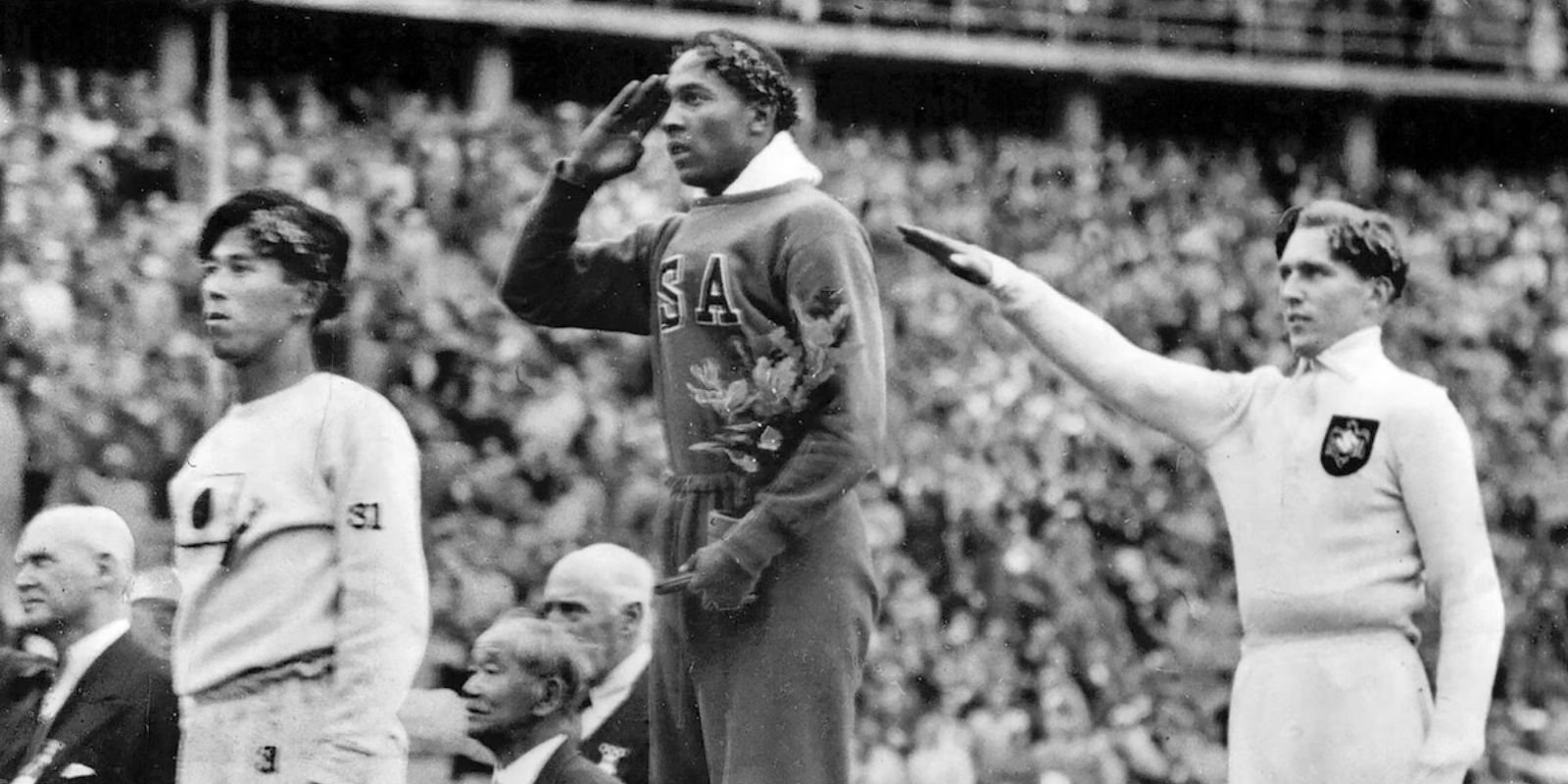
Few American Olympians are as famous as Jesse Owens. An accomplished performer, his talents were best foregrounded at the 1936 Berlin Olympics where his four gold medals made him a household name. Moreover, as an African-American triumphing at the Games, he was seen as a patriot who managed to shatter Hitler’s image of Aryan superiority.
Over the years, this led to a story, largely fabricated by American newspapers of the day, that Hitler had snubbed him – instead, it was his country.
This is the story of the Olympics, President Roosevelt, and Jesse Owens’s reconciliation with later officeholders.
Jesse Owens at the Games

The 1936 Olympics were devised by Hitler as a propaganda tool to promote his ideological agenda of German supremacy – at the expense of those the Nazi regime labelled untermenschen (Jews, Slavs, Romani – and most importantly for this case – African-Americans).
As such, some proposed a boycott, including the National Association for the Advancement of Colored People (NAACP). Its President, Walter White (no, not that one) wrote a letter to Owens, in which he wrote: “participation by American athletes, and especially by those of our own race which has suffered more than any other from American race hatred, would, I firmly believe, do irreparable harm.”
However, Owens – the son of a sharecropper and grandson of a slave – went ahead, with the aim of undermining Hitler’s racial idealism.
The previous year, Owen participated in what has been described as “the greatest 45 minutes ever in sport” when on May 25th at the Big Ten Track and Field Championships in Ann Arbor, Michigan, he set three world records and tied a fourth. Though recovering from a bad back, he equaled the 100-yard dash record while also setting records in the long jump (26ft, 8 1/2 inches), 220-yard dash (22.6 seconds) and 220-yard dash (20.3 seconds).
At the Olympics, Owens managed to earn four gold medals, making him the most decorated performer at the Games. These included new Olympic records in the 100 metres (10.3 seconds), 200 metres (20.7), and long jump (8.06 metres) and setting a world record in the 4×100 metre relay at 39.8 seconds.
Utterly crushing Hitler’s desired propaganda coup, leading Nazi official Albert Speer wrote that Hitler was “highly annoyed by the serious of triumphs by the marvelous colored American runner Jesse Owens.”
The Hitler Snub That Never Was

The story of an alleged Hitler snub was quick to make it back to the US.
However, it was a mistruth, with several American papers even noting how Hitler did congratulate Owens. “Hitler Salutes Jesse Owens” read the Pittsburgh Courier, one of the leading so-called black papers, while the Washington Post’s Paul Gallico was an eyewitness and opposed the popular narrative of a dismissive Fuhrer.
Owens has himself rebuked this claim and spoke in glowing terms about his interaction with the Fuhrer, noting: “when I passed the Chancellor, he arose, waved his hand at me and I waved back at him.” The Washington Post’s Gallico noted how Owens was “led below the honor box, where he smiled and bowed, and Herr Hitler gave him a friendly little Nazi salute, the sitting down one with the arm bent.”
If Hitler did snub anyone, it was the fellow black American Cornelius Johnson. Hitler left the stadium shortly before Johnson’s decoration, in a move fobbed off by Nazi authorities as being a pre-scheduled exit.
Even then, Hitler never really snubbed anyone. On the first day, Hitler congratulated some athletes, largely Germans such as first German gold medalist Hans Woellke. Afterwards, Internatioanl Olympic Committee (IOC) President Henri de Baillet-Latour declared that per Olympic protocol, Hitler could either receive all winners or none; he chose the latter.
As Owens biographer William J. Baker concludes, “Owens’s snub at the hands of Hitler is the imaginative stuff of hero worship.”
A Frosty Reception

Although a beacon of anti-racist resistance, Owens perhaps faced the greatest discrimination domestically.
As he pined: “When I came back, after all those stories about Hitler and his snub, I came back to my native country, and I couldn’t ride in the front of the bus. I had to go to the back door. I couldn’t live where I wanted. Now what’s the difference?”
When he returned after a victory parade, he was not permitted to use the main entrance of the Waldorf Astoria in New York but instead had to use the goods lift.
Black athletes were not in demand compared to white performers and jobs became incredibly difficult. Owens expressed: “I was no longer a proud man who had won four Olympic gold medals. I was a spectacle, a freak who made his living by competing – dishonestly – against dumb animals. I hated it.”
The Presidential Snub

The Olympian famously claimed that “Hitler didn’t snub me, it was our president who snubbed me.”
Indeed, despite his tremendous efforts at the Games, President Roosevelt did not invite Owens to the White House or even send a telegram.
As for why, the reasons seem entirely political. In order to earn re-election and thus sustain his New Deal policies, Roosevelt needed to retain the support of the solidly Democratic-voting South. The image of Roosevelt cosying up with an African-American hero might turn the conservative South against him. As Gallico notes, to some quarters, Owens “remained just a plain [n-word], and we’d rather he weren’t around, because he represents a problem.”
Many Southerners were already doubting the New Deal and in order to pass it, FDR needed Southern backing, hence why he had previously disavowed himself of anti-lynching policies in what the NAACP described as an “irradicable stain on Roosevelt’s prospects for re-election.”
Just a week after returning to the US, Owens announced he was stumping for Roosevelt’s presidential opponent, Republican Alf Landon. At one speech in front of over 10,000 African-Americans in Baltimore, he noted how Landon did sent him a message of congrats unlike the commander-in-chief.
Unfortunately for Owens, Landon would be obliterated in the election, winning just two states, eight electoral votes, and less than 40% of the vote. It was the first time the majority of African-Americans had voted for a Democrat (Herbert Hoover, who Roosevelt defeated in 1932, remains the last Republican to win a majority of black votes). In fact, 76% of northern blacks voted Roosevelt and in Owens’s hometown of Cleveland, the African-Americans voting for FDR went from under a third in 1932 to over two-thirds in 1936.
Owens was paid handsomely however, receiving $10,000 (well over $225,000 today). He later joked he was “the guy who was the beginning of the celebrity stable in political campaigns.”
By 1940, he had done a 180 on FDR, endorsing him. He commented that Roosevelt has “done more for the advancement of the colo[u]red people than any president since emancipation.” It was quite a turnout from his 1936 comments when he said FDR had done “not enough to benefit the people of the colo[u]red race.”
Later Presidential Honours

Although neglected by Roosevelt, Owens would later find himself honoured at the hands of subsequent presidents.
His most high-profile role was under President Eisenhower. As the White House’s Ambassador of Sports, he represented the US at the 1956 Games and worked as a goodwill ambassador for the People to People programme, travelling to Asia in a role Eisenhower considered of “the greatest importance.” Owens called his time under Eisenhower a “real hono[u]r.” He was even FBI checked for a reportedly considered role in the State Department.
During the 1960s, Owens was described by the New York Times as “100% Republican” and was everything from ambivalent to outright hostile towards the civil rights movement.
In 1972, he was welcomed to the White House by First Lady Patricia Nixon.
In August 1976, he attended a White House Ceremony where he was given the Presidential Medal of Freedom by President Ford. The highest possible civilian award, its engraving read: “To Jesse Owens, athlete, humanitarian, speaker, author — a master of the spirit as well as the mechanics of sport. He is a winner who knows that winning is not everything. He has shared with others his courage, his dedication to the highest ideals of sportsmanship. His achievements have shown us all the promise of America and his faith in America has inspired countless others to do their best for themselves and for their country.”
Ford stated Owens showed that “excellence knows no racial or political limits” and credited him for undermining a Games meant to “glorify racist dogma of the Nazi state.”
Owens told the crowd: “I don’t care where anybody lives, I don’t care what they do, because you can be born into anything in this Nation, as I was born in the cottonfields of Alabama, and today I stand before you and shake hands with the Commander-in-Chief of our Nation.”
In 1979, despite his political affiliation, Owens joined President Carter at the White House, where he was Carter praised him as a “young man who possibly didn’t even realise the superb nature of his own capabilities went to the Olympics and performed in a way that I don’t believe has ever been equalled since.”
Though Carter would be the last president he would live to see, his family attended the White House in 2016 under President Obama, who stated it was “African-American athletes in the middle of Nazi Germany under the gaze of Adolf Hitler that put a lie to notions of racial superiority — whooped ’em and taught them a thing or two about democracy and taught them a thing or two about the American character.”
Jesse Owens would die of lung cancer in March 1980, age 66. In 1990, he was posthumously awarded the Congressional Medal of Honor by President Bush Sr. Perhaps his greatest legacy was distilled when eulogised by President Carter: “perhaps no athlete better symbolised the human struggle against tyranny, poverty, and racial bigotry.”
GRIFFIN KAYE.
Leave a Reply