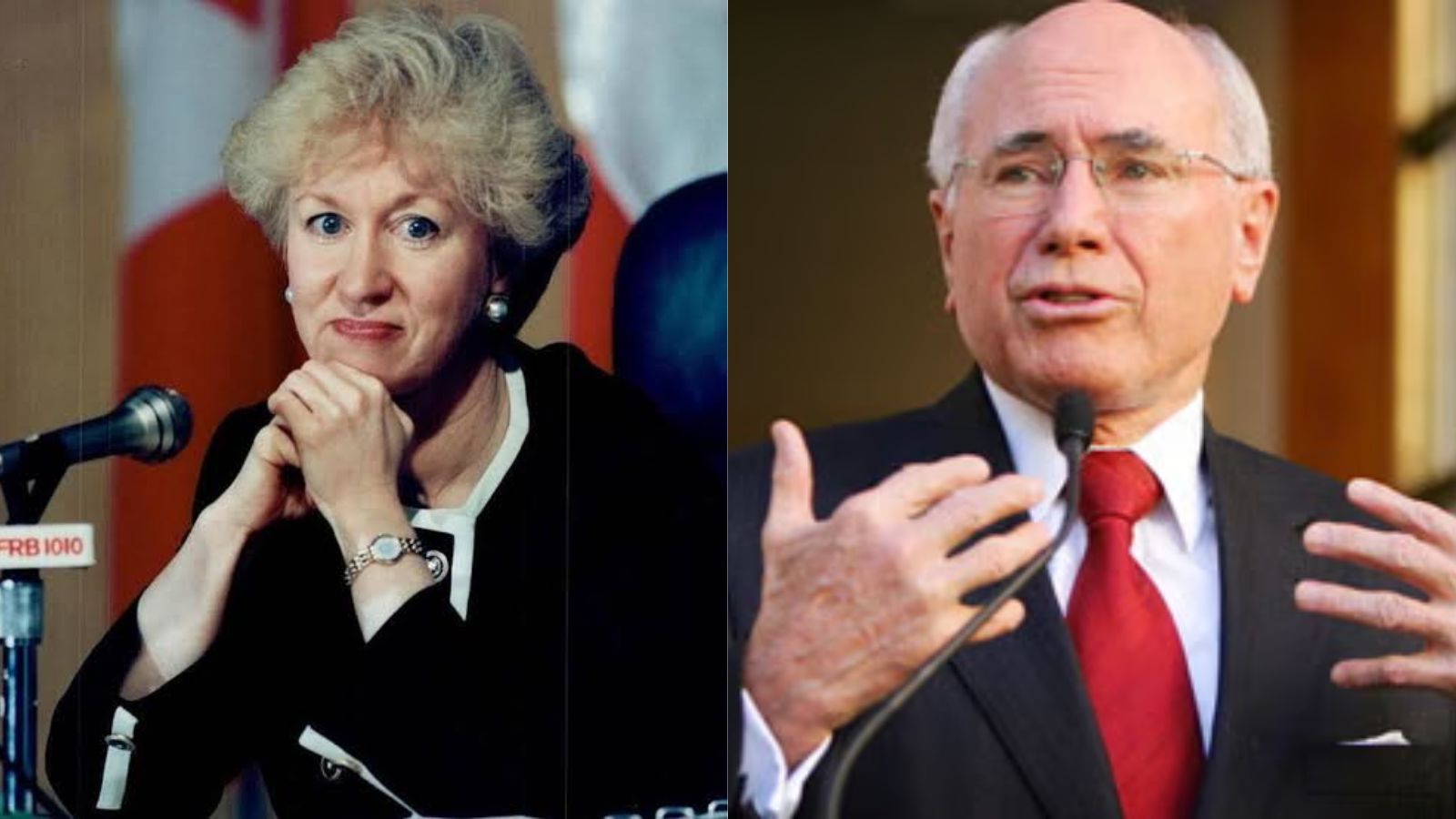
In parliamentary democracies, the prime minister is elected leader by their party MPs or party members. However, they are themselves elected Members of Parliament by constituents in a small geographic region. On very, very rare occasions, an incumbent leader of a major world nation was unseated, with voters in the leader’s constituency voting him out. These are times that major world leaders lost their seats.
Please note this list will only include incumbent world leaders and not former world leaders (for example, former British Prime Minister Liz Truss who lost her seat in 2024). This list is also not exhaustive.
Kim Campbell
- YEAR: 1993
- COUNTRY: CANADA

As the Globe and Mail, Canada’s newspaper of record, headlined noted the night of the 1993 election, “Never has governing party been so severely crushed.” It added: “Kim Campbell, Canada’s first woman prime minister, lost her own seat of Vancouver Centre as the Conservatives were handed a humiliating defeat of unprecedented magnitude.”
On election day, a series of factors caused the incumbent Progressive Conservative Party to fall from a majority government to just two seats – taking its sitting prime minister with them.
Kim Campbell, a former Attorney General and Defence Minister, was elected party leader in June 1993.
Campbell was already in a weakened position due to a lagging economy, a divisive goods and services tax imposed by her predecessor Brian Mulroney, and failed constitutional proposals that had inflamed regional tensions.
Given just months before having to go the country, Campbell failed to hollow out an image of the future under her premiership and faced a more fragmented Canada, with new parties cutting into the Progressive Conservatives’s base. In western Canada, Preston Manning’s Reform Party, a fiscally conservative party, railed against the Tories’s tax increases and ballooning national debt. In Quebec, where Brian Mulroney had proved popular, the Bloc Quebecois, a new separatist party, were on the rise after a series of failed constitutional amendments.
Things got even worse during the campaign after an infamous attack ad, which made central use of opponent Liberal leader Jean Chretien’s face. The advert drew immense criticism and had to be pulled after many saw the ad as a crude attack on Chretien, who suffered from facial paralysis due to Bell’s palsy. As Campbell later wrote in her autobiography: “What I didn’t know then was that after the ads, my own seat was lost.”
Campbell had only entered Parliament at the last election in 1988 and only won Vancouver Centre by under 300 votes. On polling day in 1993, Campbell was booted out by her constituents by nearly 4,000 votes. The Liberal candidate Hedy Fry is still the MP for the riding to this day.
Zooming out, the whole election was a shambles for the party, whose vote share crashed 27% from 1988 to 1993. Though the party won a remarkable 50.03% of the vote in 1984, it fell to 16.0% in 1993. The PCs went from 169 seats in 1988 to just two in 1993, falling from official party status and thus losing access to additional funding, speaking time, and committee assignments.
As journalist Leyland Cecco writes: “Canada’s 1993 federal election fundamentally altered the country’s political landscape and shattered its national conservative movement, forcing leaders to spend a decade puzzling over how to rebuild a broken party.
The 1993 Canadian election is a remarkable rebuke of a ruling party, a landslide loss like no other. The cherry on top is the once-in-a-generation defeat of a sitting prime minister.
Nonetheless, Campbell can console herself on not being the only Canadian PM to lose their seat, a fate that also befell Arthur Meighan and William Mackenzie King, arguably the most important prime minister in modern Canada, twice.
John Howard
- YEAR: 2007
- COUNTRY: AUSTRALIA

In 1996, John Howard’s Coalition won a remarkable landslide victory, achieving a record 94 seats in the 148-seat House. After eleven years in charge (the second-longest tenured PM in Australian history), voters gifted the Coalition a stinging rebuke, which included the defeat of Howard in his own seat in a loss described by the Economist as “crushing, humiliating and one for the history books.”
Although Howard’s party won four consecutive elections, the ruling Coalition party was increasingly unpopular in the run-up to the 2007 elections.
His WorkChoices programme, an attempt to reform industrial relations, proved unpopular. Featuring provisions that watered down union power, narrowed the scope for legal action against employers, and stripped away employee benefits like overtime pay, a March 2007 poll found that a year after implementation, 59% disapproved while just 24% approved of the changes. Another economic threat to workers was the rising interest rates, which in the campaign’s final month rose to a decade high of 6.75%.
Moreover, popular Labor Party leader Kevin Rudd promised major changes to measures such as climate change and foreign policy, promising to sign the Kyoto Protocol and pull Aussie troops out of Iraq.
John Howard’s seat of Bennelong in Syndey, which he had held since 1974, had been closely watched in the weeks leading into the election. The Coalition regularly won the seat with an overall majority of the vote and at the last election, Howard triumphed by 21.5%.
This time round however, he faced a strong challenge from former ABC journalist Maxine McKew. Howard clearly felt the pressure, making a number of constituency visits, something that McKew would later call “something of a contrast” to Howard’s normal presence in the seat.
On election night, McKee took a noticable lead over Howard though the results would not be finalised for another week. On the two-party preferred result, McKee was able to seal a victory on the 14th count due to over two-thirds of Green Party voters making McKee their second choice. In every polling station except one, there was a swing to Labor, who ultimately won on a 5.5% swing.
As such, Prime Minister Howard was unseated as Labour took the seat for the first time since the seat’s 1949 creation.
The most significant factors in Howard’s loss in Bennelong was that his Sydney seat had its boundaries redrawn into an area more beneficial to Labor. Moreover, McKee was able to mobilise the constituency’s sizable Chinese and Korean communities, which account for 14% of the population.
She noted that these groups had a “deep sense of history” over previous inflammatory comments made by Howard many decades ago and his reticence to rein in fellow party Representative Pauline Hanson’s comments that Australia was being “swamped” by Asian immigrants.
Stanley Bruce
- YEAR: 1929
- COUNTRY: AUSTRALIA

Howard was only the second Australian PM to lose his seat. He was the first since Stanley Bruce in 1929, who also lost his seat amid of a backdrop of a government attempting to dilute industrial relations.
Stanley Bruce is a notable figure in Australian political history, helping forge the modern-day Liberal-National Coalition and in 1928, he led the party into a record fifth consecutive term in office.
1929 was a rock year for the ruling Coalition, with a gloomy economic outlook. In Alex Millmow’s book The Power of Economic Ideas: The Origins of Keynesian Macroeconomic Management in Interwar Australia 1929-39, he notes that “Since 1919, foreign debt had grown by 73 per cent, with the most rapid build up in the late 1920s, averaging £47 million per annum. Consequently, Australia faced a rising external interest bill equivalent to 40 per cent of her export receipts.” Elsewhere, export prices plunged 30% (a 9% fall in GDP. In response, the government committed to new taxes and deeper cuts to public spending.
The issue that really electrified the public, MPs, and the unions was an attempted reform of the Commonwealth arbitration system, removing power from the federal courts and gifting it to the state courts.
It also came at a time of mass industrial unrest, with timber workers and coalminers striking against proposals to cut workers’ wages. These waves of strikes affected tens of thousands of workers directly while one Sydney protest drew 25,000 workers. These angered workers were only further enraged by the decision of the Bruce government to not prosecute coal baron John Brown, who illegally closed his mine to force workers into a 12.5% pay cut. As Stanley Bruce’s biographer David Lee writes: “Bruce’s failure to prosecute Brown, together with the harsh sanctions applied against unionists, struck many Australians as so unfair that it had come to compromise the moral legitimacy of the Bruce–Page government.” On election day, unemployment stood at around 12%.
With these class tensions simmering, the new reforms to the arbitration system were deeply unpopular – even within Bruce’s own party. The bill was opposed by former National leader, Bruce’s predecessor, and former prime minister Billy Hughes – himself a trade union organiser who helped establish the Waterside Workers Federation. He added an amendment to the bill forcing the legislation to go to the people. Now effectively a vote of confidence in the government, enough National MPs rebelled to defeat the government 35-34.
In the election, voters sided with the workers over the Nationals.
The Labor Party returned to government for the first time in 13 years, gaining 15 seats. By contrast, the Coalition lost 18 seats, with the Nationals and Country parties falling 8.3 percentage points behind Labor in the two-party preferred vote. Labor did particularly well in industrial and working-class bases in New South Wales, where the most intense union action was taken.
In Flinders in Victoria, another hotbed state for industrial action, Bruce lost his own seat to the Labor Party candidate, narrowly losing the first preference round by just 60 votes before being defeated 50.2%-49.8% in the two-party preference vote. There was a 10% swing to Labor and 11.3% swing away from the Nationals.
More painfully for Bruce, he lost his seat to Jack Holloway, the Secretary of Melbourne Trades Hall Council who had previously been prosecuted for the timber workers’ strike, which had been particularly potent in Melbourne and Sydney.
According to legend, after having seen four Cabinet ministers lose their seats with him, Bruce remarked: “I welcome in some ways the fact I’ve gone down with the ship by being defeated in my own constituency.”
4. Leopoldo Calvo-Sotelo
- YEAR: 1982
- COUNTRY: Spain

In the first elections in a democratic Spain since the pre-Franco regime, the centre-right Union of the Democratic Centre had governed the nation.
In 1981, the once-popular UDC leader and Spanish Prime Minister Adolfo Suarez resigned, facing a faltering economy and worsening regional disputes (such as increased violence by the Basque separatist group ETA).
He was replaced by Leopoldo Calvo Sotelo, the Deputy PM and decorated Cabinet minister. However, as leading Spanish historian Paul Preston notes, he was only chosen as “the most widely tolerated candidate” and only selected by a small clique of senior UDC members, “ensur[ing] that he began his role with a handicap.
Unlikely Suarez, Sotelo had a hard time cutting through with voters. Stanley G. Payne noted he was a “taciturn” figure who was “more of an administrator and arbiter than a political leader.” David Gilmour likewise wrote: “Calvo-Sotelo was almost the reverse of Suarez. He was a serious, somewhat lugubrious figure, entirely lacking in popular appeal. He presented a rather staid image to both the press and the public, and made no effort to improve it.”
By 1982, the entire UCD Party was unravelling, facing splinter groups led by different factions of the party such as Suarez’s CDS Party and the People’s Alliance, formed by former Francoist ministers.
Fearing the increasingly likely wipeout of the UCD, Sotelo had already tapped Landelino Lavilla, Justice Minister under Suarez, as his replacement.
However, in the 1982 elections, the UCD suffered what has been described as “perhaps the single greatest electoral disaster to ever befall a contemporary western European party.”
Amid a backdrop of unemployment topping 15%, voters went to the polls to overwhelmingly elect the socialist PSOE, who won over 200 of the 350 seats in the Chamber of Deputies on 48% of the vote.
The UCD lost 157 seats, dropping from 168 at the last election to just 11. Its vote share fell from 34% to just 6.7%, a loss of 4.9 million voters from election-to-election (more than ¾ of its 1979 total).
In terms of seats, the party fell to fourth, even outperformed by the CiU, a nationalist party who only ran candidates in Catalonia.
The UCD did not win in any constituencies or regions, performing best in Ourense in the northwest, winning 29.2% (the only location where they outpolled the PSOE).
In Madrid, the party won just 3.4% of the vote, a drop of nearly 30%. With such a meagre performance, the party only won one seat in the region, not enough to save the seat of incumbent PM Sotelo, who was placed second on the party list behind Lavilla.
The loss of the PM’s seat came as the UCD’s Secretary General Inigo Cavero was also unseated, as were 11 Cabinet ministers such as the Treasury, Defense, and Foreign Affairs Ministers.
Eluned Morgan
- YEAR: 2026
- COUNTRY: WALES

Amid a deeply unpopular Labour national government and in the wake of dismal domestic governing by the Labour Party, 100 years of dominance in deep-red Wales crumbled in 2026. This collapse took with it Wales’s First Minister, the first leader of a UK government to ever lose their seat.
In 2024, Welsh Labour leader Mark Drakeford stood down as First Minister after having led the party to victory in 2021 with an improved constituency and regional vote by about 5%. He was replaced as leader by Vaughan Gething, whose 118-day tenure was marred by controversy from a £200,000 donation from a firm owned by a man previously convicted of illegal dumping waste on protected land and accusations of perjury after saying he did not delete Covid era WhatsApp in a move that allegedly misled the Covid-19 Inquiry.
He would lose a non-binding vote of no confidence in the Senedd and was forced to resign the next month after a bloc of ministers resigned from the Cabinet.
Left with this leadership mess as well as crumbling public services – particularly NHS waiting lists that were longer than those in England – the party faced an uphill battle as they faced challenges from Plaid Cymru on the left and Reform on the right. Morgan tried to persuade voters this was a pivotal election for Wales, who might end up electing either a pro-independence Plaid or anti-devolution Reform.
Eluned Morgan became Labour’s new leader and failed to turn the Labour ship around and made a memorable gaffe a week before polling day, telling voters to vote Plaid.
Now with an unpopular Labour government in Westminster, Welsh Labour could no longer point to the Tories in national government to blame for the problems in Cardiff. Instead, Labour appeared reticent towards the nation, not allocating funds many in Wales believed they were entitled to such as the Crown Estate and HS2.
Although Morgan tried to distance herself from the unpopular Keir Starmer, it clearly failed as opposition parties had solidly tied her to the government at Westminster.
On the night, the Labour Party failed to become the largest party in the Senedd in the 27-year history of Welsh devolution.
Despite significant changes to the Senedd’s composition from 60 to 96 seats, the Labour Party crashed from 30 seats in 2021 to just nine.
Labour had not led in opinions polls for 10 months, falling into third behind leader Plaid and Reform after a crushing loss in the Caerphilly in which the party only won 11%, a 35% swing against the party. Labour voters more tactical voting in support of Plaid to avoid splitting the progressive vote would be replicated in the election.
Nationally, Labour’s vote shrank by two-thirds, losing some over a quarter of a million voters. Despite winning 120,000 votes more than the Tories in 2021, they only beat the Conservatives by just 5,000 votes. This decrease is despite a 5% turnout increase from the last election, meaning it was not a case of political apathy but saw voters actively switching parties.
In FM Eluned Morgan’s seat of Ceredigion Penfro, the government’s bad news continued as she failed to gain a seat. Notional 2021 results show Labour winning 25% of the vote and winning two seats in the boundary.
Morgan already seemed to accept defeat, admitting she was “prepared for every eventuality.”
In the end, Labour came a distant fourth, winning just 7.3%. They only polled ahead of the Green Party by 0.2%. Labour did not poll enough of the constituency vote, failing to win any of the area’s six seats. Plaid won three, Reform two, and the Conservatives one.
In the immediate aftermath of the result, Morgan took responcibility for the loss while calling on the national government to “change course”. Undoubtedly due to the party’s tremendous defeat in the 2026 local elections including the remarkable mauling in Wales, Starmer would depart Downing Street the next month.
The party’s grey future is only highlighted by the departure of some of Labour’s most high-profile figures who stood down prior to the election such as Mark Drakeford, Vaughan Gething, and Jeremy Miles.
One might argue that Labour still have a sizable influence over the Welsh government, being the largest third party and able to hold the balance of power in a Plaid minority government where they may need aid to pass progressive legislation. Either way, the party is entering a wilderness years, forced to walk through headwinds the party has never seen before.
GRIFFIN KAYE.
Leave a Reply