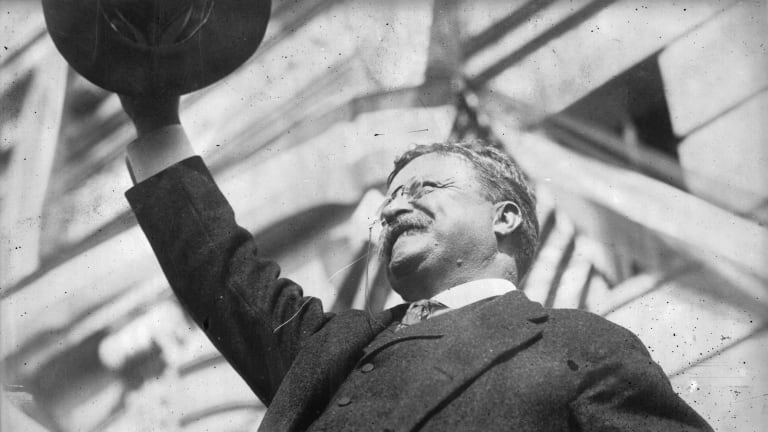
In the annals of American history, there have been a number of people who’ve ascended to the highest office in the land by way of winning a presidential election, but then you have these guys….the guys who became President of the United States by accident or unforseen circumstances like their predecessors either dying or resigning from office.
These guys were then unintentionally called upon to lead the country during some of the best and wors times in our nation’s history,but out of these all “accidental presidents” which were the ones who failed to live up to expectations and who were the ones that did more than most expected with their time in office?
Well, today I going to be looking at that as I’ll be listing all of the Vice Presidents who suddenly became President ranking them from worst to best.
#9. Andrew Johnson (VP: Mar-Apr. 1865, President: Apr. 1865-Mar. 1869)

Starting off this list is Andrew Johnson, the 17th President who was in charge of the country following the assassination of Abraham Lincoln and well…there’s a reason why his presidency isn’t highly regarded.
In 1864, Johnson was chosen to replace Hannibal Hamlin as Lincoln’s running mate in the up-and-coming election with the hope that this unique idea of a Republican and Democrat on the same ticket would lead to some unity and more importantly Lincoln’s re-election as President during the civil war.
While the latter point certainly did happen, the former…not so much as evidenced by what came next following Lincoln’s assassination and Johnson’s rise to power.
Johnson was in charge during the ‘Reconstruction Era’ and hopes were high that Johnson would be able to pass some type of legislation that would help the newly freed slaves as well as find a way to heal the divisions that occurred between the North and South.
Those hopes were dashed as Johnson issued ‘Black Codes’ which kept many of those freed slaves as labourers and he refused to support the Civil Rights Bill of 1866 and the 14th Amendment to the Constitution. On top of this, he attempted to fire Lincoln’s Secretary of War, Edwin Stanton which ultimately led to Andrew Johnson becoming the first president to face impeachment, but he avoided getting impeached by just one single vote.
All of this, plus Johnson’s decision to pardon most if not all of the confederates for their actions in the war certainly hasn’t helped his legacy or his ranking on this list.
#8. Millard Fillmore (VP: Mar. 1849-Jul. 1850, President: Jul. 1850-Mar. 1853)

We go from a President who looks like actor Tommy Lee Jones to one that looks like actor Alec Baldwin…Yes we are talking about the 13th President of the United States, Millard Fillmore.
Fillmore was a member of the Whig Party who was selected to be the running mate for the eventual winner of the election Zachary Taylor in 1848. During his time as Vice President, Fillmore had to deal with constant debates between northern and southern politicians as it relates to bringing in newly acquired states as slave states or free states, which led to the Compromise of 1850.
When Taylor died a year into his presidency, Millard was sworn in as the new President and he went on to do things like appoint Benjammin Robbins Curtis to the Supreme Court, peacefully resolved disputes that focused on Southern and European influence in places like Cuba and Hawaii respectively.
He also sent an expedition to Japan in the hopes of starting international trade in the region and passed the Compromise of 1850, with the hopes of finding a level of unity amongst both sides. However, it’s due to the much-maligned ‘Fugitive Slave Act’ that was in the Compromise of 1850 that has damaged Fillmore’s reputation despite his idealistic opposition to slavery.
Long story short, the act made it clear that any slaves that escaped were to be returned in addition to harsh punishment being dealt with no due process to those who aided in the escape efforts and this was controversial due to the fact that any person of color (even if they were freed or not a slave) could be subjected to this act if one or more people claimed they were an escaped slave.
While Millard Fillmore’s time as president was forgettable at best, he did attempt to make compromises between the north and south which is something Andrew Johnson was unable to do which is why he ranks higher.
#7. John Tyler (VP: Mar-Apr. 1841, President: Apr. 1841-Mar. 1845)

The 10th President of the United States, John Tyler comes in at number seven ahead of Andrew Johnson and Millard Fillmore, primarily due to the fact he was the first VP to become commander and chief following the death of his predecessor. This clarified the idea of who would be the new POTUS upon the previous President’s passing.
After Williams Henry Harrison died just a month into his presidency, there was a lot of confusion over who would become the new President. John Tyler believed that the Constitution gave him the power to ascend to the highest office, which he did, but not without many labelling him as things like “Acting President” or “His Accidency”.
In terms of Tyler’s successes, he signed the Webster-Ashburton Treaty which drew the line between the U.S. and Canada, ending any border disputes between the United States and Great Britain.
Tyler’s support of expansionism led to places like Florida and Texas being admitted or annexed into the Union did increase the size of the country with many of those states still a part of the U.S. today.
On the other side of things, John Tyler disagreed with many in the Whig Party on tariffs, foreign affairs and several other issues which resulted in Tyler being expelled from the Whig Party and most of his cabinet (who were filled with Whigs) resigned from their positions.
Tyler’s decision to annex Texas was also viewed with great scrutiny by many as some believed Tyler’s attempt to add Texas as a new state to the Union was due in large part to the President’s staunch support of expanding slavery into new territories.
While John Tyler’s Presidency is filled with a lot of low points, he did have the occasional significant moments like resolving the Maine Boundary and the Presidential Succession. He is also the reason why the VP can become the new President which wasn’t made into law until the 25th Amendment passed in the 1960’s.
#6. Gerald Ford (VP: Dec. 1973-Aug. 1974, President: Aug. 1974-Jan. 1977)

Much like the previously mentioned John Tyler, Gerald Ford’s ascension to the presidency is quite unique within American history. Ford became the only man to be VP and President without winning a presidential election.
In 1973, Richard Nixon’s Vice President Spiro Agnew resigned from his position over evidence that revealed the VP was accepting bribes during his time as the Governor of Maryland and as Vice President. In response to this, Nixon chose the then-House Minority Leader, Gerald Ford to be his running mate but just 10 months into his new role Nixon would resign from office in 1974 making Ford the only unelected VP and President in U.S. history.
Ford’s presidency oversaw the Fall of Saigon which put an end to the Vietnam War, but he also implemented a bill that allowed entry into the U.S. for those fleeing communist regimes. He also signed the Helsinki Accords in 1975 with the Soviet Union, pardoned Vietnam draft dodgers, appointed numerous judges including the legendary John Paul Stevens, and was able to send a team to recapture a U.S. shipping vessel that was taken over by the Khmer Rouge.
While Ford’s pardoning of Richard Nixon to get the stank of the Watergate Scandal out of the public’s attention in order to focus on bigger issues is seen today as a good move, that wasn’t the case in the early to mid-1970s and Gerald Ford would end up paying for that pardon when he lost his bidding for re-election to Jimmy Carter in 1976.
Ford’s time as President may not have seen any major achievements that still hold up today but the fact that he became second in command and President without ever winning a general election is certainly intriguing. Plus he didn’t support any policies or beliefs that discriminated against other races like the previous entries…so that’s something.
#5. Chester A. Arthur (VP: Mar -Sept. 1881, President: Sept. 1881-Mar. 1885)

Perhaps the most obscure person on this list, Chester Allen Arthur became the 21st president following the assassination and eventual death of his predecessor James A. Garfield. Arthur’s time as president did lead to some small but major changes going forward.
Upon winning the presidency in 1880, James Garfield and Chester Arthur’s relationship as President and VP was cold, especially with Arthur’s persistence of wanting people in Garfield’s cabinet who were Stalwarts (aka those who got political jobs via special favours). Things changed in September of 1881 when Garfield passed away just 200 days into office, resulting in Chester Arthur becoming the President.
If any of Arthur’s colleaguesthought that they could be able to get some positions of power due to the Stalwart becoming President they would be in for a rude awakening as Arthur signed into law the Pendleton Civil Service Reform Act in 1883, which made it official that political positions should be given to those because of their merit rather than special favours.
Arthur’s Presidency also saw the reduction of taxes when the country had a massive surplus, he redecorated the White House when it desperately needed it, he strengthened the U.S. Navy, and signed the Edmunds Anti-Polygamy Act of 1882. This law not only made polygamy a crime but also prevented those who practice it from holding office jobs or even voting.
The 21st president was also a big supporter of civil rights for Native and African Americans although much of his attempts were shot down by Congress. While his signing of the Chinese Exclusion Act was certainly a low point of his Presidency even today, his attempts at vetoing the act and well the other accomplishments he made or attempted helped to lay down the path for other Presidents who wished to clean up corporate corruption in politics.
#4. Calvin Coolidge (VP: Mar. 1921-Aug. 1923, President: Aug. 1923-Mar. 1929)

The man often referred to as “Silent Cal” became the 30th President of the United States following the unexpected death of his boss, Warren G. Harding in August of 1923 by way of a heart attack.
While his tenure as Vice President was unspectacular, Calvin Coolidge would go on to define the 1920s. As commander and chief his belief in ‘laissez faire economics’ which meant fewer regulations towards the federal market and Wall Street thus leading to a financial boom period that would come to be known as “The Roaring Twenties”.
After being re-elected in 1924, Coolidge continued his economic policies by balancing the budget, shrinking the national debt and reducing income and federal taxes in the U.S.
During Coolidge’s time as President, he opened the door into investigations regarding the Teapot Dome Scandal, he pushed to make lynching a federal crime in the U.S. and was a big supporter of Native and African Americans rights.
On the other side of that coin, Calvin Coolidge’s Presidency also saw him going against farm subsidies at a time when the prices for crops and agricultural production were bad. His response and views regarding the Mississippi Flood of 1927 were horrible and his laid-back, let the federal markets do what they like attitude become a factor in what would led to the Stock Market Crash of 1929.
Nevertheless, Calvin Coolidge’s time as President is often seen with modest success even if the man himself is forgotten about by most the general public.
#3. Lyndon B. Johnson (VP: Jan 1961-Nov 1963, President: Nov 1963-Jan 1969)

While the circumstances that led to him becoming the new President of the United States are tragic and his Presidency is polarizing at best, it can’t be argued that Lyndon Johnson’s work as both VP and later President really shaped the world we are living in today.
Despite the fact he was alienated by the Kennedy’s for most of his tenure as VP, LBJ was given some tasks that allowed him to do things that would set the stage for his presidency. For starters, President Kennedy made Johnson the head of several committees one of which saw him working with the Equal Employment Opportunities Agency which allowed Johnson the chance to work with various minorities and set the stage for LBJ to pass laws that focused on Civil Rights issues when it came time to be president.
Lyndon Johnson also worked to get the idea of an American being sent to the moon as a top priority which was important during the U.S.’s ever-going conflict with the USSR.
By the time he became President, he passed the Civil Rights Bill and Voting Rights Act which allowed African Americans to have their basic civil rights and the right to vote. He also passed a bill that led to the creation of Medicare and Medicaid, managed to get an American on the moon towards the end of his term and focused on taking care of the poverty issue within the country.
However what prevents LBJ from getting any higher on this list is the Vietnam War. Sure Johnson didn’t begin sending troops to kick off the conflict, but he and his adminstration sure did escalate it with false claims that pushed the U.S. into a war would become one of the nations biggest mistakes and became the conflict that led to him saying that he would not seek another term as President.
While Johnson’s achievements are rightfully hailed, so are his failures and both of them still loom over the United States both for the better and the worse.
#2. Theodore Roosevelt (VP: Mar -Sept. 1901, President: Sept. 1901-Mar. 1909)

Some people may forget, but Theodore Roosevelt was once a Vice President before becoming President. Much like many of the other entries on this list, Roosevelt became commander and chief by way of his boss getting assassinated.
The incumbent, William McKinley needed to find a new running mate for the up-and-coming 1900 Presidential Election after his previous one died. One name that was proposed was the former Governor of New York and war hero, Theodore Roosevelt mostly because the position of Vice President didn’t have much power and most GOP politicians thought that this would prevent TR from making any more progressive, trust-busting policies.
In the end, McKinley was re-elected with Roosevelt as the Vice President, but the president would die days after an assassination attempt and now the guy most didn’t want to have power now became the most powerful man in the United States…whoops.
Upon being sworn in as the 24th President of the United States and winning re-election in 1904, Roosevelt wasted no time in implementing a sweeping amount of progressive change. This was in the form of regulating monopiles, a bigger focus on conservationism efforts, passing the Pure Food and Drug Act and the Meat Inspection Act and even ending the Russo-Japanese War which led to him winning the Nobel Peace Prize.
With that said, Roosevelt’s brass Imperialism when it came to places like Latin America, his method in getting the Panama Canal built and his decision to discharge 167 black soldiers following the 1906 Brownsville Affair which cost many of them the chance of getting jobs or pensions is definitely some low points in Roosevelt’s time in the White House.
As impressive as Roosevelt’s successes as commander-in-chief were, the negatives and the fact the country was peaceful during this time is what’s keeping Teddy from taking the top spot. But there is just one more person who managed to do a whole lot during their unexpected rise to the presidency and did so during a period of uncertainty.
#1. Harry S. Truman (VP: Jan. -Apr. 1945, President: Apr. 1945- Jan. 1953)

Truman’s journey from small-town nobody to politician to VP to President is something unlike any other especially when you consider the time in which he came the most powerful man in the world.
In an attempt to prevent the liberal Henry A. Wallace from being re-nominated as Vice President, a bunch of Southern Democrats banded together to get someone new on the ticket for incumbent Franklin Roosevelt and that someone was Missouri Senator, Harry S. Truman. Despite not wanting the job to begin with, many Southern Democrats pushed to have him on the ticket which eventually did happen and Roosevelt won re-election before dying mere months into his historic fourth term in April of 1945.
Following the news of his predecessor’s passing, Truman (who was VP for 82 days) was sworn in as the new president and began finishing where Roosevelt left off which was overseeing the end of World War II which led to Truman making the decision to drop the first and only atomic bombs on a foreign country and helped in creating what would be the United Nations.
Truman would go on to have a number of achievements like recognising Israel as an official state, being the first president to advocate/push for a Universal Healthcare System, desegregating the military and passing the Mashall Plan which provided aid to nations affected by World War II. After winning re-election in 1948, the president continued his foreign policies of containing the spread of communism which resulted in the Korean War, an insufficient conflict that ultimately led to the U.S. signing a peace treaty to end the war and also ended Truman’s chances for re-election.
Overall, Truman’s foreign and domestic policies changed the world we currently live in and while he certainly made mistakes (much of which is hard to justify today). The fact he was thrown in a position he never wanted and had the massive task of leading the U.S. out of a world war and then had to find a way to rebuild the nation and help other countries following the war is tremendous to say the least and for that, he tops this list.
Do you agree or disagree with this list? Which VP turned accidential President was your favorite? Leave your thoughts in the comments section below and for more content like this and be sure to follow Lace ‘Em Up on Twiter @laceemupoffice and you can follow me also on Twitter @hakeemfullerton.
Leave a Reply