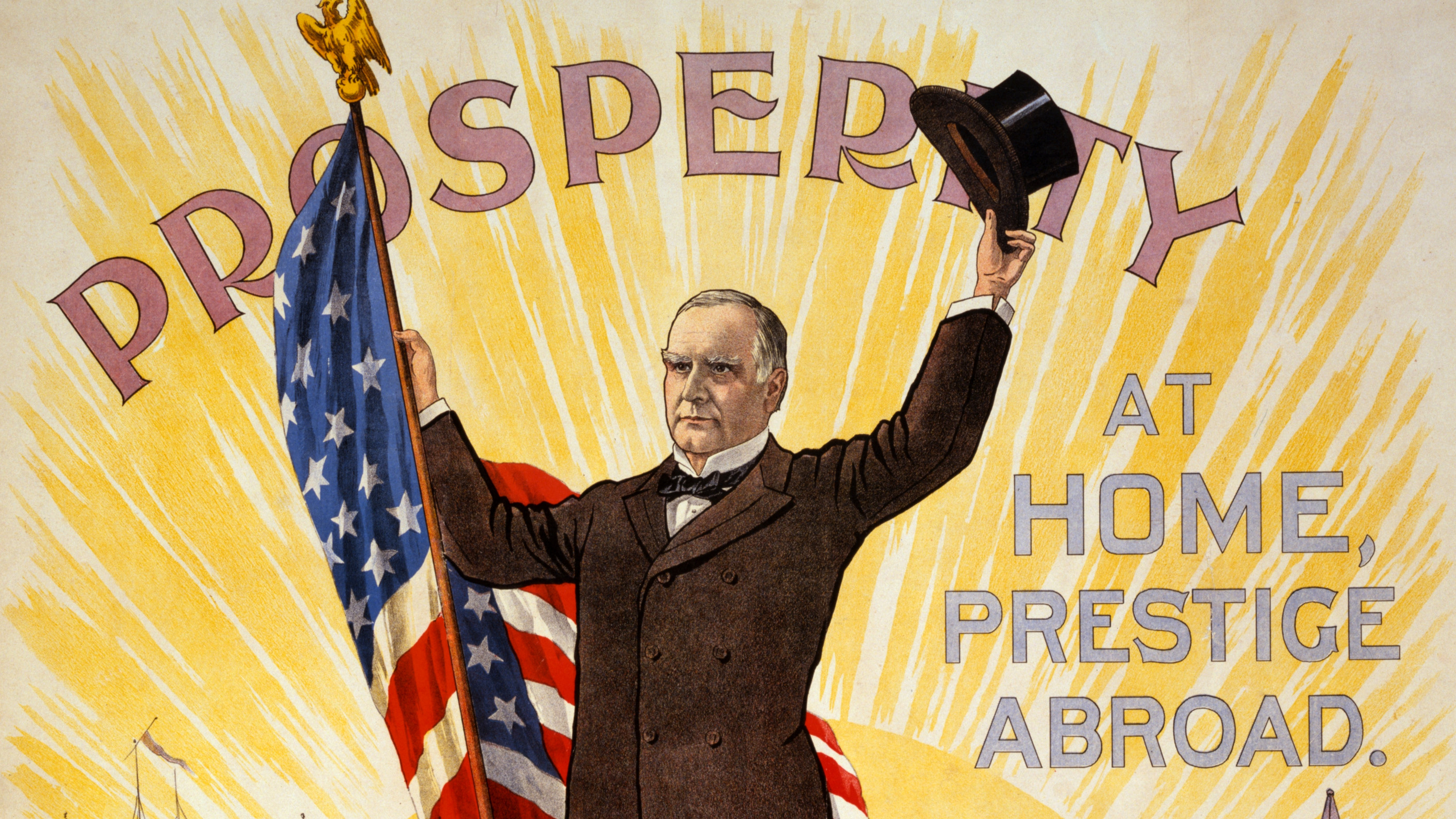
Hello, and welcome back to another edition of Lace ‘Em Up’s Presidential Election series. Today we will be going over the Election of 1900 as the incumbent Republican president, William McKinley is looking to get re-elected in what is the first Presidential election of the 20th century, and it all culminates with an ending that no one sees coming.
McKinley’s Presidency & U.S. Imperialism

Following his victory in the 1896 election, William McKinley has been busy in more ways than one; For starters, the economy has recovered from the financial crisis and businesses are continuing to boom within the country.
Secondly, the big issue of using gold or silver as currency in the U.S. is going to be solved as McKinley believes in using the Gold Standard and with the economy doing so well the idea of using silver currency begins to die out by the turn of the century.
And finally, the third biggest thing that occurred under McKinley’s term in office was the spread of imperialism by way of intervening in Latin America.
After a U.S. Naval ship called the USS Maine suffered an explosion that is still the subject of debate for some, President McKinley asked Congress to have the authority to wage war on Spain and not too long after getting approval, U.S. soldiers travelled to Cuba to fight against the Spanish forces occupying the area.
“The Spanish-American War“ as it’s been called by historians only lasted a few weeks with the U.S. acquiring Puerto Rico, Guam, the Philippines and Cuba for a certain amount of time.
However, America’s interest in imperialism and intervention would soon see the U.S. get into conflict with the Philippines after the United States refused to acknowledge the Filipino’s demands for independence following the previous war with the Spanish, thus leading to the “Philippine-American War” which would continue during this election.
Theodore Roosevelt: The New Running Mate

As President McKinley was getting renominated, he needed to find a new running mate as his Vice President, Garret Hobart had died the previous year from heart problems at the age of 55.
Many of the Republican Party bosses including Thomas C. Platt from New York were looking to find a new person to run with McKinley for the 1900 election and then they stumbled upon Theodore Roosevelt, the former Assistant Secretary of the Navy and NYC Police Commissioner who was the current Governor of New York.
With his success in New York and his time as a war hero in the Spanish-American War, you’d think Roosevelt was chosen to be McKinley’s running mate because of his credentials, however, that isn’t the case as Platt and the other GOP bosses despised Roosevelt for his progressive policies and they thought that by making him McKinley’s new running mate and presumably the next Vice President would put a halt to Roosevelt’s progressive influence in New York.
Due to the fact that the role of VP doesn’t have much power to it, Theodore Roosevelt was hesitant to accept the nomination but sure enough, he would go along with it and became President McKinley’s new running mate.
The Great Commoner Returns

At first, Admiral George Dewey who led navy forces during the Spanish-American War looked like a possible candidate to run for the Democrats but upon revelations that Dewey married a Catholic woman and gave his house (which he received for his efforts in the war) as a gift to his wife many including Protestants began to dislike him.
Things certainly didn’t get better when Dewey admitted to having never voted in an election and believed the only job of the President was to execute the orders of Congress which led to more outrage and he ultimately decided not to run.
The only other person the Democrats turned to as their nominee for president was William Jennings Bryan, the man who lost to McKinley in the previous election; Nevertheless, Bryan still had strong support amongst many within the Democratic Party, and he won the nomination a second time with Adlai Stevenson (the former Vice President to Grover Cleveland in 1892) as his running mate this time.
Not long after winning the nomination, various factions that supported Bryan in the previous election wanted him to make one of two issues his main focus of the election: The first was the continued push for Free Sliver and the second was a push for Anti-Trust legislation thus shining a spotlight on corruption within many businesses, however, Bryan decided to do neither and instead wanted to make anti-Imperialism his centre focus of the election.
Campaign Strategies & Issues of the Day

McKinley’s strategy in this election was to repeat his Front Porch Strategy from 1896 and decided to run on his record with a recovered economy and success in the Spanish-American War, which led to the GOP slogan for this election being: “Four More Years of the Full Dinner Pail”.
In addition to this, Theodore Roosevelt travelled all over the country giving speeches as to why the people should go out and vote for McKinley while also using his dynamic energy to fire up the crowd.
Bryan meanwhile decided to run a similar campaign like the previous one where he would travel and give speeches but this time focusing on McKinley’s brand of Imperialism when it came to the Philippine-American War, claiming that the President replaced one imperialist power in the Philippines with another one.
Again this also didn’t resonate too well with Americans as many of them were happy about the outcomes of the wars and it made Bryan look a little bit out of touch…leading to him quickly switching up his campaign focus on economic policies, but due to the economy doing so well, his messages about Free Silver didn’t resonate like they did four years earlier.
Election of 1900: The Results & McKinley’s Fate

William McKinley easily won re-election, remaining 25th President of the United States with 292 electoral votes and 51.6% of the popular vote while William Jennings Bryan received 155 electoral votes and 45.5% of the popular vote.
McKinley became the first Republican President since Ulysses S. Grant to win two consecutive elections with more than 50% of the popular vote.
Mere months after being re-elected, President McKinley headed to Buffalo New York in September of 1901 where he scheduled to appear at the Pan-American Exposition at the Temple of the Music for political reasons when he went out to shake hands with the people in attendance without any type of security escort much to the dismay of McKinley’s personal secretary.
On September 6th 1901, a former factory worker turned anarchist by the name of Leon Czolgosz heads to Buffalo and decides to take his frustrations about losing his job and the wealth disparity going on within the country out on William McKinley and he does so when he shoots the president twice with the second bullet getting stuck into his abdomen.

Many feared that McKinley would die from gangrene as a result of his injuries, but the President didn’t die at first and was recovering quite nicely upon being tended to by doctors. However just a few days after the attempt, William McKinley would end up succumbing to his woes becoming the third president to be assassinated Leon Czolgosz would be tried, convicted and executed via the electric chair on October 29th 1901 where his body was then covered in acid to dissolve any remaining traces of the killer’s body.
As a result of the assassination attempt on William McKinley, Roosevelt returned to Buffalo New York where he went to the Ansley Wilcox House and was officially sworn in as the 26th President of the United States, making Theodore Roosevelt the youngest man to ever become president at just the age of 42.
The death of President McKinley was not only a big blow to the country but to the corporate side of the Republican Party as well because the former roughrider was now the new commander and chief and Roosevelt was looking to spread his progressive influence throughout the entire country for the next four years.
If you like this kind of content, be sure to leave your thoughts down below in the comment section and be sure to follow Lace ‘Em Up on X @laceemupoffice you can follow me also on X @hakeemfullerton and I’ll see you in the next article.
Leave a Reply