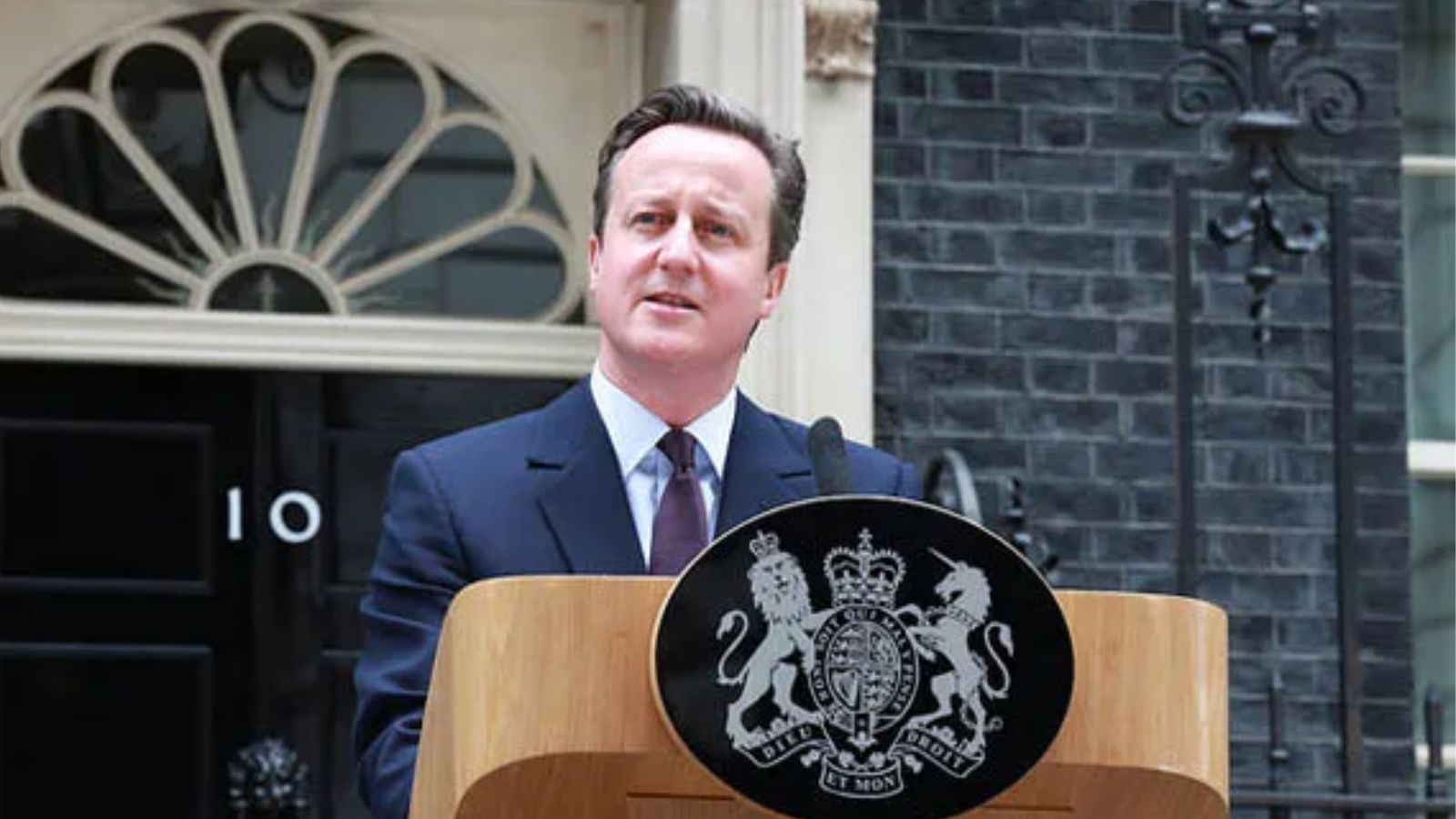
The 2015 election was a success for the governing Conservative Party under David Cameron. After five years governing in a coalition with the Liberal Democrats, the electorate returned a majority government, allowing the Tories another term – though they had no idea how soon things would turn sour. Elsewhere, it was a bad night for Labour (especially in Scotland) and the Lib Dems, who crashed down to Earth, plummeting into the single figures in terms of seats.
1. The First Conservative Majority Since 1992

In the election, the Conservatives won 330 seats, a working majority of 11 seats. The Tories were aided by the collapse of the Liberal Democrats, nabbing 27 seats from the party.
Though not an overwhelming landslide (the lowest majority for a government since 1974), it was enough to give the Tories their first majority in nearly two decades.
In 2010, the party were the largest in the Commons but, having failed to secure a majority, joined a coalition with the Lib Dems.
The party were defeated in 2001 and 2005 after being decisively booted out of government in the 1997 Labour landslide.
Thus, their last majority was in 1992 when the party exceeded expectations to hold onto a 21-seat majority.
It was also the first time a prime minister would re-elected after a full term in office with a larger popular vote share since 1900.
2. Right-Wing Parties Win Over 50% Of The Vote For The First Time Since the Second World War

A notable aspect of the election was the rise of the United Kingdom Independence Party. The populist, Eurosceptic party were able to win the third most votes of any party, successfully exploiting rising immigration to win a sizable 12.6% of the vote.
On top of the Tories’s 36.9% and the totals by the Democratic Unionist Party and Ulster Unionist Party in Northern Ireland, right-wing parties topped 50% of the vote for the very first time. While it seemed the Conservatives once had a monopoly on the right, British politics was becoming more fragmented.
It is notable though that UKIP’s appeal to low-income, older, working-class voters also helped the party snatch an estimated half a million Labour voters from the last election, as well as many traditional Labour supporters who had become alienated by the two establishment parties.
Despite such a hefty vote share, the party only won one seat, with Douglas Carswell retaining his seat in Clacton. Party leader Nigel Farage failed to win a seat, having tried to get elected in South Thanet.
3. Non-Major Third Parties Win Record 25% of the Vote

UKIP’s 12.6% of the vote helped non-major third parties win nearly a quarter of the vote for the first time.
The second-placed national third party were the Greens, who won one seat but notched up 3.8% of the vote, topping one million time and quadrupling from their 2010 performance.
The 24.8%,won by these minor parties (up from 11.9% in 2010) reflected a growing sense of disillusionment with the main parties, even if this was not borne out in the results of what had been described as the most disproportionate result in UK history up to that point.
The Electoral Reform Society wrote: “In the most disproportional election to date in the UK, millions voted for smaller parties only to see their efforts result in single-digit representation, and a majority government returned to Parliament on less than 37% of the vote and with the support of just 24% of the electorate. The two-party system has long been dead, but if the 2015 election is known for one thing, it will be for the entrenchment of multi-party politics across the whole of the UK.”
4. The SNP Win 95% of Scottish Seats

Perhaps the most interesting aspect of the 2015 election happened north of the border.
A year after the Scottish independence referendum crushed the hopes of those seeking a Scottish secession, 2015 proved the resilience of the movement and that the question of independence was far from answered.
On a vote share of 50% (the highest of any singular party since 1910), the SNP took 56 of the nation’s 59 seats. While no seats had changed hands in 2010, 50 did in 2015, all falling to the SNP.
The Liberals Democrats lost 10 seats as the SNP unseated prominent figures like former leader Charles Kennedy and Cabinet Quad member Danny Alexander.
Labour were the biggest victims however, losing 40 seats. What was once a Labour heartland now had no representation beyond one solitary seat in Edinburgh South.
In Kirkcaldy and Cowdenbeath, the seat held by the retiring former prime minister Gordon Brown, the SNP won by 10,000 votes.
Among the most notable casualties were Scottish Labour leader Jim Murphy, former Deputy leader Anas Sarwar, and Shadow Scottish Secretary Margaret Curran. However, the most eye-catching departure was that of Shadow Foreign Secretary Douglas Alexander, talking of which…
5. The Youngest MP Elected Since 1667

Despite holding a majority of over 16,600 in 2010, former Scottish Secretary and former Transport Secretary and incumbent Shadow Foreign Secretary lost his Paisley and Renfrewshire South seat to the SNP after a 70-year Labour streak in the constituency.
Not only was he dethroned but he was resoundingly defeated by 20-year-old candidate Mhairi Black.
It was widely reported that the Glasgow University student and chip shop worker would become youngest MP since the 13-year-old Christopher Monck took a seat in 1667.
Though there has been some debate about the 1667 date, she is certainly since the United Kingdom first made the movements towards universal suffrage with the Great Reform Act of 1832.
The Baby of the House later admitted some of her first year’s pay was spent on pub visits and McDonald’s – and why not?
6. The Second-Largest Swing In A General Election

While many eyes were on Paisley and Renfrewshire South, the SNP’s greatest result was probably in Labour’s ‘safest’ seat Glasgow North East, where they managed to achieve the second largest swing in a UK election.
The seat, won by Labour’s Willie Bain with 68.3% of the vote in 2010, fell to the SNP, who more than halved Labour’s vote percentage from just five years earlier.
Jumping from 14.1% to 58.1%, the SNP’s record 39.3% swing was the second largest in UK history, behind only a 42.3% swing in Blyth in 1974 (though it was current MP Eddie Milne who sought re-election under a different party and thus that of Anne McLaughlin in Glasgow North East is the most of a non-incumbent).
It is also the second largest increase in vote share by a party with a 43.9% increase, only behind Glasgow Gorbals in 1945 where Labour gained 80.0% of the vote, a 74.1% increase from 1935.
- The Liberals Democrats Not the Largest Third Party for the First Time in 92 Years

In the 2015 election, the Liberal Democrats collapsed.
Having become the biggest third party in 2005, 2015 saw the party fall from a firm third with 57 seats to just eight.
The loss was a personal failure for Nick Clegg. The once ultra popular Lib Dem leader faced a historic low of just 13% approval as he failed to rein in the Conservative government. In particular Deputy PM Clegg’s concession to the Tories on raising tuition fees was a betrayal to young voters and he was harshly punished.
It meant that not only did the party lose their decade-long status as the third-largest party and the ultimate protest vote party (overtaken by the SNP) but for the first time since the party’s creation in 1859, they were not one of the three biggest parties – either in terms of seats or votes.
8. The Largest Election-on-Election Vote Decrease In History

The Liberal Democrats lost 15.1% from their 2010 performance, the largest decrease in a share of the vote to that point.
It overtook the party’s disastrous 1924 performance where they lost 118 of their 158 seats.
The vote loss also dwarfed famously bad historic losses such as the Tory Party in 1945 and 1997 and Labour in 1983.
In the vote slump, notable MPs unseated include Cabinet ministers Danny Alexander, Ed Davey, and Vince Cable.
One particularly brutal result was in Norwich South. In 2010, the Lib Dems won the seat from Labour, defeating former Home Secretary Charles Clarke. In a very rare instance of such a result, incumbent MP Simon Wright fell from first to fourth in 2015, even placing some 142 behind the Green Party candidate. It was the first instance of this happening outside of Ireland since 1931.
As political scientist Rob Ford wrote: “The party managed only about 55 second places in England and Wales, limiting its ability to appeal to disaffected voters. Ukip – with 120 second places – is in a stronger position to make that argument in many areas now.”
9. The Only Shadow Chancellor to Lose Their Seat in the 65-Year History of the Position

Labour’s rout in Scotland was partnered with a similarly shocking result in Morley and Outwood where Labour Shadow Chancellor Ed Balls narrowly lost his seat.
Although the seat seemed in jeopardy in 2010, Balls retained it by over 1,000 votes. This time however, Conservative Andrea Jenkyns nabbed the seat by just 422 votes.
Serving as Shadow Chancellor, had Labour won, Balls would have occupied the second most senior Cabinet position and arguably the second most powerful office in the UK.
Since the position has existed since the Second World War, no Shadow Chancellor had ever lost their seat.
10. The Lowest-Ever Winning Vote Percentage in A Constituency (<25%)

While eyes are often on results on the mainland, elections in Northern Ireland are also interesting in their uniqueness: different parties, an important unionist/nationalist divide, and a more fragmented and multi-party system.
In 2015, Social Democratic and Labour (SDLP) MP Alasdair McDonnell was seeking re-election for a third term in his Belfast South seat, having scored 41% of the vote in 2010, a 17% margin of victory.
Belfast South would see the only occasion in British history in which an MP won on less than one in four votes cast.
On just 24.5% of the vote, McDonnell retained the seat, with his near-6,000 majority falling to below 1,000 as the Democratic Unionist Party won 22.2%, the Alliance polled 17.2%, and Sinn Fein obtained 13.9%. The Ulster Unionist Party and Green Party also both won under 10% but performed well enough to retain their deposit.
GRIFFIN KAYE.
Leave a Reply