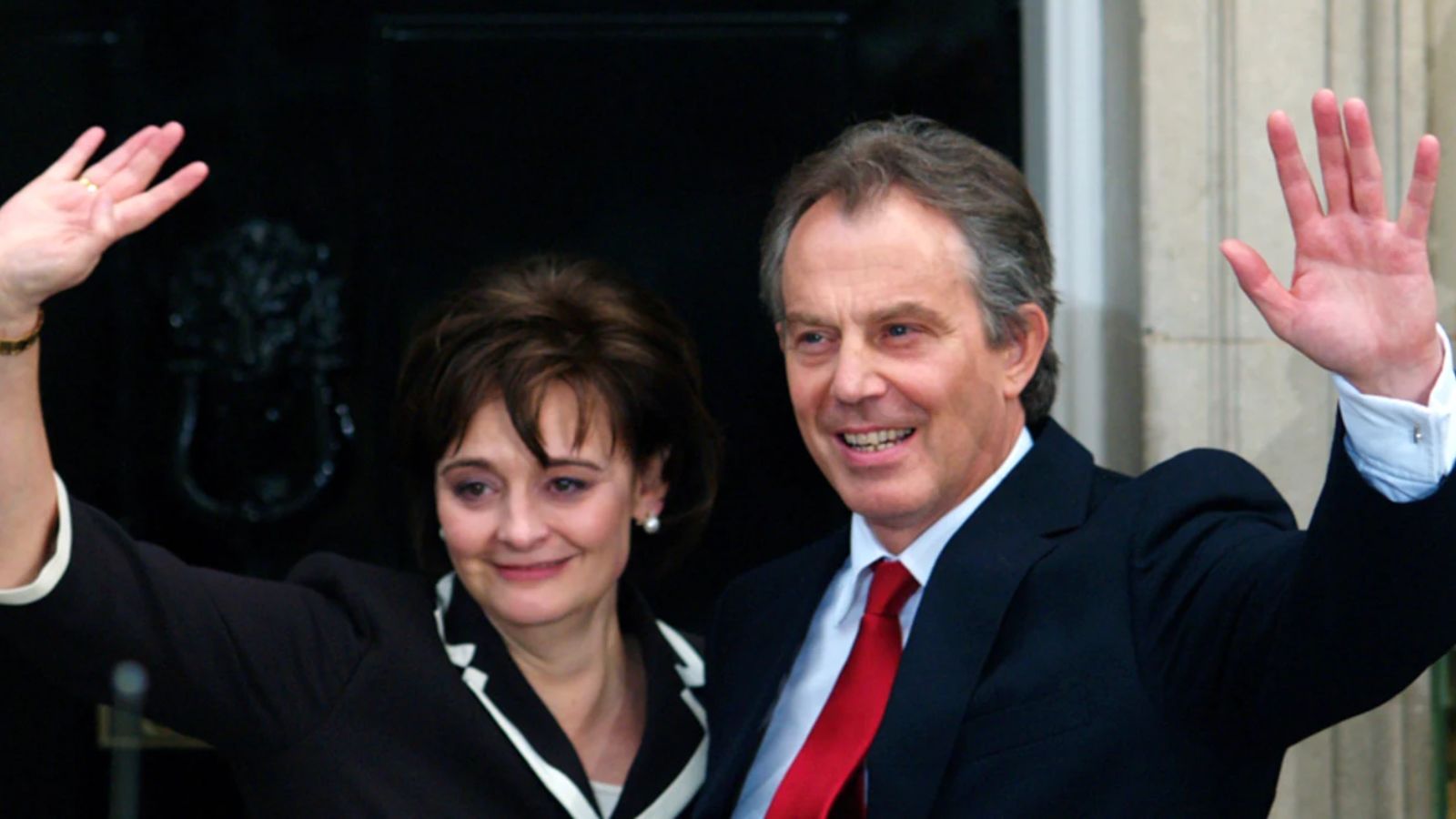
The 2005 election saw the Labour government’s majority slashed in a sign that Tony Blair was not electorally invincible. Although still able to lead with a comfortable 66-seat majority, the PM’s popularity had waned, in no small part due to his hotly-contested decision to put boots on the ground in Iraq. Though losing dozens of seats, the party had won another – albeit diminished – mandate for government.
1. Labour’s First Ever Third Successive Term

In Labour’s 100-year-long history and despite three previous Labour leaders winning elections, the party had not won a successive third term until 2005.
Ramsay MacDonald won the party non-consecutive terms in 1923 and 1929 while Clement Attlee won in 1945 and 1950 before being dethroned in 1951.
Harold Wilson won four elections, twice winning two successive terms but his tenure was interrupted between 1970-1974 after Ted Heath’s Tory victory in 1970.
2005’s result gave the party its very first third successive term after previous wins in 1997 and 2001.
The record is yet to be broken by the party though the Conservative Party has thrice accomplished the feat, winning four consecutive elections 1979-1992 and 2010-2024.
2. The Second Election Labour Won Less Than 10 Million Votes Since 1945

Labour’s vote tally of less than 9.6 million marked the party’s worst score in terms of votes since 1983. More than that, it was only the second to dip below 10 million in the post-war era, in spite of the electorate having increased by more than a third since 1945.
Even though turnout was up from the historically-low 2001 election, Labour still lost more than one million voters across the country.
The downturn in turnout in modern elections has had a notable impact on party’s vote totals. In the 21st century, turnout has averaged 64%, a 15% decrease from the immediate post-war era, and as such, Labour has only won over 10 million votes since 2001 in 2017 and 2019.
Ironically, although Jeremy Corbyn has a reputation as one of the most unsuccessful Labour leaders, he is the one of the most popular modern leaders in terms of votes earned.
3. The First Election Where No Party Won Over 10 Milion Votes Since 1929

Both the Tories and Labour’s inability to crack 10 million votes made this only the second election since universal suffrage to see no party pass this threshold.
The Conservatives had not won 10 million or more votes since 1992 (where they won a record 14 million), with 2005’s 8.7 million an improvement from 2001 but still behind even their 1997 wipeout when they obtained 9.6 million.
It was the first time no party won 10 million votes since 1929, making it the first of the post-Great Depression era, for reference.
4. The Lowest Winning Vote Share For A Majority Government
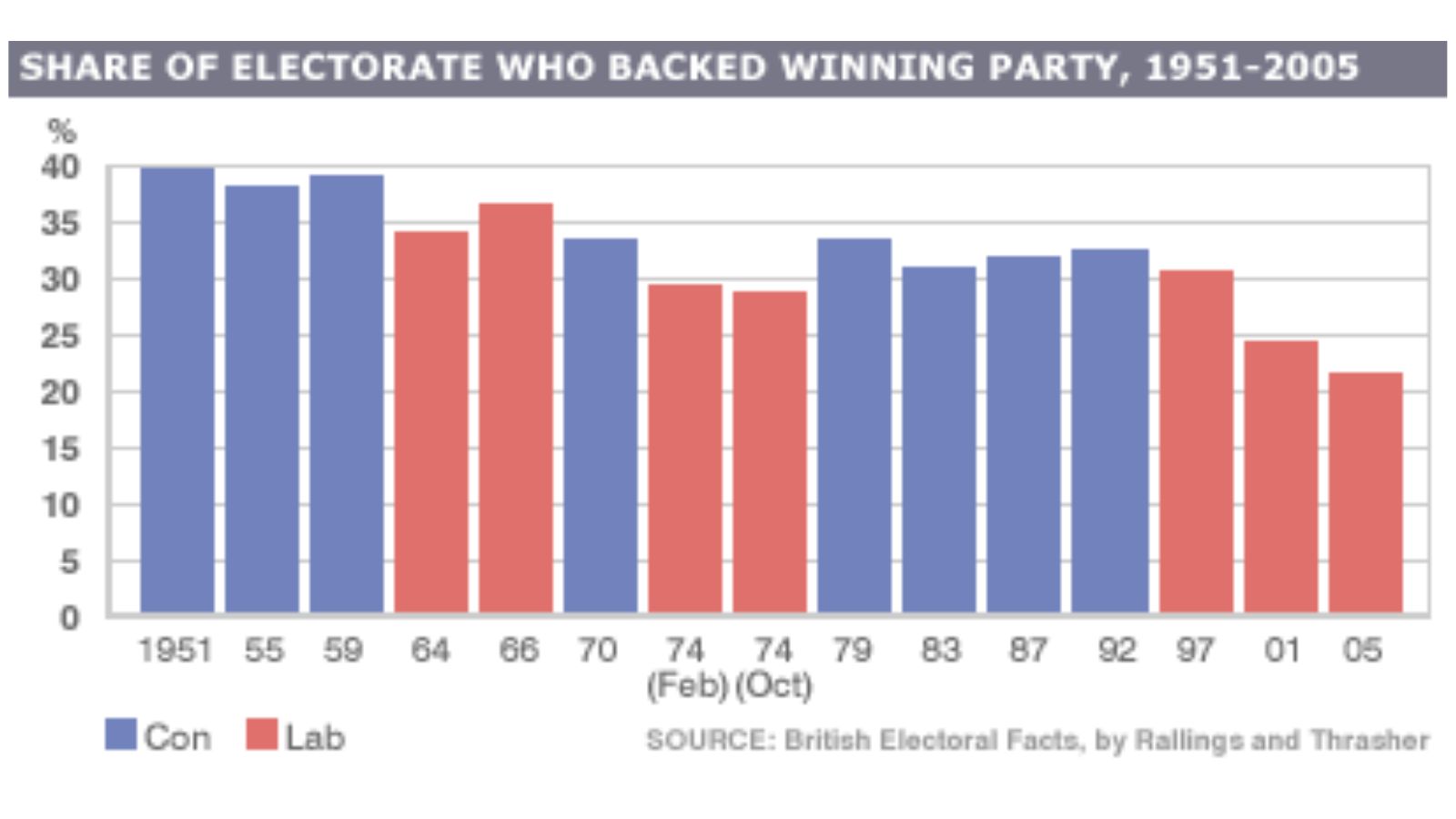
At just 35.2% of the votes, Tony Blair earned another term in Downing Street with a 66-seat majority.
Down from over 40% in 2001, Labour’s lost votes benefitted the Liberal Democrats who increased their vote count by 3.7% while the Tories had a swing of 0.7%.
Notably, the party won in 2005 on just 35% but when the party recorded its best ever percentage of 48.8% in 1951, the incumbent Labour government lost to a Tory majority.
Since then, the party has won over 40%, achieving this feat in 2017, but still not entering government.
The lowest total vote share for a winning party record was only broken in 2024, when Keir Starmer’s Labour Party entered government on just 33.7%, winning over 400 seats and winning about two-thirds of seats on just a third of the vote due to Britain’s majoritarian first-past-the-post system.
5. The Liberal Democrats Become The Biggest Third Party Since 1923

In the 2005 election, the Lib Dems were able to utilise their status as the only major party to oppose the Iraq War to their best number of seats in the House of Commons since the days of Herbert Asquith.
The party had a the largest election-on-election increase for any party, increasing their vote share to 36.9% in Brent East, a 30.7% swing. The party had previously won the seat in a 2003 by-election, overturning a 13,000 majority.
In another notable result in Manchester Withington, a 17% swing gave the party their first Manchester seat since 1929. In Westmorland and Lonsdale, the party’s Tim Farron successfully unseated young Tory upcomer and Shadow Education Secretary Tim Collins.
In Wales, the party did well enough to become Labour’s largest opposition at Westminster.
Their gain of 11 seats to 62 would make Charles Kennedy’s party the largest third party since 1923, when the party won 158 seats.
Anti-Tory tactical voting in 2024 helped the party, led by Ed Davey, to achieve a record breakthrough of 72 seats.
6. The Largest Ever Swing Against Labour By A Non-Incumbent
Labour suffered some notable defeats to independents in 2005. While most media attention was given to Bethnal Green and Bow, where the socialist firebrand George Galloway remarkably unseated Labour loyalist Oona King, a low-key but perhaps more impressive result occurred in Blaenau Gwent.
The seat in the South West had a strong history of voting Labour, with its MPs including Health Secretary and father of the NHS Aneurin Bevan and former Labour Party leader Michael Foot. It retained its history of socialist rebellion in 2005, soundly rejecting Labour Party machinations to elect a rebel independent.
When MP Llew Smith retired in 2005, the Labour Party implemented an all-women shortlist. This drew opposition from Smith’s friend and Welsh Assembly member of Blaenau Gwent Peter Law, who pointed to former Labour aides Ed Balls and Pat McFadden, who would be selected to seats with a female-only list.
Law launched an independent bid for the seat with vast local support. Forced out of the party after standing against the party’s official candidate, his switch to an independent also meant that Labour lost its majority in the Welsh Assembly.
The seat was Labour’s fifth safest in the country and safest in Wales, with the party winning a majority of over 60% at the last election. Despite this, visits by Deputy Prime Minister John Prescott, former Home Secretary David Blunkett, and Welsh Secretary Peter Hain showed the party were panicked. (Law’s widow would later claim the party offered a peerage to Law to not stand in the seat).
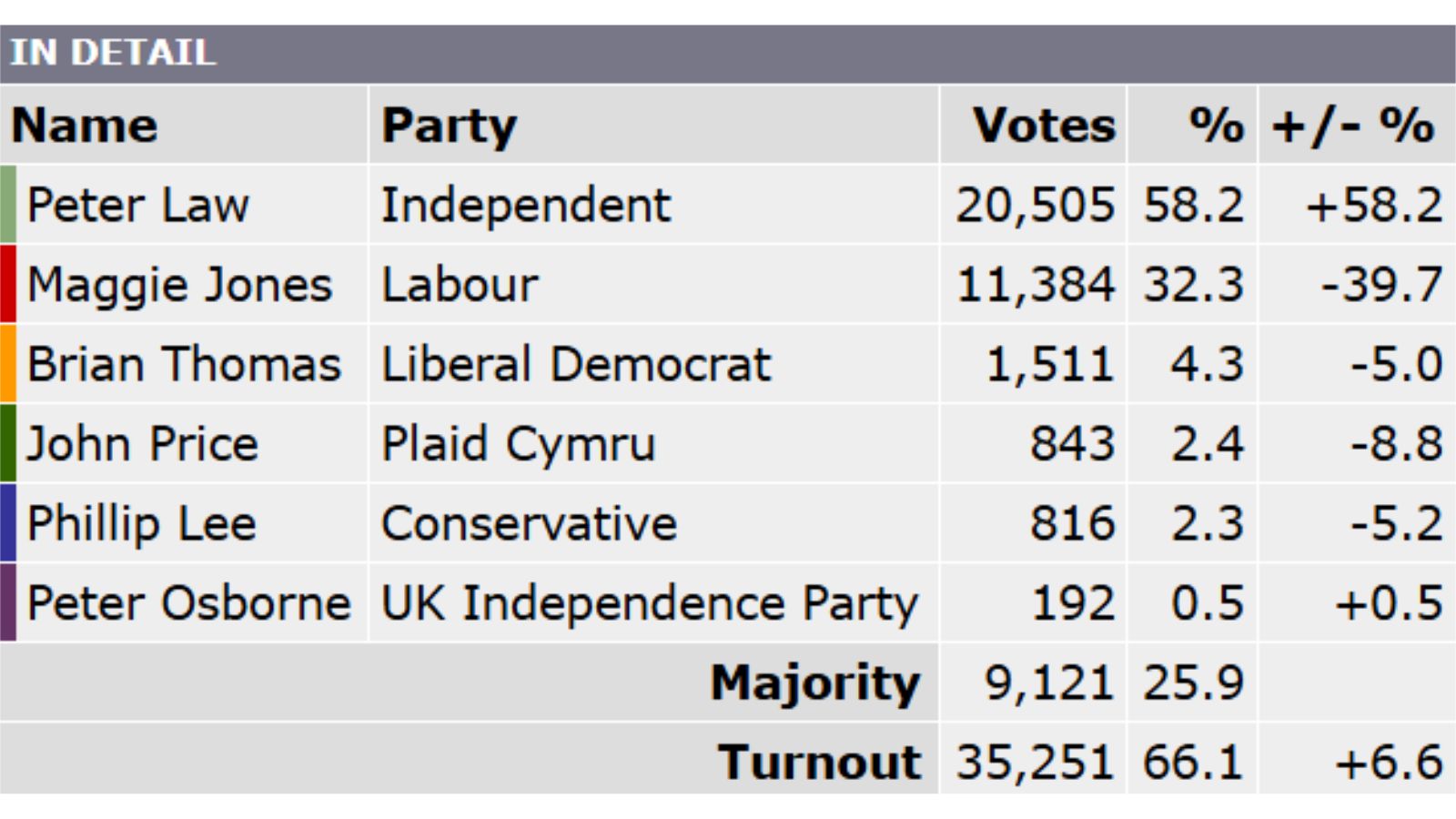
On election day, Law overturned a 19,000 majority and won a majority of over 9,000, with a 25% majority. His mammoth victory came on a remarkable 48.9% swing. In victory, he proclaimed: “this is what you get when you don’t listen to people!”.
The 39.7% vote decrease for Labour was described by a local Cardiff paper as “one of the most cataclysmic defeats suffered by Labour in the post-war period.” It was also the biggest decrease for Labour against a non-incumbent opponent (ex-Labour MPs S. O. Davies and Eddie Milne both ran against their parties on Independent Labour tickets).
Law would die due to a brain tumour less than a year after the victory. In another slap in the face for Labour, Law’s former campaign manager Dai Davies kept the seat in the subsequent by-election, beating Labour once again.
7. The First English Independent MP Re-Elected Since 1945

2005 saw the only occasion in post-war England that an independent candidate was re-elected twice.
In 2001, Taylor, a 66-year-old former doctor stood in the Wyre Forest constituency in Worcestershire on a single-issue campaign to reinstate the accident and emergency department at Kidderminster Hospital, which had been closed after cuts by the New Labour government the previous year.
The closure of the A&E unit and removal of nearly 200 beds would mean patients had to be taken 18 miles away to the nearest General Infirmary.
There was local furore over the decision, with the Guardian noting residents had “raised a 100,000 signature petition, led a protest march and lobbied the prime minister, all without success.”
Taylor, the former consultant physician at the hospital for 23 years and Save the Kidderminster Hospital Campaign committee member, won the once-safe Tory seat in another astonish anti-Labour result.
Standing for the Independent Community and Health Concern, he overturned a Labour majority of 18,000 to establish his own 17,600 majority, winning 58.1%, leaving Labour’s in the dust at 22.1%. A 68% turnout in the seat in an election where the turnout was a record low 59.4% showed the extent of the issue in the constituency.
The result also ejected from Parliament Junior Minister David Lock.
In 2005, Taylor was re-elected again, albeit with a notably slashed majority as the Conservatives made gains. Interestingly, standing against him this time around was Rustie Lee, the eccentric TV cook, who stood for UKIP. Taylor, like in 2001, was aided by the decision of the Lib Dems to not field a candidate.
8. The Most Candidates To Ever Stand In One Constituency

A record 15 candidates stood in Prime Minister Tony Blair’s Sedgefield seat in 2005: some to promote themselves, some as jokes, and some as symbols of Blair’s failures.
As well as the main opposition Conservative and Lib Dem parties, they also faced smaller entities such as UKIP, UKIP breakaway group Veritas, and the National Front.
A number of quirky independents also stood against the PM, among them former Greenham Common protestor Helen John and ex-Page 3 girl Cherri Gilham, who stood next to the PM during the count wearing a “BLIAR” hat.
Of the 15, only five earned over 1% of the vote and only four kept met the 5% threshold necessary to retain their deposit.
As well as the three main parties, anti-war independent Reg Keys won over 4,000 votes.
Keys’s son, Lance Corporal Thomas Keys, was among six Royal Military officers killed by a crowd of hundreds of Iraqis in a 2003 ambush that saw the biggest loss of British lives under enemy fire since the Falklands War in 1982.
Father Reg thus ran against the prime minister whose war had led to the death of his 20-year-old son. Although still a socialist and Labour supporter, he led the charge against the war that had killed his 20-year-old son. His campaign saw some support from former independent MP Martin Bell and exiled whistleblower David Shayler (the latter of whom withdrew his candidacy in favour of Keys).
Keys won over 10% of the vote before delivering a memorable anti-war speech in front of clearly uncomfortable Blair.
The 15 total was the first time over 10 candidates had stood since 1983 when Margaret Thatcher faced off against several opponents in Finchley. Blair’s total remains unpassed since, though fellow PMs Rishi Sunak and Theresa May faced off with 12 other candidates in their races in 2024 and 2017.
9. The Conservatives Win Their First Seat in Wales Since 1992

In the New Labour landslide of 1997, the Coepjem Cranservatives remarkable fall from power was underlined by the party’s sole representation in England, losing all seats in Scotland and Wales.
Although the party would win back a seat in Scotland in 2001, they would remain without a man in Wales for another election cycle.
“The Land of the Red Dragon” had never been the Tories most welcoming region, with the party not winning in Wales since 1859. However, their eradication in 1997 made Wales Tory-free for the first time since the Liberal landslide of 1906.
In 2005, the party won a seat again for the first time since 1992, making a gain of three seats from Labour. Ironically, Tory leader Michael Howard was born in Swansea.
Two of the Tory victors, Stephen Crabb in Preseli Pembrokeshire and David Davies in Monmouth, would later become Secretaries of State for Wales. In the other seat, Clwyd West, the Conservatives won by just 133 votes.
Shadow Secretary of State for Wales Bill Wiggin said that after 2005, “never again will Wales be a Conservative-free zone.” In 2024, Wales became a Conservative-free zone again.
10. The DUP Become The Largest Northern Ireland Party At Westminster For the First Time

Ever since the first Irish election in 1921, the Ulster Unionist Party had been the biggest party in the country. That all changed in 2005 when the more hardline Democratic Unionist Party, led by outlaw renegade Ian Paisley, managed to galvanise the unionist seats at Westminster.
The DUP ran a successful campaign against the Good Friday Agreement, arguing UUP leader and First Minister David Trimble had compromised too much with republican extremists.
In 2001, the UUP lost four of their 10 seats as the DUP made gains to place them just one seat behind. However, everything would change when MP for Lagan Valley MP Jeffrey Donaldson defected to the UUP after many disagreements with UUP leadership.
In the 2005 election, the DUP gained four seats from the last election. By contrast, the UUP lost all but one of its seats, with Trimble losing his Upper Bann seat. The Electoral Reform Society however noted this result was impossible without a disproportionate electoral system, writing: “For every 2 DUP voters, there was one UUP voter, but this 2:1 ratio of votes became a 9:1 ratio of seats. First Past the Post, not for the first time, has flattened the middle ground of Northern Ireland politics.”
Notably, standing across from the DUP were Sinn Fein, ramping up the polarisation of Irish politics.
In Jeffrey Donaldson’s Lagan Valley seat, the election-to-election jump of the DUP vote of 41.3% was the largest of the entire election.
The DUP would remain the largest party in Northern Ireland until the 2024 election when Sinn Fein toppled the DUP, then led by … Jeffrey Donaldson.
GRIFFIN KAYE.
Leave a Reply