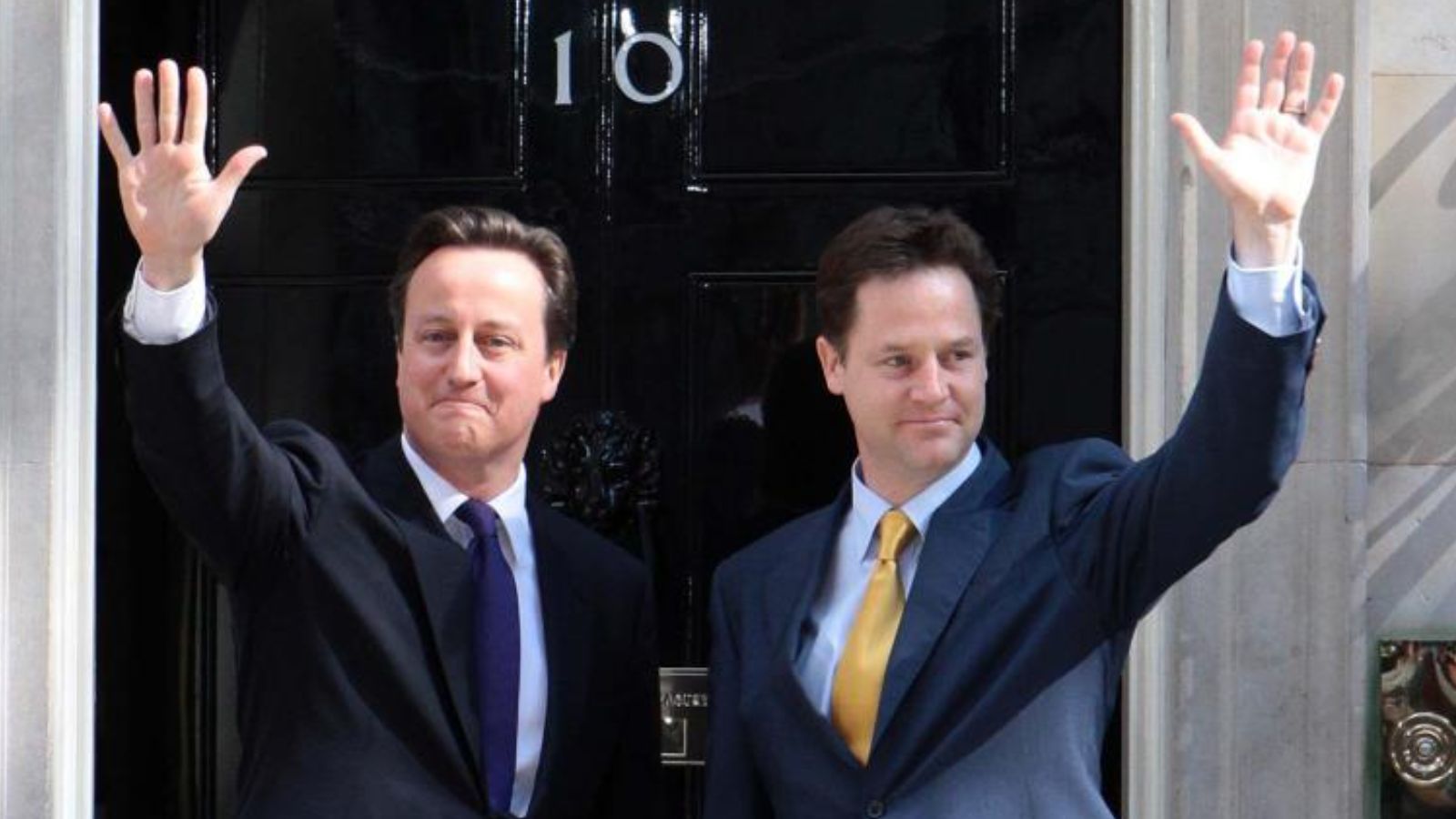
The 2010 election most notably saw the Conservative Party return to power for the first time since 1997, ending Labour’s 13 years in government, the party’s longest continuous streak occupying No. 10 Downing Street. Though they had managed to wrestle back government from Labour, it came with the notable caveat that no party had won an overall majority of seats. In order to boot Gordon Brown out of Downing Street, Tory leader David Cameron thus entered into a coalition with the perennial third party, the Liberal Democrats.
1. The First Government Coalition Since 1945

For all its many criticisms, the UK’s majoritarian first-past-the-post system, it has been ruthlessly effective in returning strong, single-party governments.
Indeed, the 2010 election was the first to return a hung parliament – in which no party holds a majority of the seats – since the pre-Thatcher years. The last occasion this occurred was February 1974 when Labour leader Harold Wilson defied expectations to return to government, forming a minority administration when he narrowly edged out Tory leader Edward Heath in seat count.
Instead of governing in a minority position or calling another election to attempt to garner a majority like Wilson did, Cameron entered into a coalition with the Liberal Democrats, led by Nick Clegg, who entered government for the first time. Their 57 seats gave the Tories a 38-seat working majority.
The British public’s only reference for a coalition is this deal, which marked the first multi-party governance since World War Two when all major parties formed a unity government as the nation fought against Nazi Germany.
2. All Major Parties Change Leader For First Time Since 1979

The most marked change since 2005 was the switch of prime ministers as the once highly-electable Tony Blair was becoming increasingly unpopular both with his party and across the country. So after a decade at the helm, Blair stepped down to allow long-time Chancellor Gordon Brown to fulfil the office Blair had promised him.
Having lost a third consecutive election in 2005, oft-forgotten leader Michael Howard resigned and the moe youthful David Cameron took over as party leader. Although a new MP, only elected at the last election, he had previously been given important roles such as briefing prime minister John Major and being Special Adviser to the offices of Home Secretary and Chancellor.
Thirdly, despite Charles Kennedy making the Lib Dems the biggest third party by seats since 1923 at the last election, Kennedy faced intense internal pressure to resign after revelations about his alcoholism became public. He was initially replaced by North East Fife MP and ex-record-setting Olympic sprinter Menzies Campbell. Himself dogged by questions about his age, he was shortly thereafter replaced by the popular Nick Clegg.
It marked the first time all three major party leaders had changed since 1979, when the Tories replaced Ted Heath with Margaret Thatcher, Labour switched Harold Wilson for James Callaghan, and the Lib Dems swapped out the disgraced Jeremy Thorpe for David Steel between the 1974 and 1979 elections.
Thatcher was in the 1979, 1983, and 1987 elections and when John Major succeeded her, Labour kept their 1987 candidate Neil Kinnock. Major again contested in 1997, losing to Tony Blair who was still leader in the 2001 and 2005 elections.
3. Gordon Brown Becomes The First Prime Minister To Not Win An Election Since 1979

Talking of 1979, this election made Gordon Brown the first PM to never win an election since Jim Callaghan, who took over the office when he was made Labour leader in 1976 and, after a vote of no confidence, lost his only election to Margaret Thatcher against the backdrop of the so-called Winter of Discontent.
Thatcher would triumph in three elections, Major won in 1992, and Blair was victorious in 1997, 2001, and 2005.
While this has become increasingly common today (Liz Truss, Rishi Sunak, and – as of writing – Andy Burnham have not won any elections; Theresa May did not win a majority), it made Brown the first to do so in 31 years.
When Callaghan left office, it was only 15 years since the previous instance, which occurred when Alec Douglas-Home, made party leader in 1963, was defeated by Harold Wilson’s Labour the next year.
4. The Most MPs Standing Down Since 1945

With Labour’s defeat perhaps imminent, over 100 Labour MPs exited parliament. Among the most prominent names were ex-Deputy PM John Prescott, former Home Secretary John Reid, and former Defence Secretary Geoff Hoon.
Some high-profile Labour MPs who stayed, such as former Home Secretaries Charles Clarke and Jacqui Smith, lost their seats.
In all, 149 MPs stood down.
Conservatives standing down included ex-leader Michael Howard, former party Chairman John Gummer, and vocal backbencher Ann Widdicombe.
Elsewhere, Alex Salmond announced his plans to become an SNP MSP and Ian Paisley ended his career.
Many MPs stood down due to the 2009 expenses scandal, a controversy that hurt the reputations of all parties, with many MPs accused of the misuse of public funds. Several MPs were later arrested and imprisoned.
5. No Etonians Elected Labour MPs For The First Time Since 1923

Labour had long had a reputation as the working man’s party, often consisting of MPs from working class backgrounds such as miners and union men.
Ironically then that the end of New Labour – led by Tony Blair, the first private school MP since Alec Douglas-Home – also marked the end of Labour MPs educated at Eton, the elite boys-only private school that educated 20 future prime ministers.
After the departure of Sir Tim Dalyell in 2001, Mark Fisher, MP for Stoke-on-Trent Central was the party’s only Etonian. This ended when Fisher, MP for Stoke-on-Trent Central and a critic as the New Labour governments, stood down in 2010 citing health issues.
According to Lace ‘Em Up’s rigorous research department, Labour would not have another Eton MP until 2024 when Kanishka Narayan was elected MP of the Vale of Glamorgan. He has since entered Cabinet as Minister of Artificial Intelligence, the first Labour Cabinet minister educated at Eton since 1968.
While electing no Etonians, Labour did become more diverse, electing its first female Muslim MPs, one of whom was future Home Secretary Shabana Mahmood in Birmingham Ladywood.
6. George Galloway Was Not Elected For The First Time Since 1987

While Labour were the big losers of the election and notable Labour MPs were unseated, the party pulled off a big coup in Bethnal Green and Bow, which the party won from Respect after George Galloway pulled off a remarkable victory there last election.
Ever since 1987 when he toppled former Home Secretary and SDP leader Roy Jenkins, the socialist firebrand George Galloway had won re-election while remaining a thorn in the side of the party leadership. After leading a crusade against the invasion in Iraq, Galloway was kicked out of the party but decided he would stand against Labour on an anti-war platform with his new Respect Party.
Able to capitalise on the constituency’s large Muslim population, the Scottish orator was able to unseat Blair loyalist Oona King on a 26.2% swing in a traditionally Labour heartland.
However, by 2010, Labour’s Rushana Ali (a Muslim woman) won the seat back for Labour. Galloway, whose time as an MP was relatively unmemorable outside a cringe-inducing stint on Celebrity Big Brother, contested the neighbouring Poplar and Limehouse constituency in 2010, coming third with 17.5%. With his inability to retain a seat in Parliament, it was his first loss since his career starting.
Although he would win by-elections in 2012 and 2024, the Respect-turned-Workers’ Party leader has not managed to retain a seat in an election since his expulsion from Labour.
7. The Green Party’s First Ever Seat in the House of Commons

Talking of third parties, 2010 was a breakthrough year for the Greens, electing their first-ever MP with the voters of Brighton Pavilion sending former MEP Caroline Lucas to Parliament.
In 2005, Brighton Pavilion was the Greens’s best seat, winning 22% of the vote. After pouring resources into this top target seat in 2010, Lucas triumphed, winning a majority of over 1,200 over the incumbent Labour Party.
The party’s first MP in Westminster, environmentalist and columnist George Monbiot called it: “a massive breakthrough, not only because she’s a brilliant, charismatic, humane politician who will enrich parliamentary life, but also because it proves it can be done, even under our antiquated political system.”
In her 14-year tenure, Lucas turned the constituency into a safe Green seat, increasing the party’s vote share from 31.3% to 57.2%. Lucas would be the sole Green representative in the chamber during her career, retiring in 2024 – a year when the party made a breakthrough by obtaining a record four seats.
8. 0 Seats Change Hands in Scotland From 2005 Elections

A look at the 2005 and 2010 election results in Scotland reveals no changes in any of the nation’s 59 seats, though two by-elections lost by Labour between the elections were gained back.
Having won in Scotland since 1959, Labour’s two highest-ranking politicians, Prime Minister Gordon Brown and Chancellor Alistair Darling, both held seats north of the border.
The Conservatives, despite entering government, won just one seat, having won it in 2001 after being wiped out in 1997.
Having won 41 of the country’s 59 seats in 2005 and 2010 – reflecting their dominance in the area – few could have predicted they would plunge to just one seat five years later.
9. Labour’s Worst-Ever Constituency Result In A Post-War Election

In the 2005 election, Liberal Democrat Tim Farron won the once-safe Tory seat of Westmorland and Lonsdale after multiple recounts, by just 267 votes. It was notable for unseating Tim Collins, an upcoming Tory prospect and Shadow Education Secretary.
In 2010, Farron was easily re-elected, winning 60% of the vote, nearly double that of the Conservatives. More interesting however is the result for Labour, whose candidate Jonathan Todd won just 2.2% of the vote. Of some 51,487 votes cast, he won just 1,158.
Farron would later become party leader and the seat is now the Liberal Democrats’s longest-held and most dependable seat.
The rural seat in south Cumbria has been particularly unwelcoming to Labour. Despite the red wave of 1997, the party only just got the vote of one in five of those who voted. Moreover, in 2024, it was the only constituency where Labour lost their deposit, winning 4.7%, a factor attributable to undergoing boundary changes as well as anti-Tory tactical voting.
10. The First Voided Election Results for Illegal Practices In 99 Years

In the 2010 election, Immigration Minister Phil Woolas narrowly retained his Oldham East and Saddleworth seat by just 103 after running what the New Statesman described as “one of the most disgraceful election campaigns in recent history.”
Woolas would narrowly turn back the Liberal Democrats in a campaign which saw Labour’s candidate make some bold campaigning efforts to smear Lib Dem opponent Elwyn Watkins.
Ads from Woolas linked Watkins to unlawful foreign donations and linked him with Islamist extremists. One memorable image implied Watkins had been arrested by the police. Internal emails later revealed these had been made in a concerted effort to obtain the angry, white male vote.
Watkins appealed, ultimately successfully, to have the election results voided and overturned under section 106 of the Representation of the People Act 1983, which makes it illegal to make false statements of fact about a candidate.
Although occasion results have been declared null, it was the first overturned for illegal practices since 1910. By comparison, the History of Parliament website notes 25 MPs were unseated for this reason between 1885 and 1911.
Now Shadow Immigration Secretary, Woolas was kicked out of the party so would have to folk out his own appeal costs. Deputy Leader Harriet Harman said his days in the party were over indefinitely as party leader Ed Miliband called it “a salutary reminder to all politicians across the political spectrum about the importance of a clean fight.”
The High Court would have the final say, upholding the previous ruling. Woolas was booted from office and barred from standing for public office for three years in a decision YouGov polling showed was supported by 71% of respondents (only 7% disagreeing).
GRIFFIN KAYE.
Leave a Reply