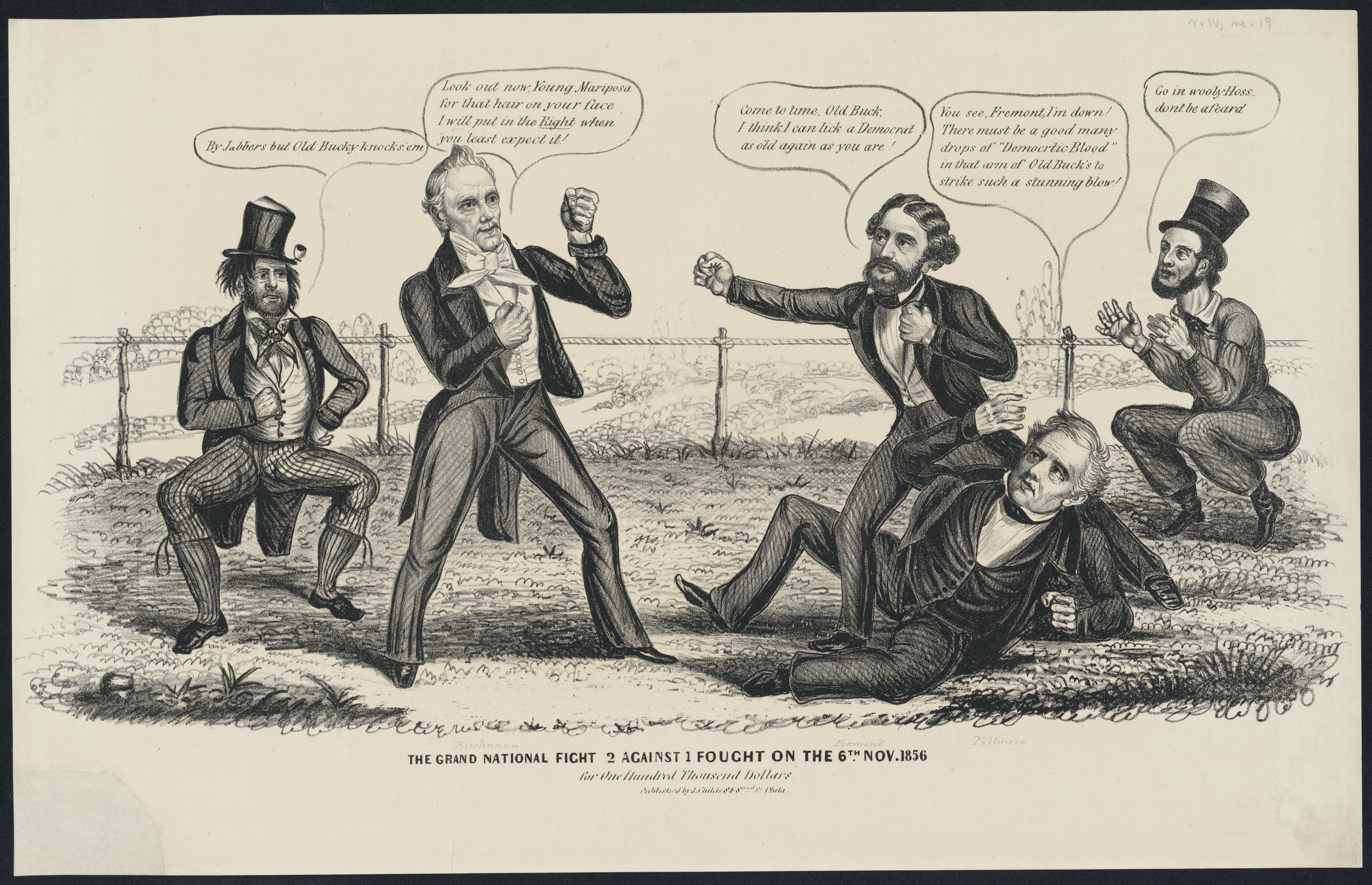
Hello and welcome back to another edition of Lace ‘Em Up’s Presidential Election series for today we will be discussing the election of 1856. America’s push into the Civil War is getting closer and closer as we have yet another three-way race for the White House including the first presidential election to involve a brand new political party.
Franklin Pierce’s Troubled Presidency

President Franklin Pierce was dealing with a multitude of issues not the least of which was having to lead a nation that was ripping itself apart over the issue of slavery. The president didn’t make things better by signing into law The Kansas-Nebraska Act which basically destroyed the Missouri Compromise and allowed the residents of the new states of Kansas and Nebraska to settle the slavery issue for themselves.
This paved the way for ‘Bleeding Kansas’ which saw pro and anti-slavery forces in the area battle each other resulting in the deaths of 50 or more people and lasted until 1859 with Kansas becoming a free state in 1861.
President Pierce also supported a document called the Ostend Manifesto which proposed the idea of purchasing Cuba from Spain and adding it to the U.S. as a slave state with threats of going to war with Spain if they refused to sell. As you can imagine, many Northerners who opposed the expansion of slavery especially within the Democratic Party were furious with Pierce over these two actions which plagued his Presidency even more.
Deciding the Democratic Nominee

Despite the fallout of the Kansas-Nebraska Act and the Ostend Manifesto, Franklin Pierce decided to run for a second term. He had to deal with stiff competition within his own party in the form of Stephen Douglas, Lewis Cass and James Buchanan.
After more than a dozen ballots, both Pierce and Douglas would withdraw their names seeing that they had no chance of winning (in Pierce’s case) and Douglas chose to drop out after the eventual winner of the nomination promised to only serve one term if elected thus opening the door for Douglas to run for the presidency in 1860.
Ultimately, it was James Buchanan who got the party’s nomination due to a combination of being out of the country during the calamity with the Kansas-Nebraska Act and promising to serve a single term if elected president; Buchanan’s running mate was John Breckinridge, a former U.S. Representative from Kentucky.
The Birth of the Republican Party

The Whig Party would cease to exist by the mid to late 1850s but in its place saw the remaining Whigs join forces with other groups like the Free Soil Party, the Liberty Party and the remnants of the Federalists to create a new political party in 1854 to oppose the Kansas-Nebraska Act with this new party being called ‘The Republican Party’.
The Republicans ended up finding success in the 1854 midterms with the party gaining seats in Congress. By 1856 they looked determine to take the Democrats down with their policies on stopping the expansion of slavery, ending the practice of polygamy within Mormon settlements and obtaining financial aid to construct a Transcontinental Railroad which fell in line with their presidential slogan: “Free Speech, Free Press, Free Soil, Freemen, Fremont…And Victory.”
The Republicans nominated John Charles Fremont, a former Senator of California and soldier who fought in the Mexican-American War. Fremont’s running mate is William Dayton, a former Senator from New Jersey who actually beat fellow Republican and future U.S. President Abraham Lincoln to win the party’s nomination.
The Know Nothing Party

The third player in this election was the American Party best known today as “The Know Nothing Party” as most of the people who were a part of this group just didn’t know anything about party plans leading to many newspapers simply referring to them as “Know Nothings” and the party as “The Know Nothing Party”.
Despite the silly name, the Know Nothing Party gained much support since the 1852 election with the party running 76 members in the 1854 midterms and 35 of them got elected including Nathaniel Banks, who became the new Speaker of the House in Congress.
As 1856 rolled around the Know Nothings believed they were strong enough to nominate another candidate for president and they chose former U.S. President Millard Fillmore with Andrew Jackson Donelson, the nephew of Andrew Jackson as his running mate.
What makes this whole situation strange is the fact that Millard Fillmore wasn’t even a member of the party, nor did he support nativist ideas and in fact he was out of the country when he got the nomination. Even still, Fillmore went along with it presumably hoping that this would be his opportunity to win the presidency back in his own right.
The Campaigns

The Republicans were pulling no punches when it came to their platform which was to stop the spread of slavery throughout the Western Territories. However the Democrats were firing back by claiming that electing Fremont to the Presidency would lead to civil war.
The Democrats and the Know Nothings are bringing up claims of cannibalism that occurred during an expedition Fremont led years ago and are insinuating that he was a Catholic, at a time when being a Catholic in the U.S. was unpopular due to nativistic beliefs. However these claims of Fremont being a Catholic were proven to be untrue.
The Democrats were hoping that the demonizing of Fremont in the eyes of the voters would help Buchanan’s chances for winning, however a comment Buchanan made about 10 cents a day being a fair wage for the working class was understandably criticized leading to him getting the unfortunate nickname of “Ten Cent Jimmy”.
Fillmore meanwhile, promised to bring unity back to the country if elected president as the two major parties were unable to do so and some Americans turned their support to the Know Nothing Party.
The Election Of 1856: The Results

As seen from the electoral map above, James Buchanan became the fifteenth President of the United States receiving 174 electoral votes, but got less than 50% of the popular vote as he got only 45.3%.
John Fremont received 114 electoral votes and 33.1% of the popular vote which was an impressive first try for the new political party, but of course as we all know this wouldn’t be the last time the Republican Party ran in a presidential election.
Millard Fillmore only received eight electoral votes which was just the state of Maryland and got 21.5% of the popular vote. This was the best performance in terms of the popular vote for a third-party candidate since 1848. The Know Nothings would fall apart after losing this election with a number of their members going on to join the Republican Party.
James Buchanan as of the timing of this article is the last person to have held the position of Secretary of State to become President and if the rumours are true, then Buchanan is the first and currently only LGBTQ person to have won the presidency in American history.
Be sure to follow Lace ‘Em Up on Twitter @laceemupoffice you can follow me also on Twitter @hakeemfullerton and I’ll see you in the next article.
Leave a Reply