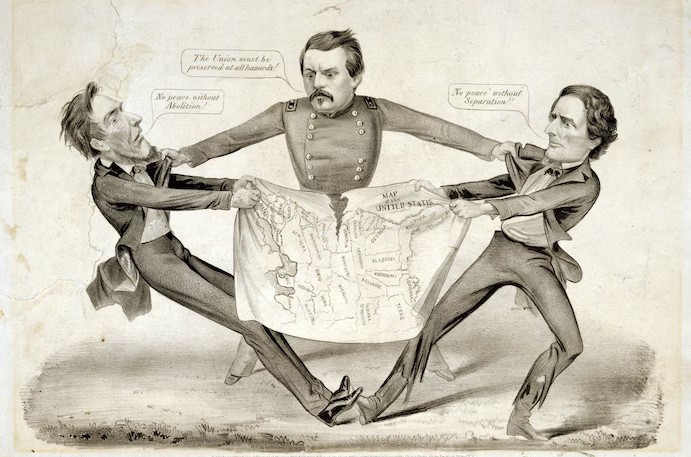
Hello and welcome back to another edition of Lace ‘Em Up’s Presidential Election series for today we will be going over the Election of 1864. It’s the first U.S. election since 1812 to take place during a war and the stakes are not only high for the future of the country but for the incumbent president, Abraham Lincoln.
The Civil War: America’s Darkest Period

Since Lincoln’s win back in 1860 and the assault at Fort Sumner in Charleston South Carolina, 11 Southern states have seceded from the Union to create “The Confederate States of America” and this would lead to American forces engaging in full on Civil War. This resulted in the deaths of thousands upon thousands of Americans with the Union (who represented the North) struggling to beat the Confederacy (who represented the South) in the early stages of the war.
Despite a number of important victories like the Battle of Gettysburg and the Siege of Vicksburg, the Confederates weren’t slowing down in the slightest bit and many Americans were questioning the point of the war as it went on and on with no apparent end in sight.
Other acts of violence occurred outside of the battlefield such as the New York City Draft Riots where middle-class white men refused to be drafted and rebelled against the wealthy elites while also antagonizing African Americans who were excluded from the war.
The riots only lasted for several days but they saw over a hundred people killed and over two thousand more injured, which was small compared to those soldiers who died during the war; It becomes very clear that the outcomes on the battlefield would dictate the results of the next presidential election.
Lincoln’s Presidency

Despite Lincoln’s best efforts to remain moderate on the issue of slavery, the writing was on the wall for what he needed to do. By 1863, Lincoln issues the Emancipation Proclamation and gave his famous Gettysburg Address before eventually supporting the idea of abolishing slavery in the Southern States, which surprisingly angered some Northerners who felt that the rotten practice known as slavery would eventually die out on its own.
Lincoln’s presidency had other problems aside from the war as much of the country didn’t like him due to his suspension of the Writ of Habeas Corpus thus allowing people Lincoln believed were involved in conspiracies against the Union to be sentenced to jail without any trial.
On top of that, some Republicans questioned Lincoln’s leadership to a point where even Salmon Chase (Lincoln’s Secretary of the Treasury) challenged him for the nomination and had a good shot at unseating the president. It’s only thanks to Lincoln’s political maneuvering and his decision to appoint Chase to the Supreme Court which allows the president to secure the nomination…But things were still problematic within the Republican Party.
The Republican Split

Despite Lincoln winning the nomination, the Republicans remained divided as the more radical members believed that Lincoln wasn’t doing enough when it came slavery or the Civil War, so they splintered off and created a new party called ‘The Radical Democracy Party’. These radicals nominated John Fremont, who was the Republican Party’s presidential candidate back in 1856 with a Union General from New York named John Cochran as Fremont’s running mate.
Faced with these calamities going into the next general election, Lincoln was unsure of his chances to win as the last president to win a second term was Andrew Jackson more than 30 years ago back in 1832. Nevertheless, Lincoln gathered as much support as he could and ran for president as part of the National Unity Party (another splintered-off faction of the Republicans).
In order to get the support needed to win the election, Lincoln needed to get those Democrats who hadn’t seceded from the Union who were known as ‘Peace Democrats’ as they wanted to end the war as quickly as possible but through compromise and negotiations. Because of this, Hannibal Hamlin (Lincoln’s Vice President) was dropped off the ticket and was instead replaced by the Military Governor of Tennessee and Democrat, Andrew Johnson as his new running mate.
The History Between Lincoln and McClellan

In November of 1861, George Brinton McClellan was appointed the new General of the Union Army but problems soon arose between McClellan and Lincoln as the general’s habit of hesitation on the battlefield spurred Lincoln to humorously remark that if the general wasn’t going to be using the Union army, then he’d like to borrow it.
Lincoln at one point attempted to meet with McClellan at his house, only to wait for hours until the general arrived and even then he snubbed Lincoln before going to bed….which is a very bold move to say the least.
While most were getting tired of McClellan’s reluctancy to beat back the South, Lincoln tolerated it if it meant that the general could lead the North to victory; That said, even the stoic Lincoln had his limits and at the Battle of Antietam, Confederate General Robert Lee retreated but McClellan and his army didn’t pursue him. Lincoln soon demands a answer for this unusual decision and he got one in the form of a letter written by McClellan.
In the letter, McClellan basically tells Lincoln that they shouldn’t emancipate the slaves and that he (the president) has the utmost trust in McClellan’s abilities as Major General. Naturally, Lincoln read this letter and decided to move forward with the emancipation order, but also informed McClellan that he was fired from his position effective immediately.
Turning the Tide

In October of 1863, George McClellan decides to run for president under the Democratic Party with the goal of getting revenge for Lincoln dismissing him from his previous position. McClellan’s running mate was Ohio Representative George Pendleton and the two became the youngest major party presidential ticket in American History at a combined age of 76.
While the Republicans may have been divided, the Democrats weren’t so unified either as their hopes for a balanced ticket would go up in flames as McClellan and Pendleton ran under a peace platform. This was approved by party officials at the convention, but McClellan was a ‘War Democrat’ aka someone who wanted to finish the war and he rejected the platform which led to an inconsistent and dysfunctional ticket.
By September of 1864, John Fremont realised that the Democrats were attempting to run a “balance ticket”, so he dropped out of the race and endorsed Lincoln. With Fremont out of the race and the success of General William Sherman’s victory in The Battle of Atlanta, helped in Lincoln’s chances of winning heading into election day.
The Election of 1864: The Results and Aftermath

By 1864 the states of Kansas, Nevada and West Virginia were added to the Union and were allowed to vote. This combined with eleven southern states seceding from the country and the electoral votes needed to win were 118 or higher.
As you can see from this map, Abraham Lincoln crushed George McClellan in a landslide victory; Lincoln received 212 electoral votes and 55% of the popular vote while McClellan got 45% of the popular vote and 21 electoral votes (which were just the states of Kentucky, his home state of New Jersey and Delaware).
Lincoln became the first President since Andrew Jackson to be re-elected and the first Republican President to get a second term. Sadly Honest Abe wouldn’t get the opportunity to do much during his second term never mind see the end of the Civil War following the events on April 14th, 1865.

On that day, actor and confederate sympathizer John Wilkes Booth entered the Ford’s Theatre where he snuck in and shot Lincoln in the back of the head before messing up his own leg and making his getaway.
While Booth and some of his conspirators would end up dead or sentenced to prison following their roles in the plot, Abraham Lincoln would tragically die the next day at just the age of 56, making him the first president to die from an assassination attempt and thus Andrew Johnson became the 17th President of the United States.
Be sure to leave your thoughts down below in the comment section and be sure to follow Lace ‘Em Up on Twitter @laceemupoffice you can follow me also on Twitter @hakeemfullerton and I’ll see you in the next article.
Leave a Reply