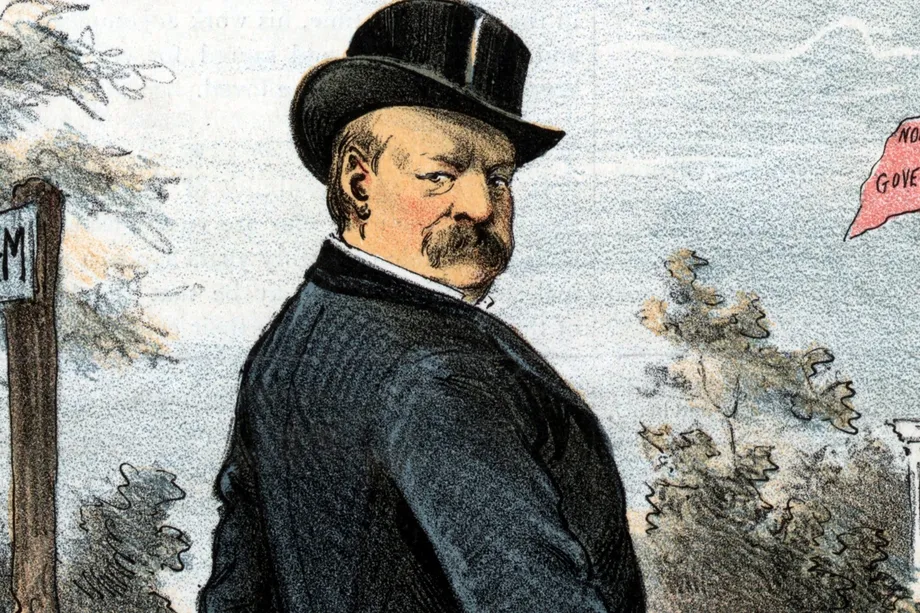
Hello, and welcome back to another edition of Lace ‘Em Up’s Presidential Election series today we will be going over the Election of 1884, the GOP have been in the White House for more than twenty years and the Democrats are looking to finally take it back with a crime-busting New York Governor leading the charge…Can they get it done? Let’s find out.
Chester Arthur’s Presidency

Following the assassination and eventual death of President James A. Garfield in 1881, Vice President Chester Allen Arthur became the 21st President of the United States and many stalwarts aka folks who got important jobs via special favours saw Arthur’s ascension as a golden opportunity to continue the corrupt politics that had occurred under former President Ulysses S. Grant.
However, Arthur decided to turn his back on the stalwarts and instead signed into law the Pendleton Civil Service Act which basically meant that political jobs should be given to those who earned them by way of a person’s merit or skills and not because of any special favours.
Arthur’s time in office would also see him reducing taxes, making the U.S. Navy stronger than it was before and making the act or practice of Polygamy a crime in the United States. Unfortunately, Arthur’s health was declining due to his bout with Bright’s Disease and he questioned if he could make it another term but decided to make the effort to run for the Republican Party’s nomination in 1884.
James G. Blaine

In addition to President Arthur, a few other names were considered for the GOP nomination like Robert Todd Lincoln, the Secretary of War and famous son of President Abraham Lincoln and famed Civil War General, William Tecumseh Sherman but both strongly declined.
Two names that did run for the nomination were George Edmunds, a Senator from Vermont and James G. Blaine, the former Speaker of the House, Secretary of State and Senator from Maine who had previously run for the GOP nomination in 1876 and 1880 but lost.
As the old saying goes “Third Times the Charm” and James G. Blaine got his party’s nomination for president with John Logan, a Senator from Illinois and a General in the American Civil War as his running mate.
Grover Cleveland

The Democrats have been unlucky when it comes to presidential elections for the last few years probably a result of seceding from the Union during the Civil War or the madness that was the Election of 1876, but when you consider that the last Democrats to be the President was Andrew Johnson back in 1865 and he wasn’t even elected to office, the party is hoping to turn things around.
The Democrats nominated Grover Cleveland, who much like Samuel Tilden in 1876 was the Governor of New York and a ‘Bourbon Democrat’…No, they weren’t liberals with serious alcohol addiction, they were Democrats who believed in similar policies to that of Thomas Jefferson like a limited government and high tariffs, although the bourbon part of the name was used as a way to say these types of Democrats were old-fashioned.
Cleveland’s running mate was Thomas Hendricks the now former Governor of Indiana who won electoral votes in 1872 and he was the running mate to Tilden back in 1876.
Third-Party Candidates

While there were a lot of third parties who ran in this election, only three really stood out…First was the Prohibition Party, a party whose main issue was to stop the consummation and disruption of alcohol and they chose John St. John, a former Governor of Kansas with William Daniel, a little-known politician from Maryland as his running mate.
Next was the Greenback Party which got around 3% of the popular vote in the previous election and is now hoping to continue this momentum by nominating the former Governor of Massachusetts and Civil War General, Benjamin Butler with former Confederate General, Absolom West as his running mate.
Finally, there was the Equal Rights Party, a party that pushed for the rights of women to vote and hold positions of power in politics; They nominated Belva Ann Lockwood who was a lawyer and former teacher from Washington with a woman named Marietta Stow as her running mate…even though Lockwood and the Equal Rights Party would be pulling in around .04% of the popular vote, her participation in this election is memorable for her being the first woman to appear on the ballots for general election.
The Mulligan Letters

During the election, it’s revealed that James Blaine despite being a reformer whose looking to clean up the corruption, doesn’t have such a clean image as a number of letters discovered by someone named James Mulligan reveals that Blaine has been using his positions of power for special favors to many businesses.
In one of those letters, it describes how Blaine was paid a whole lot of money by the Little Rock and Fort Smith Railroad company for land grants with another letter simply ending with the words “Burn These Letters”.
Once news regarding what would be called “The Mulligan Letters” goes out to the public, many detractors are chanting “Burn These Letters” to Blaine with one person even claiming that the Senator had “prostituted his high office for personal gain.” So, it looks like an easy sweep for the Democrats once this scandal hits, but they’ll soon discover their own candidate has a checkered past of his own.
Ma Ma, Where’s My Pa!

While Blaine deals with the fallout of the Mulligan Letters, it’s brought to light two weeks after winning his party’s nomination that the crimefighting former Sheriff and Mayor turned Governor of New York had a nine-year-old illegitimate child with a 38-year-old woman named Maria Crofts Halpin.
According to the Buffalo Evening Telegraph, a nine-year-old baby boy named Oscar was revealed to be the son of Grover despite the child being born out of wedlock. Once news of the scandal emerged, Cleveland admitted to the affair and said it occurred with a loose woman when he was single during his time as a lawyer and that his been secretly financing the boy because it was the right thing to do… However, Halpin’s story is much different.
As told by Maria to the Chicago Tribune on October 31st 1884, she claimed that she was a store clerk in Buffalo New York when she encounter Cleveland who went on to rape her following a dinner date which eventually led to the birth of the illegitimate child. To make things even worse, Maria also mentions that Grover would ruin her image if she went public and when she refused to let go of the whole thing, Cleveland had her committed to an insane asylum whilst using his connections to cover up the scandal.
This led to Cleveland’s squeaky-clean image taking a hit and many people at his rallies yelling the phrase “Ma Ma, Where’s My Pa”. So, you have both of the major candidates suffering a scandal that’s tarnishing their well-respected reputations, but things go from bad to worse when the October Surprise comes into play.
The October Surprise

While the Mulligan Letters have damaged much of Blaine’s reputation in the eyes of many reform-minded Republicans called ‘Mugwumps’, his biggest problem appears during a GOP meeting in the lead-up to the election.
At this meeting, a conservative Reverend named Samuel Burchard arrives makes a speech where he decries the Democratic Party as nothing more but the party of “Rum, Romanism and Rebellion” and while the rebellion part refers to the Democrat’s part in the Civil War, it’s the Rum and Romanism parts in that phrase that’s going to be the most problematic.
The rum part refers to the Irish-Americans and the word Romanism is seen as a despairing remark to Roman Catholics once people within the Democratic Party discover that this was said in a meeting that James Blaine was at, they try to connect Blaine and the Republicans of being anti-Irish and anti-Catholic which is going to hurt there chances in some major states…But will it be enough to help Grover Cleveland?
The Election of 1884: The Results

For this election, you needed 201 or more electoral votes to win and by the end of it all, Grover Cleveland became the 22nd President of the United States with 219 electoral votes compared to James Blaine who received 182 electoral votes making Blaine the first Republican since 1856 to lose a Presidential election.
While Cleveland may have won just enough electoral votes to win the presidency, he barely wins the popular vote with Cleveland getting 48.9% to Blaine’s 48.3% with 57,579 votes separating the two making this the closest victory in the popular vote since 1880.
The votes in several states were close with the most notably being Grover’s home state of New York which he won with about 1,000 more votes than his rival; If Blaine had won New York, he would’ve won with 218 electoral votes making him the new president, but many historians believe it’s the revelation of the Mulligan Letters, the speech regarding Romanism and the Prohibition Party’s involvement that ultimately costs Blaine and the Republicans the win.
Speaking of the Prohibition Party, they ran hard against Blaine and the Republicans following the speech that included the word ‘rum’ and for their efforts, John St. John came in third place with 1.5% of the popular vote and Benjamin Butler of the Greenback Party came in fourth with 1.3%.
Cleveland’s win not only makes him the first Democrat elected to the White House since James Buchanan, but it also ends a more than 20-year losing streak for the Democrats with six consecutive election losses under their belt from 1861-1885.
If you like this kind of content, be sure to leave your thoughts down below in the comment section and be sure to follow Lace ‘Em Up on X @laceemupoffice you can follow me also on X @hakeemfullerton and I’ll see you in the next article.
Leave a Reply