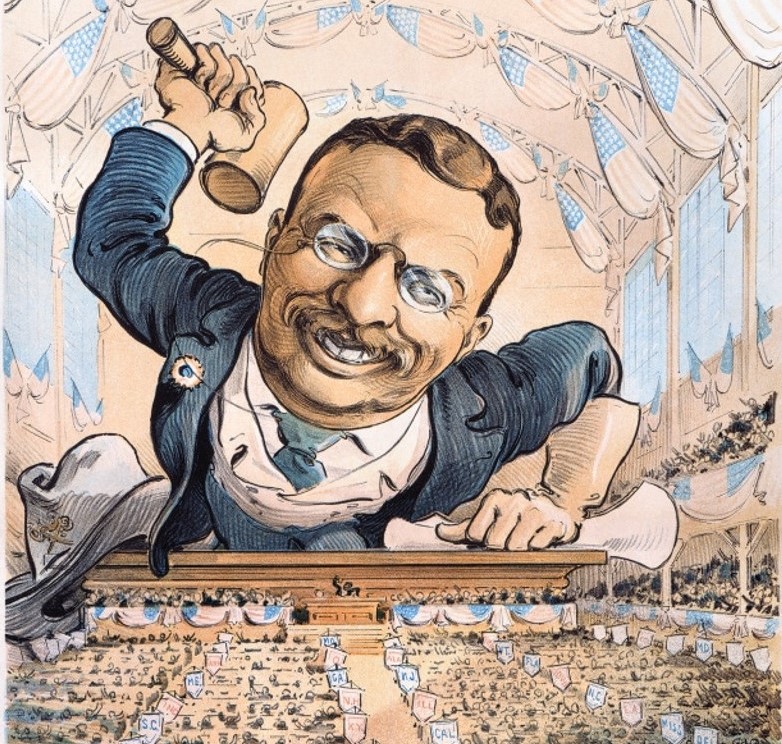
Hello, and welcome back to another edition of Lace ‘Em Up’s Presidential Election series for today we will be discussing the Election of 1904. Theodore Roosevelt has been transforming the United States since taking office and now his got a presidential election to win in 1904.
Theodore Roosevelt & Progressive Reforms

As you may recall from the election of 1900, President William McKinley had died as a result of an assassination attempt just months after winning a second term, thus leading to his Vice President taking over in his place.
That VP was Theodore Roosevelt and he was going make a significant amount of change that would not only eclipse his predecessors legacy, but also begin a period of progressive reforms that would dominate much of the early 20th century in America.
Theses reforms saw Roosevelt regulating corperate monopolies, supporting conservation/creating national parks and helped in the construction of the Panama Canal which became crucial in America’s overseas trading. Roosevelt also continued McKinley’s efforts of foreign intervention when he expanded the size of the Navy and playing a major role in ending the Russo-Japanese War, which made him the first president to win a Nobel Peace Prize.
All this and more made turned the former VP into a very popular figure and it couldn’t have come at a better time as the election of 1904 was just around the corner with Roosevelt looking to win an official term as president.

Some Republicans however weren’t a big fan of Roosevelt due to his progressive policies and this led to the pro-business wing of the GOP trying to convince McKinley’s campaign manager and Senator of Ohio, Mark Hanna to run against the incumbent.
Sadly, Hanna died from complications of Typhoid Fever in February of 1904 and with no serious contender left to challenge the President, Roosevelt got the nomination with Charles Fairbanks, a pro-business Senator from Indiana as his running mate in order to pacify the conservatives within the Republican Party.
Roosevelt decided to run on his record as Commander-in-Chief while also supporting ideas like protective tariffs and supporting both the Gold Standard international trade.
Alton B. Parker for President

After two back-to-back losses for the Presidency, William Jennings Bryan decided not to run in 1904. This gave many pro-business/conservative Democrats the chance to nominate one of their own in the upcoming election. Some tried to get former President, Grover Cleveland to run but he refused which was probably for the best as his health wasn’t in the best shape anyway and he would end up dying just a few years later.
This led to a bunch of other names running for the party’s nomination but none of them could really generate enough excitement until William Randolph Hearst, the famous newspaper magnate and U.S. Representative from New York attempted to go for the nomination with hopes that the Progressive Wing of the party would support him, but Bryan (still leader of the Democrats Progressive Wing) refused to endorse him.
Eventually Alton Brooks Parker, the Chief Judge of the New York Court of Appeals decided to go for the party’s nomination; While Parker didn’t actively seek the nomination, he did throw his name into the mix as he was very popular with many conservatives including those in the Republican Party and with the help of many Bourbon Democrats, Alton Parker soon became the Democratic Party’s nominee for president.
Parker’s running mate was a former West Virginia Senator and businessman named Henry Davis, who at the age of 80 years old was the oldest man to ever be nominated for a major party’s Presidential ticket.
Third-Party Candidates

The election of 1904 saw a number of third party candidates make a run for the Presidency with at least four of them standing out.
First was Eugene Victor Debs who was a former union leader from Indiana who became known for his participation in the Pullman Strike of 1894 and had actually ran for Presidency back in 1900, but got less than 1% of the popular vote. Since then his support had increased and with the newly created Socialist Party of America, Debs once again ran for the presidency, this time with Benjamin ‘Ben’ Hanford who was a writer and would be politician from Ohio as his running mate.
Next up was Silas Swallow, a Methodist preacher from Pennsylvania who ran with the Prohibition Party with a businessman from Texas named George Washington Carroll as his running mate.
Thomas E. Watson, a former Senator and U.S. Representative from Georgia and longtime member of the Populist Party decided to run for president despite the popularity of the party falling into decline over last several years.
Finally, there was George Edwin Taylor who was a journalist and social activist from Little Rock, Arkansas who ran with the National Negro Liberty Party; Though the party got less votes than all the other candidates (as many states refuse to put a black man on the ballot), Taylor does stand out for being the first African American to actually run for President in American history.
The Campaigns

Most Americans found the 1904 election pretty unmarkable as Parker and Roosevelt agreed on many issues and both were the polar opposites of what their party stood for at the time. Roosevelt being a reform-minded progressive in a party that was mostly pro-business and Parker being a pro-business conservative in a party that was quickly becoming more progressive.
While Roosevelt’s whole perception of being a trust buster is still remembered today, he actually played well with the business communities as many of them including the insurance companies heavily funded his campaign in exchange for Roosevelt regulating monopiles rather than destroying them.
Parker was also funded by some in the business community, but he had a few things working against him such as a lack of support from the progressives, a speech he gave criticizing Roosevelt’s foreign policy backfired while on the campaign trail and his personality was seen as boring and uninteresting compared to the charismatic Roosevelt.
This combined with Roosevelt’s popularity as well as the reforms he enacted during his time in office and with the economy doing pretty well at the time, made things look like an easy win for Roosevelt.
Election of 1904: The Results

Since the 1900 election, the electoral votes needed to win this time around 239 or more votes as you can see from the map above Theodore Roosevelt easily won.
Roosevelt received 336 electoral votes and 56.4% of the popular vote while Alton B. Parker received 140 electoral votes and 37.6% of the popular vote; Parker’s popular vote percentage was the worse showing for the Democrats in a presidential election in which the two major candidates got electoral votes since Lewis Cass in the election of 1848.
Eugene V. Debs came in third place with no electoral votes but got 3% of the popular vote while in fourth place Silas Swallow got 1.9% and in fifth place Thomas Watson with 0.8%.
Teddy Roosevelt won 32 states to Parker’s 13, and he even won the state of Missouri which hadn’t voted for the Republicans since 1868; Roosevelt’s margin of victory in the popular vote was 18.8% which was the highest in American history since the uncontested election of James Monroe in 1820.
If you like this kind of content, be sure to leave your thoughts down below in the comment section and be sure to follow Lace ‘Em Up on X @laceemupoffice you can follow me also on X @hakeemfullerton and I’ll see you in the next article.
Leave a Reply