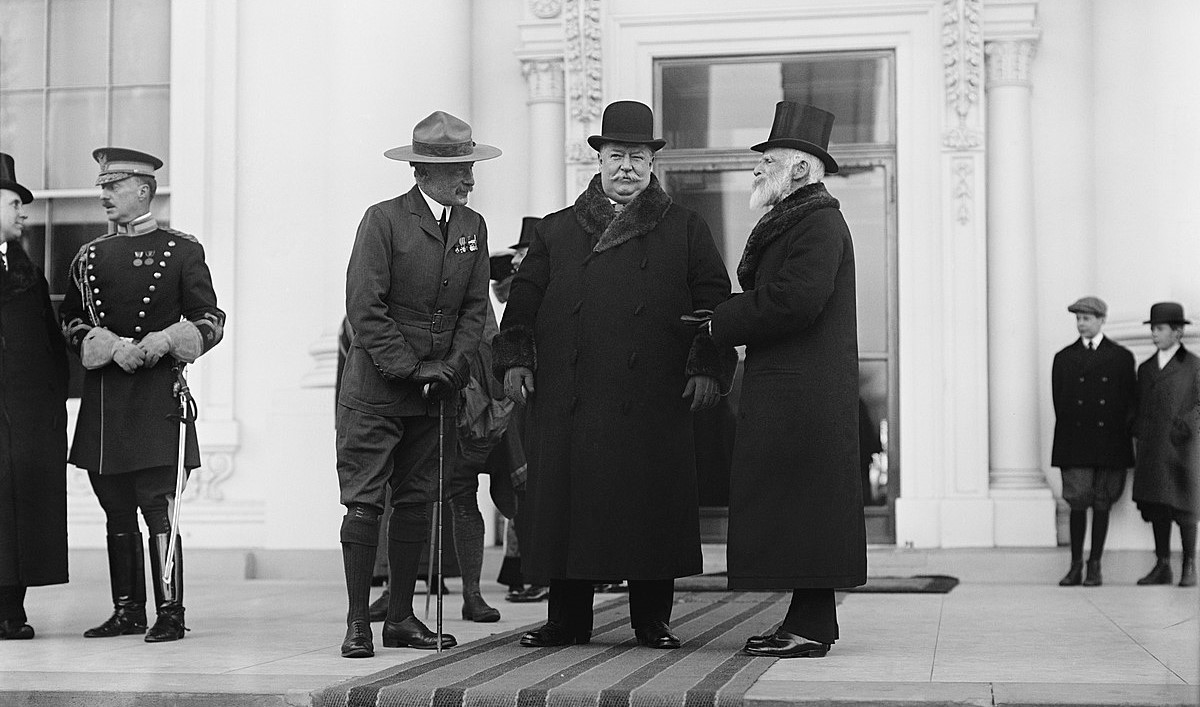
Hello, and welcome back to another edition of Lace ‘Em Up’s Presidential Election series as we will be going over the Election of 1908; Theodore Roosevelt is looking to have his best friend take his place as Commander-in-Chief and to do that he’ll have to take on a progressive titan from years gone who is looking for one more shot at the Presidency.
Roosevelt’s Second Term

After winning an official term as president in the 1904 election, Theodore Roosevelt continued his progressive policies such as passing the Hepburn Act of 1906 which regulated railroad rates that were way too high and the Pure and Food Drug Act & the Meat Inspection Act which prevented foods with dangerous chemicals and misleading labels from being shipped out or sold without proper examination.
Being one of the key figures in America’s ‘Progressive Era’ in the early 20th century, some hoped that Roosevelt would remain in office, but he decided not to seek another term as president and instead wanted someone else to continue on with his legacy as the nation’s most progressive leader.
This gave way to the first-ever Presidential Preference Primary which saw delegates from different states being selected while also giving them the opportunity to nominate a candidate.
Speaking of which, there were a number of Republicans like Charles Evans Hughes the Governor of New York and future Supreme Court Justice, Philander C. Knox the Attorney General of Pennsylvania, Robert La Follette Sr. the Senator from Wisconsin, Joseph B. Foraker Senator from Ohio and even Roosevelt’s Vice President, Charles Fairbanks made a go for the nomination…Yet despite their attempts, there was only one person in the President’s mind who could continue his work.
William Howard Taft: Roosevelt’s Handpick Successor

Roosevelt tried to persuade his best friend and protégé, William Howard Taft who was a former lawyer and the Secretary of War to succeed him as president, even though Taft was hesitant to the idea of running for president as his aspersions were more centred around becoming a judge for the Supreme Court, still, he decided to follow along with his buddies plans and agreed.
Because Roosevelt was so beloved by many including some in the Republican Party, his endorsement of Taft ensured the former Ohio lawyer that he would become the nominee which of course he was.

Although many delegates wanted Roosevelt to run again as evidenced by the nearly 50-minute ovation his name got when he was brought up at the Republican National Convention (or RNC for short), everyone went with the President’s picked successor
Taft’s running mate was James Schoolcraft Sherman, the U.S. Representative from New York and associated with both the progressive and conservative wings of the Republican Party; Sherman won the nomination on the first ballot and many hoped that his involvement on the ticket would satisfy progressives and keep New York soildily red for the GOP.
The Return of William Jennings Bryan

When it announced that Roosevelt wasn’t running for re-election in 1908, many within the Democratic Party saw William Jennings Bryan as a more worthy successor to the president’s legacy as he was promoting many of the progressive policies that Roosevelt would later enact upon taking office.
Even though Bryan had a history of losing presidential elections, he still had control over the party and with the support of the Democrats’ progressive wing, it was no surprise that William Jennings Bryan became the party’s nominee for a third time.

Bryan’s running mate this time around was John Kern, a former State Senator from Indiana would the nomination for VP after many of the other names decided to withdraw or declined to run,
Some newspapers lambasted the Democrats’ Presidential ticket with the New York Times claiming that
“A man twice defeated for the Presidency was at the head of it, and a man twice defeated for the Governor of his state was at the tail of it”.
Regardless, Bryan believes that he’ll be able to swipe the floor with Roosevelt’s protégé and finally due what he was unable to do in his previous bids and that’s becoming the new President of the United States.
The Socialist Party

Following their success in terms of the popular vote in 1904, the Socialist Party returned and were looking to see if they could win some electoral votes this time as many people believed the Socialists would end up getting a million votes come election day.
Eugene Debs was once again nominated as the party’s candidate for president with Ben Hanford again as his running mate. Similar to Bryan, this was Debs’ third time running for president but after dispelling rumors of his health being in bad shape he easily won his party’s nomination.
As a matter of fact, both of the major parties thought that the Socialists would end up stealing away support from voters who weren’t too sure about Taft as a candidate but were also not satisfied with Bryan as the Democrats’ nominee again.
Campaign Strategies

Much like his previous two attempts for president, Williams Jennings Bryan did a lot of travelling and gave numerous speeches in order to fire up the base and rally support, but the issue of silver currency by 1908 was considered antiquated, so he switched up his focus to issues like campaign finance reform, pushing for the direct election of senators and the creation of an income tax whilst promoting the party slogan “Shall the People Rule?”
As Roosevelt’s chosen successor, Taft was running on the same ideas that his friend supported and this ended up driving most of the progressive voters away from Bryan it probably didn’t help that an expose came out revealing that both Taft and Bryan had ties to people who accepted brides and Bryan never cut off his connections while Taft actually did.
However things went from bad to worse for Bryan and the Democrats as Taft’s campaign slogan in this election was “Vote for Taft now, you can vote for Bryan anytime.” which was a not-so-subtle dig at Bryan’s two failed runs for the presidency in 1896 and 1900.
For his part, Eugene Debs went on an extensive whistlestop tour where he travelled around the country making brief appearances, however, this also made him very exhausted and this led to Debs’ brother delivering speeches in his place while the Socialist candidate attempted to regain his energy.
Election of 1908: The Results

Since the last election, the new state of Oklahoma was now able to vote in this election thereby increasing the number of electoral votes needed to win by 242 or more.
When election day rolled around, William Howard Taft easily won thus becoming the 27th President in U.S. History; Taft won with 321 electoral votes and 51.6% of the popular while also carrying 29 states in the process.
William Jennings Bryan, in his third and final bid for the presidency came in second place once more with 162 electoral votes, which was better than his previous performance in 1900, but he also suffered his worst showing in the popular vote ever in this election, receiving 43.1% and carrying only 17 states.
Eugene Debs and the Socialist Party came in third place again but were unable to get the million votes they had anticipated, instead, they walked away with 2.8% of the popular vote.
With this victory, the Republican Party won their fourth consecutive presidential election which hadn’t happened since the election of James A. Garfield in 1880.
If you like this kind of content, be sure to leave your thoughts down below in the comment section and be sure to follow Lace ‘Em Up on X @laceemupoffice you can follow me also on X @hakeemfullerton and I’ll see you in the next article.
Leave a Reply