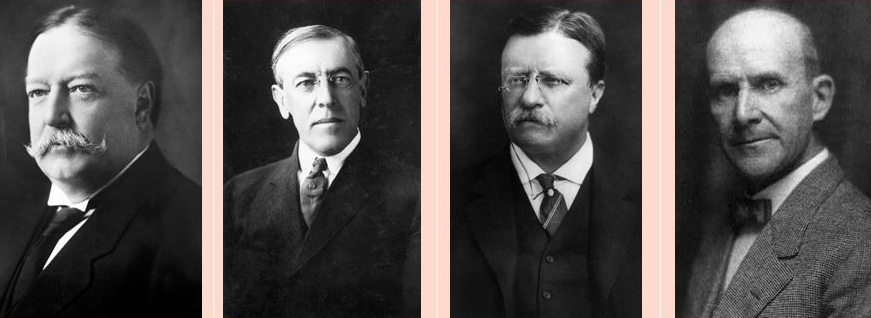
Hello, and welcome back to another edition of Lace ‘Em Up’s Presidential Election series today we will be going over the Election of 1912. It’s the first four way battle for the presidency since 1860 and while a civil war may not be the end result, it’s still one of America’s most chaotic elections.
William Howard Taft’s Presidency

After winning the election of 1908 mainly due to being Roosevelt’s handpicked successor, the newly elected President Taft was now in a position he never wanted to begin with, but attempted to make the best out of it when it came foreign and domestic policies.
Let’s start with the foreign policies…President Taft made a staunch effort to not use military force in order to spread American influence aboard, but instead he wished to use arbitration in order to settle problems and he also adopted the policy of ‘Dollar Diplomacy’ which expanded the United State’s financial reach to other countries like Latin America and East Asia.
Taft also looked to reduce as much European influence as possible and even proposed using the ‘Monroe Doctrine’ if necessary, while at the same time intervening in foreign matters involving Mexico and Nicaragua.
On the Domestic side of things, Taft refused to sign a bill that was supported by many labor unions, he removed all African American’s who held office jobs in the South, he appointed six different people to the Supreme Court, he allowed New Mexico and Arizona to officially become states and he busted up 70 out of 99 corrupt trusts which was more than Roosevelt’s who had broken up 40 during his time in office…So some bad and some good.
Taft also went on to fire most of the people Roosevelt had appointed and this led to so much conflict within the cabinet that the Chief Forrester of the Roosevelt/Taft Administration began voicing his disapproval before getting fired and further escalating the division’s occurring within both the president’s cabinet, but also the Republican Party as well with the pro-business/conservative side of the GOP taking over whilst the progressive wing of the party was being pushed out of the picture.
The Return of Theodore Roosevelt

Following his decision to not run for another term in 1908, Theodore Roosevelt decides to spend some time with his family and even went hunting for animals in Africa, however during his travels Roosevelt hears what William Howard Taft is doing as president and this angers him not only because Taft is firing people TR appointed to government jobs, but Taft’s trusting busting/investigations on businesses like Standard Oil, and U.S. Steel enraged the former president as Roosevelt either approved or supported these companies.
After making his grand return to New York City and getting a massive ovation in 1910, Roosevelt is convinced by many progressives to break his promise to not run for another term and decides to go for the Republicans party’s nomination for president which by this point has increased the number of GOP primaries as a way to reduce the influence many of the party bosses previously had.
Despite the fact that Roosevelt performed better than his protégé and got more delegates, it becomes all in vain as the GOP party bosses controlled the convention and they decided to go against the will of the people and give the nomination to William Howard Taft which causes a large amount of chaos within the convention over claims of fraudulent votes being given to the incumbent president by many of the Roosevelt supporters.
Ultimately, Roosevelt and his supporters stormed out of the convention to create a new political party, leaving William Howard Taft to accept the nomination with Vice President James Sherman again as his running mate making Sherman the first sitting VP to be re-nominated since John C. Calhoun back in 1828.
The Bull Moose Party aka The Progressive Party

Weeks after the GOP Convention, Roosevelt along with his supporters and fellow progressives like famed suffragist, Jane Adaams, Gifford Pinchot and former Indiana Senator, Albert Beveridge held their own convention in August of 1912 to create a brand new political party known as ‘The Progressive Party’ also referred to as ‘The Bull Moose Party’ after Roosevelt allegedly responded to a journalist with the remark “I’m feeling as strong as a bull moose.”

Roosevelt was welcomed with thunderous applause by the corwd and he was unanimously nominated with Hiram Johnson, the Convention Party Chairman and Governor of California as his running mate.
Roosevelt proposed a platform that called for a “New Nationalism” which focused on ideas like: Minimum Wage and Suffrage for Women, an 8 Hour Work Day, Direct Election of U.S. Senators, an Inheritance Tax, Campaign Finance Reform, National Health Service, Worker’s Compensation, and a Social Security System among countless other things.
Because most third parties lack the money and influence of the Democrats and Republicans, Roosevelt and his supporters are traveling everywhere they can to get their progressive agenda out to the masses.
Woodrow Wilson

With all this drama going on between Taft/Roosevelt and their respective party wings, the Democrats were feeling mighty confident about their chances going into this election. Even still, winning the election would be a big challenge for the Democrats since the last time they won the White House was all the way back in 1892, so the party needed to find someone who could get them back into power and the two leading names running for the nomination was Champ Clark, the then Speaker of the House from Missouri and Woodrow Wilson, the Governor of New Jersey.
Wilson, in addition to being the former president of Princeton University was also a reform minded progressive who wasn’t sure if he’d get the nomination after turning his back on the corrupt party bosses upon winning the Governorship in New Jersey.
Things changed however when the corrupt politicians of New York’s Tammany Hall endorsed Champ Clark leading to the Democrats progressive figurehead, William Jennings Bryan to throw his support behind Wilson.

After 46 ballots and some animosity within the convention, Wilson wins the nomination with his running mate being Thomas Marshall, the Governor of Indiana and one of a few politicians who swung their votes over to Wilson.
Upon being named the nominee, Wilson’s platform in this election was called “The New Freedom” which were progressive reforms on tariffs, business and banking while also looking to abolish monopiles that have been enriching themselves under the presidencies of Theodore Roosevelt and William Howard Taft.
Eugene Debs & The Socialist Party

As drama continues on within the GOP and the Democrats still unsure of their road to victory, another political party also gets involved in the form of The Socialist Party who again runs Eugene Debs as their nominee for president as Debs was a household name by this point thanks to his efforts as a Union Leader and his previous attempts at the presidency.
Throughout Taft’s time in office, the American people or most specficially labors and factory workers were angry over many of Taft’s pro-business policies and this leads to many believing that the Socialist Party will see a major rise in popularity going into the election of 1912.
In fact, one of the other key reasons behind Roosevelt’s decision to run for a third term was to prevent the Socialists from achieving success in the next general election as a growing number of members within the party had won a number of elections in the state and local level.
Debs, for the fourth time in a row agrees to run as the party’s nominee for president, but this time with a new running mate in Emil Seidel, who is the Mayor of Milwaukee Wisconsin and the first Socialist Mayor of a major U.S. city in American History.
Bad Blood & Political Campaigning

Most of the election as you can imagine focused mainly on the rivalry between Taft and Roosevelt with the former friends constantly badmouthing each other in the press with Roosevelt calling Taft a traitor to the progressive cause while Taft would call Roosevelt’s policy ideas radical if not fringing on the verge socialism.
Despite the mudslinging by Taft and Roosevelt, it doesn’t take long for the incumbent president to realize that he stands little chance against his predecessor or the progressive platforms of Roosevelt and Wilson.
Not only that, but Taft’s vice president would die less than a week before the election thus leading to William Howard Taft hastily picking the president of Columbia University, Nicolas Butler as his new running mate while also making James S. Sherman the last VP to die while still being in office.
Eugene Debs and the Socialists meanwhile are traveling the country whilst making speeches that criticize the two major parties for being in the back pocket of the wealthy elites. Debs also mentions the former president and refers to him as an ‘Unprincipled Demagogue’ and while also calling the current president “Injection Bill Taft”.
Sadly, the Socialist Party have didn’t have the money to compete with the other candidate and the fact that many of Roosevelt’s ideas appealed to some socialist voters, left many Debs supporters to shifting away in favor of the progressives.
Shots Fired!

With Taft having no chance of winning and the Socialists being relegated to the background, the election soon became a two way race between Roosevelt and Wilson with both men using speeches and in Wilson’s case motion pictures to help sway the people to their side but while both men ran on progressives platforms, Wilson had the benefit of being the nominee for one of the established political parties thus making it easier for him to reach the masses.
Roosevelt on the other hand was running as a third party candidate and like much third parties before and after they don’t have much of the influence or financial backing of the Democrats or Republican to campaign for long periods of time.
Even still, Roosevelt is using his popularity and dynamic skills as a speaker to draw huge crowds even at the expense of his own health, however its Roosvelt’s health that becomes a big issue on October 14th during a trip in Wisconsin.

As the former president prepares to leave his hotel to deliver a speech at the Wisconsin Auditorium now called Miller High Life Theatre, a former saloonkeeper named John Schrank pulls out a .38 caliber revolver and shoots Roosevelt straight in the chest which should’ve killed him.
Miraculously, Roosevelt didn’t die as his steel eyeglass case and his 50-page folded speech in his breast pocket saved his life; Roosevelt then tells the crowd not to hurt his assailant before allowing the police to drag him into custody.
So what was Schrank’s reasoning for shooting Roosevelt in the first place?…Well as the story goes: the deranged saloonkeeper had a dream in which former President William McKinley rose from his coffin and pointed to a figure dressed like a monk and that monk was none other than Theodore Roosevelt. Upon learning this, Schrank was “instructed” by the dead president to avenge his death and needless to say Schrank was declared insane and was sent to a mental hospital where he lived until passing away in September of 1943.
Despite having the bullet lodged in chest, Roosvelt went on to give that speech which lasted an insane 84-90 minutes with the former president even showing off his speech and his bloody shirt which both having bullet holes still inside, leaving the crowd in absolute shock that the former president was shot.
While this moment of badassery has become the stuff of legend in the life and times of Theodore Roosevelt, it also led to the campaigns coming to a temporary halt in order for the former president to heal up from the assassination attempt.
After all of this madness and stunning turn of events, it’s time to look at the results with but as you’ll soon see from the electoral map the winner of this election didn’t have any problem scooping up votes.
Election of 1912: The Results

Since previously election, the electoral votes needed to win this race were 266 or more thanks to the inclusion of the new states of New Mexico and Arizona, but as you can see from the electoral map above the election wasn’t close as Woodrow Wilson became the 28th President in U.S. History.
Wilson won with an mind blowing 435 electoral votes, but got disappointint 41.8% of the popular vote which is the lowest percentage of the popular vote for Democrat elected for the first time since James Buchanan in the election of 1856.
Theodore Roosevelt came in second place…that’s right…in second place with 88 electoral votes (which were the states of Washington, California, South Dakota, Minnesota, Michigan and Pennsylvania) and 27.4% of the popular vote; Making this the first and to date only time a third party candidate in American History ever came in second place in a presidential election.
William Howard Taft came in third with an 8 electoral votes (which was two states: Utah and Vermont) and 23.2% of the popular vote. It marked the first time a Republican President failed to win re-election since Benjamin Harrison in 1892. In fact, Taft suffered the worse loss of any U.S. president attempting to be re-elected and it wouldn’t be for another 20 plus years until a candidate loss with the exact amount of electoral votes.
Eugene V. Debs came in fourth place with no electoral votes but pulled in an impressive 6% of the popular vote which was the best performance for the Socialist Party in a presidential election.
Many historians believe that the split within the Republican Party is what led to Woodrow Wilson’s landslide victory in the electoral college with many rightfully believing that had Roosevelt won the GOP nomination for president againt then Roosevelt would’ve become president again and the first one to serve a third term as commander-in-chief, albeit with a third nonconsecutive term.
If you like this kind of content, be sure to leave your thoughts down below in the comment section and be sure to follow Lace ‘Em Up on X @laceemupoffice you can follow me also on X @hakeemfullerton and I’ll see you in the next article.
Leave a Reply