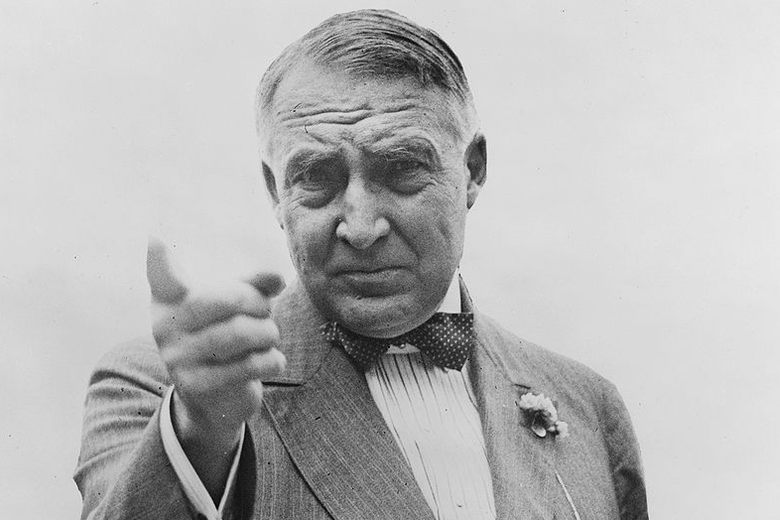
Hello, and welcome back to another edition of Lace ‘Em Up’s Presidential Election series. Today we will be going over the Election of 1920 as two dark horse candidates are looking to lead the country into a new era following the madness of the last several years.
World War One & Peace Treaties

After narrowly winning re-election, Woodrow Wilson promised to keep America out of World War One as the nation believed in neutrality when it came to getting involved, however Wilson went back on his campaign promise in 1917 when he get the United States involved in World War One.
The decision to get the U.S. into the war was already in the minds of many especially after the sinking of the RMS Lusitania, but minds were certainly changed upon the discovery of the Zimmermann Telegram. This letter basically saw the Germans asking Mexico to form an alliance in case America got involved in the great war and in return, Germany would help Mexico reclaim the states of Arizona, New Mexico and Texas as those states were previously owned by Mexico until the U.S. decided to declare war to get those territories in the mid 1840’s.
When British forces intercepted the telegram, they informed the United States about this and Woodrow Wilson asking Congress to declare war against Germany in April of 1917, and just like that America was now involved in what many referred to as “The War to End All Wars”.
World War One came to its conclusion on November 11th, 1918 and President Wilson along with other foreign leaders had to figure out a way to make certain that another conflict like this never happens again. This led to Wilson proposing ‘The League Of Nations’ a group that would be designed to settle international conflicts with the hope of creating world peace.
A compromise to settle all of these bitter feelings after the war known as “The Treaty of Versailles” and Wilson spent the rest of his term in office trying to convince the United States to join the league and sign the treaty, unfortunately many in Congress weren’t interested in joining the league or signing the Treaty of Versailles resulting in Wilson going on an extensive tour across the country to get the people interested, but the trip was a diaster for Wilson’s health and soon afterwards his dream for a League of Nations came to an end.
America’s Post War Chaos

From the Spanish Flu Pandemic which saw around 50-100 million people dead to a growing fear of anarchism in the U.S. which led to the First Red Scare to factory workers going on strike and the economy not doing so good…It’s safe to say that 1919-1920 was a very insane time period in American history.
Perhaps the best example of this madness would have to be the amount of race riots that were going on in the country; Now President Wilson already had a poor record on race relations for much of his time in office, but the year of 1919 really took things to the next level.
‘The Red Summer of 1919’ was a period in which racist white men committed acts of unspeakable violence towards African Americans with many black people either being set on fire, drowned, shot at, beaten to death with stones or being lynched from trees.
Property damages and arson occurred as a lot of misinformation regarding black men committing unwanted acts against white women led to around 60 race riots in just this one year alone all while the police at the time refused to help and those African Americans who managed to escape such brutality left their family’s and homes…never to return again.

Meanwhile, President Wilson’s relentless attempts to get the League of Nations passed led to tremendous stress on his body leading to him suffering from a horrible stroke which paralyzed half of his body and made him unable to much of anything.
His wife, Edith took care of her husband while also dealing with some of the responsibilities of the president unbeknownst to many at the time which is why many refer to Edith Wilson as “America’s First Female President”.
Overall, it’s been a very chaotic couple of years since the end of World War One and as the new year of 1920 gets closer, so does that year’s presidential election and it becomes obivous that the country is looking for some change.
Democratic Party’s Presidential Candidates

It wasn’t clear for either the Democrats or Republicans as to whom would be their nominee for president as many Americans were looking to move passed the progressive policies that occurred under the previous presidents and many of the names who ran had slim chances to win.
While at least 14-16 people ran or were considered for the Democratic Party’s nomination only six names really stood:
- William Gibbs McAdoo- Secretary of the Treasury & Wilson’s Son-in-Law
- A. Mitchell Palmer- The U.S. Attorney General
- Al Smith- Governor of New York
- John Davis- U.S. Ambassador to the United Kingdom
- James M. Cox- Governor of Ohio
- Edward I. Edwards- Governor of New Jersey
In spite of his worsening health, Woodrow Wilson had actually thought about running for a third term as president and hoped that the Democratic Convention would get so out of hand that the party would end up nominating him and he even managed to block William McAdoo’s nomination as he was seen as a favorite early on.

Ultimately after a deadlocked convention and going through 44 ballots, the Democrats chose James M. Cox as their nominee for president on July 6th 1920. The party chose Franklin Delano Roosevelt who was the Assistant Secretary of the Navy from New York as Cox’s running mate.
Roosevelt looked like a solid pick for Vice President not just because of his work as the Secretary of the Navy, but he was also the fifth cousin to former President, Theodore Roosevelt.
Republican Party’s Presidential Candidates

The Republicans at first were looking to make Theodore Roosevelt their nominee once again but Roosevelt would end up dying in his sleep back in January of 1919 from a blood clot at the age of 60 and with no clear successor to Roosevelt, the GOP had to find someone else to get the nomination which was easier said than done.
Charles Evans Hughes, the Supreme Court Justice who narrowly defeated Wilson in 1916 was seen as the guy to get the party’s nomination at first, but following the death of his daughter due to tuberculosis early in the year he decided not to run.
As a result of having no clear front runner, a bunch of names ran for the Republican Party’s nomination:
- Leonard Wood- Major U.S. Army General
- Frank Orren Lowden- Governor of Illinois
- Warren G. Harding- Senator from Ohio
- Hiram Johnson-Senator from California
- Robert La Follette Sr.- Senator from Wisconsin
- Calvin Coolidge- Governor of Massachusetts
The GOP’s convention was also deadlocked when it came time to pick a candidate, so the higher ups of the Republican Party allegedly had a meeting in a smoke-filled room where Harry Daugherty, a political campaign manager convinces many of the party bosses to nominate Warren Harding as a compromise candidate.
Harding’s chances of winning were dashed early on after a poor showing at the primaries, but after much deliberation and many delegates switched their support him by the 10th ballot, Warren Harding won the party’s nomination.

The Republicans were at first looking to nominate Irvine Lenroot who was the progressive Senator from Wisconsin as Harding’s running mate, but many delegates protested this and as a result, Calvin Coolidge was chosen to be the Hardings’ running mate.
Coolidge was not only the Governor of Massachusetts at the time, but also become famous for his handling of the Boston Police Strike in 1919 in which the officers protested for better wages only for Coolidge fire them all and brought in some new officers, so having him on the ticket helped to make the Harding look all the more stronger.
Third Party Candidates

With all of the madness going on in the country at this time, it’s not too surprisingly to find out that some third parties decided to run for president starting off with the Prohibition Party who ran for office despite the fact that prohibition had been passed into law around this time.
Nevertheless the party decided to nominate Aaron Watkins, a Methodist preacher and former school administrator from Ohio as their candidate with David Colvin, a little known politician from New York as his running mate.
Next up was the Farmer-Labor Party, a new political party that focused on issues regarding nationalizing industries like the railroad companies, an end to Wilson’s Espionage and Sedition Act and the creation of a Federal Department of Education; They nominated Parley Christensen, a former lawyer and State Representative from Utah with Max Hayes who was a newspaper editor from Ohio as his running mate.
Finally, we come to the Socialist Party, who nominated Eugene V. Debs for a fifth time as their candidate for president, however Deb’s time as a candidate would be much different this time around as he’ll running for president in prison.
You heard that right…Eugene or Convict Number 9653 as he was known in prison ran for president despite being locked inside a jail cell after voicing his disapproval of American involvement in the war which led to Debs being arrest under the Espionage and Sedition Act.
Debs’ running mate was a Chicago lawyer by the name of Seymour Stedman and their candidacy marked the first time in U.S. history a political party ran a candidate from prison.
The Political Issues

There were a number of issues going into this campaign but the big ones centered around joining the League of Nations, views on prohibition and gathering up support from immigrant and minority voters.
Because the Democratic Party and more specifically Woodrow Wilson got the U.S. involved in the war and supported the British throughout the conflict, left many Irish and German Americans unhappy as Wilson promised to do the opposite in 1916 and he didn’t really have their interest when it came to peace negotiation. This led to many of those immigrants shifting their votes for Harding as does mostly thanks to Woodrow Wilson’s prejudice domestic policies over the past eight years.
This election was also the first one to occur following the ratification of the 19th Amendment which gave females the right to vote, and many women found Warren G. Harding ‘handsome’ by the standards of that time. It also probably helps that Harding himself didn’t take a stance of prohibition but the Republican Party platform supported the idea and this further helped his chances voters especially the women.
Campaign Methods

As the election continue, both candidates used different strategies to fire up the crowd and get their message across with James Cox traveling via train and going on speaking tour while his running mate did the same giving multiple speeches a day.
Cox traveled to 36 states which was both a rarity and impressive for a candidate to do and despite his train having an accident just outside of Arizona, he felt confident of victory, unfortunately he and the Democrats still had one lingering problem around their necks going into the election and that was Woodrow Wilson.
Being painted unfavorably by conservative newspapers of the day, James Cox was but depicted as a carbon copy of Woodrow Wilson and it didn’t help that Cox had similar views to Wilson particularly on Irish Americans who Wilson blamed along with German Americans for the country’s failure for the League of Nations not coming off the ground.

While Harding would eventually deliver speeches during a few tours in Maryland, West Virginia and Pennyslvania, his team decided to conduct Harding’s campaign mainly from his home in Marion, Ohio where’d he gave speeches from his front porch similar to that of former Ohio Republican Presidents: James Garfield, Benjamin Harrison and William McKinley.
In these speeches, Harding was vague with some of his language but focused mainly on the ideas of “America First” and “Return To Normalcy” with the idea being that Harding wished to return the U.S. back the good ole days before the war and the progressive era, where the U.S. were more concerned on matters within our own country rather than those aboard.
With the help of advisors like Harry Doherty and Will Hays, Harding’s campaign team was able to reach the masses more than the Democrats as the campaign was well financed and got the assistance of famous Jazz singer and actor Al Jolson, who helped portrayed Harding as the man the America needs going into the new decade.
Election of 1920: The Results

By time election day emerged, it became clear that Warren G. Harding won in a landslide becoming the 29th President of the United States. He received 404 electoral votes and 60.3% of the popular vote; Harding even won the state of Tennessee which hadn’t voted for the Republicans since 1872.
James M. Cox received only 127 electoral votes and 34.2% of the popular vote; Although Cox would outlived both his running and the two men who made up the GOP’s presidential ticket in 1920, Cox still suffered one of the worse defeat in U.S. Election History.
Eugene V. Debs in his fifth and final run for the presidency finished in third place yet again with 3.4% of the popular vote…a decent enough finish especially for someone locked in a jail cell; Parley Christensen came in fourth place with 1% of the popular vote and Aaron Watkins came in fifth place receiving 0.7% of the popular vote.
Harding’s victory would re-ignite a feel of Republican dominance that was prevalent in the previous years as he became the first sitting U.S. Senator to ever become president and was also inaugurated on March 4th which was his 55th birthday.
This election became the first one since 1820 to see a candidate win the presidency with 60 or more percent of the popular vote, a feat that wouldn’t be achieved by any other candidate until 1936.
If you like this kind of content, be sure to leave your thoughts down below in the comment section and be sure to follow Lace ‘Em Up on X @laceemupoffice you can follow me also on X @hakeemfullerton and I’ll see you in the next article.
Leave a Reply