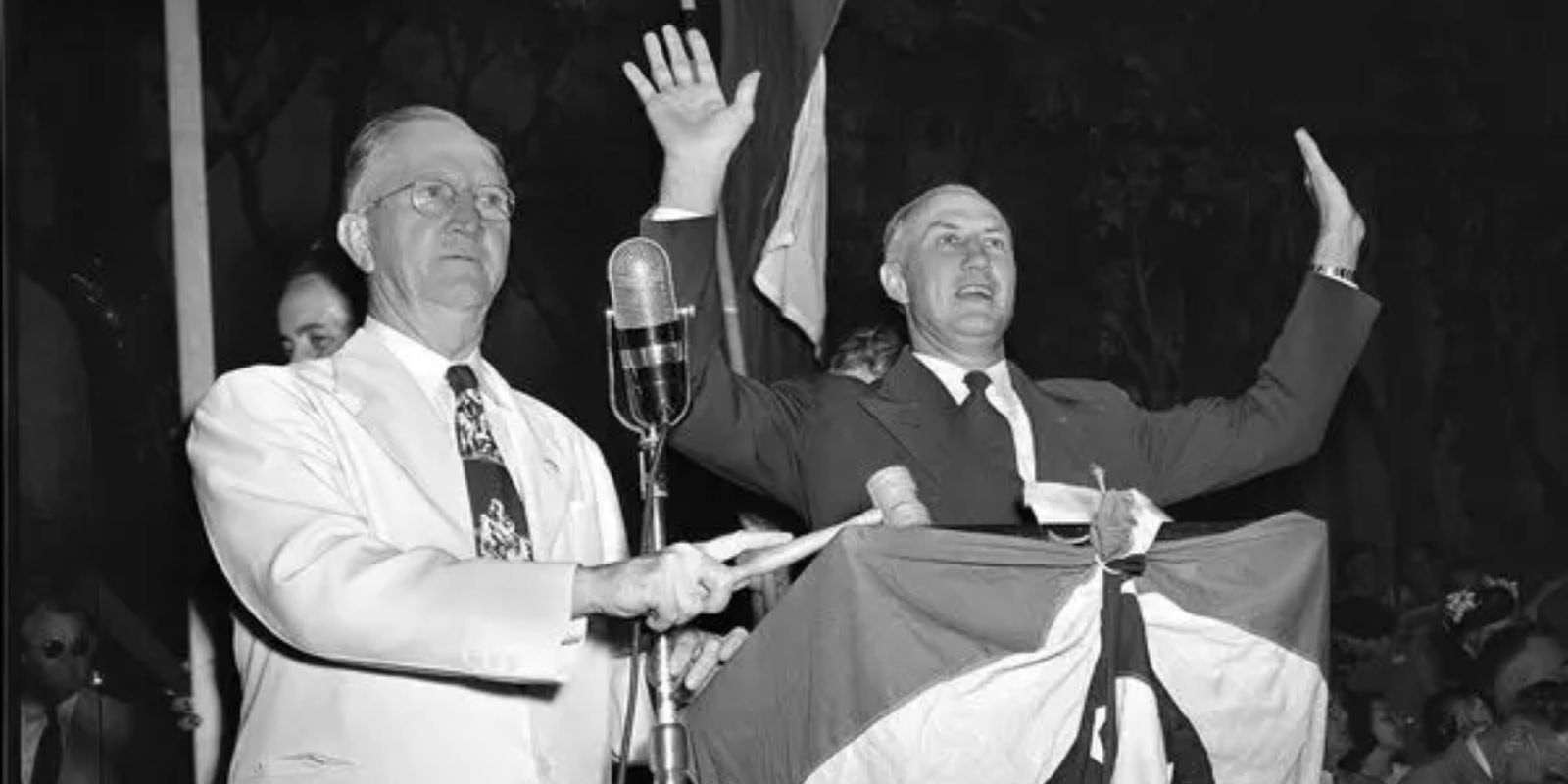
This is “The History of Political Parties”, a series looking in-depth at short-lived, obscure, or now-defunct political organisations from across the United States and the United Kingdom who made their mark on their respective political system.
In this series, we have previously covered the life and times of the Free Soil Party. A century later, a party that was arguably the antithesis to the Free Soil moment came to the fore when the rift between the northern and southern branches of the Democrats became irreconcilable.
In 1948, the States’ Rights Party was established with the breakaway outfit running in the presidential election to prevent civil rights legislation. Though unsuccessful, their legacy may be best encapsulated by proving to be a long-term signal of the Democrats increasingly loose grip on the solid South.
The Democrats and The Solid South

It is importance to note the extent of Democratic dominance in the South after the Civil War.
After 1865, Democrats took control of the South, opposing post-war Reconstruction policies.
The Deep South became more firmly rooted as a one-party, Democratic-controlled region by black voter disenfranchisement methods such as poll taxes, literary tests, and white primaries. These states additionally operated on fear, with the Ku Klux Klan having a grave influence while lynchings provided a particularly terrifying form of public deterrence.
In some states, it was not unusual for the Democrats to get above 90% of the vote.
Even by the Roosevelt years, the South remained ardently Democratic, with the New Deal coalition meaning that by 1936, he won 97% of the vote in Mississippi and 98.6% in South Carolina.
Southern Influence: Remaining or Waning?

Cracks first appeared in the Solid South in 1920 when the unpopularity of former President Woodrow Wilson caused the Democrats to lose both Tennessee and Oklahoma for the first time since Reconstruction. 1928 proved an even greater outlier when Republican Herbert Hoover won the two states Democrats lost eight years earlier, as well as North Carolina, Florida, and Texas. Such was partly due to southern opposition to Democratic nominee Al Smith, who was anathematic to southern voters as both anti-Prohibition and a Catholic.
The South returned firmly back to the Democrats during Roosevelt’s presidency, especially his first two terms. By 1936, every southern senator was a Democrat.
Although the South were happy with some New Deal policies such as agricultural labour policies, large-scale infrastructure projects, and redistributive economic policies, some notable aspects faced southern opposition.
With southerners holding key seniority positions, they could dictate the passage of policy and work as a bloc to sink legislation adversarial to their aims.
Notably, they managed to successfully defeat efforts to introduce a federal anti-lynching law, with the KKK-affiliated Senator Theodore Bilbo commenting “if you succeed in the passage of this bill, you will open the floodgates of hell in the South. Raping, mobbing, lynching, race riots, and crime will be increased a thousandfold.” Another, Senator Allen Ellender of Louisianna, added: “we shall at all cost preserve the white supremacy of America.”
Despite having passed the House and having wide northern support, it was filibustered on the Senate floor by southern lawmakers. Indeed, despite the efforts of seven presidents from 1890-1952 and over 200 bills introduced in Congress, all efforts for an anti-lynching law fell flat in the face of southern opposition.
As The New Yorker’s Louis Menand noted: “Making liberal democracy work in the years of the Depression and the war meant compromising with elected officials who were illiberal and undemocratic. Roosevelt understood the politics, and stayed away from the issue of segregation.”
However, there is evidence the party’s hold was slipping.
At the party’s 1936 convention, the two-thirds rule that had allowed an effective southern veto over presidential nominees, was abolished. Additionally, while many southerners opposed FDR’s 1940 convention-breaking third term, they could not rally a competent rival campaign. In the primaries, Texas’s John Nance Garner won less than 10% of the vote and only the first place in the roll call votes for Texas and Virginia; at the convention, Roosevelt won handily on the first ballot.
In 1944, in opposition to Roosevelt’s centralised power and liberal positions, Texas and Mississippi ran unpledged electors. In Texas, these had a negligible impact on the result other than a footnote protest vote while in Mississippi, Roosevelt stormed the state with 88% of the vote. It was far less effective than previous southern Democrat rebellions pre-Civil War (such as 1832, 1836, and 1860).
The 1948 Democratic Convention

By the 1948 Democratic Convention, southern tensions had already been rising.
As The New Republic newspaper noted: “Southerners have usually been content with headlines proclaiming their ‘revolt’, followed by a brief period of pouting, before they quietly voted the straight ticket again on election day. This time the ‘revolt’ has started months before the convention time, and its leaders are not political unknowns but the Democratic state organisation leaders themselves.”
In 1947, the Truman-commissioned President’s Committee on Civil Rights published its report titled To Secure These Rights. The 178-page report proposed measures such as a permanent civil rights commission, a fair employment body, and banning electorally discriminatory poll taxes. It advocated ending Jim Crow laws, angering southern voices, proclaiming that “our domestic civil rights shortcomings are a serious obstacle” to the US’s image as a global leader.
Truman, wanting to try to dull the challenge posed by third-party candidate, Progressive Henry Wallace, briefly referenced a desire for civil rights legislation in his January State of the Union speech.
Ironically, in 1944 southerns had accepted Truman as Roosevelt’s running mate, replacing the more left-wing Wallace, who they feared would push a civil rights agenda.
Southern Governors produced a resolution condemning the move, joined by 52 Representatives and 21 Senators.
Just 24 hours after the State of the Union speech, 200 marching Klansmen burned a cross outside a Georgia courthouse in a sign of resistance. This coincided with a popularity crash in the south, where voters were nine-to-one opposed to the proposed civil rights programme. One Gallup poll showed Truman’s disapproval ratings jump drastcally from 18% to 57%.
At the convention, a pro-civil rights plank was put forward. Written by Minneapolis Mayor and future Vice President Hubert Humphrey, the northern liberal wanted a more radical platform than the more vague, bland ‘commitments’ the party had previously passed.
In a passionate speech, he declared: “to those who say that we are rushing this issue of civil rights, I say we are a hundred and seventy-two years late..[T]he time has arrived for the Democratic party to get out of the shadow of states’ rights and walk forthrightly into the bright sunshine of human rights.”
The motion passed by 651 to 582.
In protest, 35 southern delegates – 13 from Alabama and the entire 22 Mississippi delegation members – walked out. Those who remained tried in vain to nominate Georgia Senator Richard Russell over Truman, with only North Carolina giving Truman any delegates.
The Southern Dissent Deepens: The Dixiecrat Convention

Creating a breakaway party was doubtlessly a risk. After all, the south had become known as the area of yellow-dog Democrats, referring to the fact voters would overwhelmingly support the Democrats, even if they nominated a yellow dog.
However, it was figured that under a Democratic banner committed to states’ right with hostile racist overtones, the party could capitalise on southern disenchantment with an increasingly centralised, liberal, northern-based Democratic Party.
It should be noted that the hope of the party was never to win the election. Inspired by the book Whither Solid South?, written by Charles Wallace Collins the previous year, its strategy was to obtain the 127 possible electoral college votes from the south. This would be enough to hold up the election, with no candidate having enough to earn a majority. From here, the southerners would hold the balance of power, and force anti-civil rights concessions out of the winning party.
Even if the hated Republicans won, it would be a win for the Dixiecrats, who would have proved the importance of southern support and make the party change course. As supporter and Senator James Eastland put it: “Northern Democrats would still prefer a Southern Democrat to a Republican, and Republicans would prefer a Southern Democrat to a Northern one.”
So it was that just days after the Democratic Convention concluded, southern Democrats hosted an impromptu convention in Birmingham, Alabama. It hosted 6,000 at the Municipal Auditorium where delegates from 13 states convened.
The party was officially titled the States’ Rights Democratic Party but, due to their geographical position in former Confederate states, were nicknamed Dixiecrats, in a term seemingly coin by William Weismer of The Charlotte News.
The rebels disliked the name though it was in fitting with the Confederate character of the convention, which featured a large portrait of General Robert E. Lee. One Alabama newspaper further noted the “ugly carnival scene” that “shouted ‘nigger’ and burned President Truman in effigy.”
The people present at the convention included several high-profile Democrats, including former Alabama Governor Frank Dixon who stated Truman’s “vicious programme” of civil rights would “reduce us to the status of a mongrel, inferior race, mixed in blood, our Anglo-Saxon heritage a mockery.” Also there was fascist and white nationalist Gerald L. K. Smith.
The party’s Declaration of Principles read: “A long chain of abuses and usurpations of power by unfaithful leaders who are alien to the Democratic parties of the states here represented has become intolerable to those who believe in the preservation of constitutional government and individual liberty in America.”
The party platform added that: “We oppose the totalitarian, centralized, bureaucratic government and the police state called for by the platform adopted by the Democratic and Republican conventions.” The Truman-backed Fair Employment Practice Commission (FEPC) was a particular target of Dixiecrat ire, which was labelled both an American arm of the Gestapo secret police and a product of a Kremlin-like communist coup.
As for who the party would nominate, Arkansas Governor Benjamin Laney was the favourite as one of the most outspoken critics against Truman’s proposals. However, Laney withdrew himself from consideration, paving the way for the nomination of South Carolina Governor Strom Thurmond as president and Mississippi Governor Fielding L. Wright.
Thurmond was partly nominated for his otherwise progressive record, including fighting for labour rights like an eight-hour workday, a minimum wage, and healthcare relief. He had also been a keen New Dealer. During his time as Governor, he even received praise from the National Association for the Advancement of Colored People for his effort to prosecute those responsible for the lynching of Willie Earle.
Despite this, his racial rhetoric was far from progressive. He remarked “on the question of social intermingling of the races, our people draw the line.” More famously, at the convention, he uttered the famous soundbite: “all the laws of Washington and all the bayonets of the army cannot force the Negro race into our theaters, our swimming pools, our schools, our churches, our homes and into our churches.”
Campaign, Strategy, and Effect

The States’ Rights Party’s strategy was to influence the Democratic Party at the local level, controlling the state party so that the name on the Democratic Party ticket in November was that of Thurmond-Wright, not Truman-Barkley.
This worked in four states: Louisiana, Mississippi, Alabama, and South Carolina. It would gain ballot access in 13 states.
For their part, the official Democratic Party tried to ignore the southern insurgency. In one rare acknowledgement, it dismissed the southern rebellion as a small clique who were working anti-democratically to deprive southern voters of a real choice. Other than that, Truman campaigned vigorously and defiantly against the Republicans and Thomas Dewey but completely looked past the Democratic bolters.
However, there were signs that Democrats were unnerved by their southern counterparts.
In his iconic biography of Truman, David McCullough notes how Truman campaigned in Texas, which no Democrat had ever felt the need to before. He utilised notable Texas Democrats such as former Speaker of the House Sam Rayburn and former Vice President John Nance Garner to thwart the Dixiecrat threat.
There were rumours of threat to the president’s life, with a train departing ahead of each of Truman’s train journeys to ensure Truman would be unharmed in the case of manipulation.
Notably, Thurmond posed a threat too as he was the first major presidential nominee from the deep south since the Civil War. Republicans had almost no presence in the area so running a candidate there would be impractical while the Democrats would often nominate someone from a key swing state like Ohio or California, assured of southern backing (though a running mate would sometimes be a southerner to pacify these interests).
There were fears also that the States’ Rights Democrats could split the vote in states where Republicans had started to gain momentum, such as Virginia, which they had won by a 25-point margin in 1944.
Truman stood by, and even expanded his desegregation efforts, writing in his memoirs: “I have never traded principles for votes, and I did not intend to start the practice in 1948 regardless of how it might affect the election.”
In some ways, the Dixiecrat campaign backfired as their split allowed Truman to pursue a more supportive line on desegregation, signing Executive Order 9981, which desegregated the US armed forces in perhaps Truman’s greatest civil rights achievement.
The party’s core base was among wealthy southern interests. Bankers, manufacturers, and oil and cotton bosses were among the most fervent supporters. According to Sarah McCulloh Lemmon’s “The Ideology of the Dixiecrat Movement”, Wallace Wright, the 54-year-old owner of The Merchants Co., the largest wholesale grocery firm in Mississippi, was the largest financial backer while the largest single backer was Alabama’s Wallace Malone who donated $3,500.
The party scored a major win in the Georgia gubernatorial primary where the Dixiecrat-sympathising Herman Talmadge won, potentially opening the door to winning Georgia too. He promised to champion white supremacy and segregation, declaring he was fighting “to keep Georgia a white man’s state” against Truman’s “oppressive, communistic, anti-South legislation.”
Front cover features on Time and Newsweek, both national papers, gave greater press coverage to the campaign.
The Election Results

Prior to the ballots being cast, few would have backed the president to emerge victorious. Facing party splintering from the Progressives (who would eventually cost Truman New York) on the left and the conservative Dixiecrats in the south, mixed with disastrously low approval ratings made a loss a seeming inevitability. Gallup polling showed Truman was flagging behind Republican opponent Thomas Dewey by a notable margin.
As for the Dixiecrats, the south did not exactly provide the political establishment with the earthquake some were expecting.
The party won just four states: Louisiana, Mississippi, Alabama, and South Carolina – the only states where the party were listed as the official Democratic Party. These votes, plus the vote of one faithless elector in Tennessee, gave the rebellious rump 39 electoral votes.
Looking at the states they won, the party performed best in Mississippi, where they won 87% of the vote. Dixiecrats won all 82 counties, 45 with over 90% of the vote and 70 with over 80%. He was the first third party to win every county in any state and the first non-Democrat to win the state since 1872.
In Alabama, where they won with 79%, Truman won no recorded votes. The states also featured the safest county in the country as the Dixiecrats won Choctaw County by 98.83% of the vote. The five safest counties were all won by Dixiecrats, all with over 97%, four of which were in Alabama, with one in South Carolina.
In South Carolina, they won with over 70% of the vote. South Carolina had been a firm Democratic state, even giving Al Smith over 90% in 1928 and FDR 87% the year before.
In Louisiana, the Dixiecrats won a plurality, capturing 49% of the vote, meaning Truman became the first Democrat president to not carry the state.
In every state where they ran as a third party, they struggled to win many votes against the official party.
They did place ahead of the Republicans in Georgia, winning 20% of the vote. The state was one Dixiecrats had noted the potential to win if the newly elected Governor Talmadge was able to influence the state party.
In total, they won over one million votes, around 2.4% of the popular vote – about the same as Henry Wallace’s Progressive Party, which won 0 states.
Naturally, 98.8% of their vote came from the south.
Why The Dixiecrats Failed

The Dixiecrats never set out to win the election but even their focused efforts in the South failed as Truman prevailed in Texas, Oklahoma, Arkansas, Tennessee, North Carolina, Georgia and Florida. Despite being a party supposedly created to protect southern interests, they only won 23% of southern votes. So why was this?
Perhaps the main reason is a lack of sufficient support.
Many southerners refused to back the movement, devoid of their ideological stance.
Sid McMath, who was running for Arkansas Govenor, was a notable backer, enthusiastically campaigning for Truman across the south. He would win his primary against allegations of having sold out to “the negro vote” and later win re-election against Dixiecrat bigwig ex-Govenor Laney.
Even those uneasy with Truman such as left-wing Florida Senator Claude Pepper who wanted Truman replaced as the nominee and Alabama Governor Jim Folsom who preferred Henry Wallace both held the official party line, not rebellion against Truman.
Moreover, segregationists Harry Byrd in Virginia and “Boss” Crump of Tennessee, who had large party machines in their respective states, did not wholeheartedly manage to channel support for the Dixiecrats despite hostility to Truman.
Even when fellow segregationist and Thurmond’s second cousin Herman Talmadge won the primary (guaranteeing him election victory), he did not move drastically enough to displace Truman from the ballot in Georgia.
Senator James Eastland of Mississippi was the only major congressman to actively campaign for the States’ Rights Democrats. Senator Richard Russell of Georgia, who southerns nominated at the Democratic convention, did not do so despite his condemnation of the Truman civil rights plank.
Historian Sean J. Savage notes that “For conservatives such as Russell and Senator Harry Byrd of Virginia, the SRD movement appeared to be not only a futile, quixotic campaign but one that would be disruptive of their regular state Democratic organizations.”
Many people supportive to the movement did not support the Dixiecrats for several reasons. Not only could they then try to reform from within, utilising their large influence, but they would also have a lot to lose.
The Atlanta Constitution, writing before the election, noted: “The Southern States…must make up their minds whether they will risk the committee position and the prestige of their Congressmen and Senators by throwing them into a fourth party with consequent loss of position.” It further added that people like Russell, “can do more as a Democrat than as a Dixiecrat.”
Additionally, the nomination of Kentucky-born Alben W. Barkley as Truman’s running mate perhaps dampened the southern defections.
Another factor in the loss was a lack of media coverage. As mentioned, Truman did not rise to the challenge of the Dixiecrat’s in public speeches.
Thurmond added that “since we didn’t have the leaders, we didn’t have the news media, and didn’t have the TV…I couldn’t reach the people.”
This led to a lack of resources, which included little funding. By October, the party had registered just $158,000, according to the book The Dixie Revolt and the End of the Solid South 1932-1968 by Kari Frederickson.
As the University of Tulsa’s Emile B. Ader commented in the article “Why The Dixiecrats Failed”: “the very one-party system that Democratic politicians had so solicitously cultivated for the purpose of maintaining white superiority worked against the bolting Democrats.”
The Dixiecrat Decline

Days after the election, Truman remarked to his White House staff that he didn’t want “any fringes in the Democratic Party”, which included states’ righters, according to the diaries of Assistant Press Secretary Eben A. Ayers.
Many Democrat-affiliated figures, such as Eleanor Roosevelt, wanted the role of Dixiecrats within the party diminished. This call was joined by organisations such as the civil rights organisation NAACP and the CIO-PAC union. The American Federation of Labor’s president William Green was particularly stinging in its criticism calling what he called the Taft-Dixiecrat coalition “the most sordid and disgraceful political alliance in our national history” and “just as repulsive as the Stalin-Hitler pact.”
Truman and his colleagues and advisers warned against a hostile and reactionary approach that would be counter-inituative and cause a wider backlash.
Major Democrat figures such as VP Barkley downplayed their success and influence whereas Democratic National Committee Chair J. Howard McGrath did not invite Dixiecrat state Democrats to the meeting to name his successor, remarking in May 1949 that “a Dixiecrat has no future in the Democratic Party.”
Perhaps the ultimate indicator of Dixiecrat longevity would rest in the 1950 Midterm elections.
In Alabama, pro-reintegration forces defeated the Dixiecrat forces on the Democratic States Executive Committee, winning five of the seven seats in the run-off for the undecided constituencies.
In perhaps the most notable result, former presidential nominee Strom Thurmond lost the Democratic primary for the South Carolina senate to incumbent Olin D. Johnston 54%-46%.
Even wins for the segregationist cause were not necessary empowering to the States’ Rights movement. While the left-wing liberal Claude Pepper lost his seat, his anti-administration opponent called himself a “Truman now Democrat”. Moreover, though one of Truman’s biggest critics, James F. Byrnes became Govenor of South Carolina by an overwhelming margin, he still did so through the official party, shunning the Dixiecrats.
By the time of the 1952 presidential election, most major Dixiecrats folded back into teh major party scene: either returning to the Democrats (members were pledged to loyalty and the segregationist Alabama Senator John Sparkman was the nominee) or supported the Republican Party, who nominated decorated war hero and Texas-born, Kansas-raised Dwight D. Eisenhower.
In 1956, the States’ Rights Party ran again in protest of the civil rights movement, with unpledged electors, the nominee T. Coleman Andrew, and Harry Byrd running but having a negligible impact.
Thurmond: Afterlife

Ironically, although many Democrats, feared not defect to the Dixiecrats in case it would negatively impact their position, it actually propelled the career of Thurmond. Strom would remain in the limelight for the near half a century.
In 1952 and 1956, he would support the Republican candidate Dwight D. Eisenhower. Thurmond had been part of a “Draft Eisenhower” campaign to get the war hero on the ballot in 1948.
The former South Carolina Governor would be elected to the Senate as a Democrat in 1954, winning on an unprecedented write-in campaign.
In 1956, he led the “Massive resistance” southern movement against the ruling in Brown v. Board of Education which ordered school desegregation.
Today, he is probably best-known for his 1957 efforts to block the Civil Rights Act. Speaking for over 24 hours on the Senate floor, he attempted to filibuster the bill but was unsuccessful.
In 1960, he won 15 electoral votes when on the ballot as the running mate of presidential hopeful Harry Byrd, who – like Thurmond in 1948 – ran as an anti-civil rights Democrat. They won the states of Mississippi and Alabama.
In 1964, angered by the revolutionary 1964 Civil Rights Act, Thurmond departed the Democratic Party to officially join the Republicans and campaign for Barry Goldwater. In 1968, he backed Richard Nixon. He would later become associated with Ronald Reagan.
In his last decades, he held positions such as the chair of the Senate Judiciary Committee and President pro tempore. After 49 years in the chamber, he stepped down aged 100.
Legacy

In the short-term, the Dixiecrats had little electoral success but could prove that southern Democratic support was not to be taken for granted.
Indeed, 1948 was the last time the Democrat won the majoirty of white votes in the south as many southern states, including Texas, Oklahoma, and Tennessee went to the Republicans in 1952. Overall, the Republican vote in the South went from 29.7% in 1948 to 49% in 1952. Louisiana fell to the Republicans in 1956.
The Democrats, for their part, nominated segregationist senator John Sparkman in 1952 and southern moderate Estes Kefauver in 1956.
Much as he supported Eisenhower, who then cracked the solid south, he also supported Barry Goldwater, who would win all 1948 Dixiecrats states plus Georgia. As the Political Research Quarterly noted: “Dixiecrats left for the Republican Party, first at the national level and then at the state and local levels, wiping out the Democrats’ conservative faction.”
Additionally, this was not an isolated incident. Thurmond’s anti-civil rights platform in 1948 undoubtedly influenced similar efforts in 1960 by Harry Byrd and 1968 by George Wallace.
Famously, when signing the 1964 Civil Rights Act, President Johnson (ironically one of just three southern Democratic senators to not sign the Southern Declaration against racial integration alongside Albert Gore Sr. and Kefauver) declared that his party had “lost the south for a generation.”
By 1964, Goldwater had taken up the conservative states’ rights, small government, southern preservation outlook of the Dixiecrats. Such reflects the famous musings of Richard Hofstadter that “When a third party’s demands become popular enough, they are appropriated by one or both of the major parties.”
In 1964, the south firmly opposed the Democrats, in 1968, they voted for the pro-segregationists again, and in 1972, the south became Republican territory (with only the exceptions of southern Democratic presidential candidates occasionally winning some states).
As such, the manoeuvrings of Thurmond are perhaps one of the greatest reflections of the party switch in the south. Larry Sabato and Howard Ernst note that: “Many historians believe that the 1948 States’ Rights Democratic Party was the first sign of fission within the Democratic New Deal coalition and the modern Republican Party’s success in the South.”
This trend remains into the 21st century. One can draw a line from Thurmond’s run in 1948 to today to demonstrate how the South, in a matter of decades, went from a solid Democratic stomping ground to firm Republican soil.
GRIFFIN KAYE.
Leave a Reply