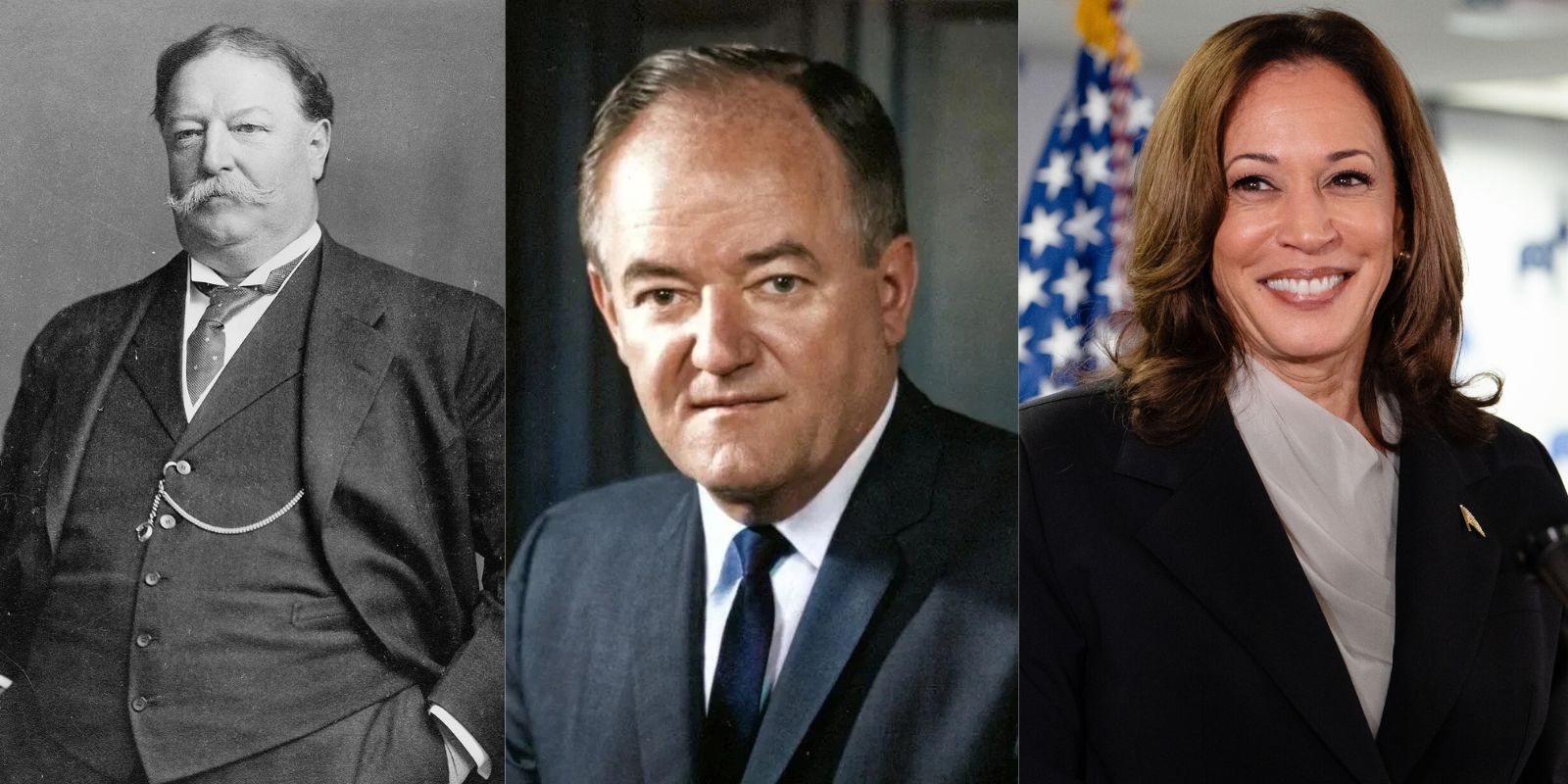
Since 1912, political parties have used, to differing success, the state primary method for parties to nominate their presidential candidate. In the modern system, it would be totally unthinkable for a presidential primary winner to not go on to be nominated by their party. However, as we shall see, it is not uncommon for a non-winner or even someone who never competed in the primaries to be the nominee. Here are 10 cases – five from the Democratic and five from the Republican Party – where the person put forward by their party was not the one who ended up in the presidential race.
1. William Howard Taft (1912)
PRIMARY WINNER: Theodore Roosevelt

1912 marked the first year of the presidential primary and in many ways, the establishment easy made a mockery of the concept.
This primary saw perhaps the most heated contest between successive party leaders as former President and Republican leader Theodore Roosevelt took on the man he had groomed to be his replacement.
At the 1908 nominating convention, Secretary of War Taft won handily, aided by Roosevelt’s endorsement, and would go on to win the subsequent election.
The relationship quickly soured when Roosevelt was not consulted by the new President on Cabinet appointments.
When Roosevelt got back from a much-publicised global expedition, Roosevelt was dismayed at how Taft had diverted the party from his progressive position to a more conservative direction.
This conservative direction, which included firing Roosevelt’s ally and head of the US Forest Service Gifford Pinchot, a tough trust-busting line, and raising tariffs, led in 1910 to the Democrats regaining the House for the first time since 1894 while progressives like Hiram Johnson and Robert La Follette outperformed their more conservative counterparts.
Angered by his former friend’s perversion of his vision, Roosevelt backtracked on previous promises and ran for the Republican nomination.
Roosevelt was such a domineering figure of the party, such a cult of personality, that he was a clear favourite of the party’s rank and file. He would win nine states (including in Taft’s home state of Ohio) to Taft’s two and double Taft’s delegate count.
However, Taft and party bigwigs controlled the convention and were able to wrangle the results, with Taft gaining support from the establishment-controlled state convention delegates. Taft would win 561-107 after this so-called “rotten borough” scheme.
The convention was a scene of chaos as fights broke out between pro-Roosevelt and pro-Taft wings. William Gregorio noted that “concealed barbed wire guarded the rostrum”, perhaps in preparation for the mayhem.
Roosevelt, undeterred, ran as a third-party candidate for the Progressive Party, sometimes called the “Bull Moose” Party. Seemingly feeling he had been robbed, he would instead make a point of tanking Taft’s chances.
Roosevelt’s liberal “New Nationalism” platform included support for women’s suffrage, social insurance schemes, an eight-hour working day, a federal minimum wage, and a national health insurance programme.
In the election, the Democrats won easily as the traditionally Republican vote had been split. Roosvelt, however, had the most successful run of any post-Civil War third party, winning 88 Electoral College Votes, winning in states such as Pennsylvania, Michigan, and California; President Taft was not even on the ballot in the latter. As for Taft, it was the worst performance of an incumbent president ever as he won two states and just eight ECVs.
2. Warren G. Harding (1920)
PRIMARY WINNER: Leonard Wood

The 1920 Republican primary marked a potential turning point for the party. After all, outgoing President Woodrow Wilson was the first two-term Democratic president since the establishment of the Republican Party and one of just two Democrat presidents since the American Civil War. It was also the first since the death of Theodore Roosevelt, the most important individual in the history of the Republican Party, only behind Abraham Lincoln.
The best performer in the primaries was Roosevelt ally and former army major general Leonard Wood, who won eight states and 287 delegates. This was still short of the 471 needed for a majority to secure the nomination. Opponents such as Illinois Governor Frank Lowden and Senator Hiram Johnson also held three-figure delegate counts, with the latter winning a quarter of a million more votes than Wood.
At the convention, though Wood led on early ballots, his inability to clinch the nomination led the convention to instead put forward a compromise candidate. Dark horse candidate Warren Harding won the nomination on the tenth ballot after smoke-filled room negotiations between party bosses. A reliable Republican Party hand, the well-liked Harding was seen as acceptable to the difference wings of the party. As his biographer Andrew Sinclair noted, he was “the available man.”
The Senator had underperformed in the primaries, only barely winning his home state of Ohio and chose not to contest primaries in many other states.
He is the only person on this list to have not won a primary but to have been nominated and later won the election. Partly because he was facing another non-primary winner…
James Cox (1920)
PRIMARY WINNER: A. Mitchell Palmer

Part of the reason Harding was chosen was due to his strength in the key swing state of Ohio where Democrats were poised to nominate Ohio Governor James Cox.
Many primaries returned uncommitted (uninstructed) delegates, who did not back a particular candidate. Although unwilling to put their name forward, two former nominees vied to be nominated: former three-time nominee and Secretary of State William Jennings Bryan and President Woodrow Wilson who desired a convention-busting third term.
Moreover, names as diverse as future Republican President Herbert Hoover, Socialist prisoner Eugene Debs, and Henry Ford all won votes, albeit in minimal numbers.
Of those with a fighting chance, A. Mitchell Palmer performed best, winning two states and over 100 pledged delegates. By the time of the convention however, ex-Treasury Secretary William McAdoo had the most delegates at 266. It should be noted that up until 1936, the Democratic nominee needed two-thirds backing from delegates, rather than a simple majority.
President Wilson opposed McAdoo, hoping a convention deadlock would lead to a third nomination for himself.
On the 12th ballot, Cox overtook McAdoo but was still some 300 votes short of winning the nomination. Cox finally prevailed on the 44th ballot.
As mentioned in the previous entry, Cox struggled, barely winning a third of the popular vote. He even lost ground in the reliably-Democrat Solid South.
Although the convention did not back the primaries winner, it is perhaps more historically important for two reasons. Firstly, it marked the first time a woman from one of the major parties won a vote for president when Laura Clay was nominated and it is also notable for James Cox’s Vice-Presidential running mate: a fresh-faced, 38-year-old Franklin D. Roosevelt.
John Davis (1924)
PRIMARY WINNER: William McAdoo

If McAdoo felt robbed in 1920, it would not get much better the next election cycle.
In 1924, McAdoo was clearly the party members’ favourite for the nomination and one who could adequately bring together the many strands of the Democratic Party. In the primaries, he won nearly 60% of the popular vote of the 12 participating states.
At the convention, he was harmed by his personal relationship with Democrat-supporting oil tycoon Edward Doheny, who had been implicated for bribery in the wake of the Tea Dome scandal. As former nominee William Jennings Bryan commented, such closeness had damaged McAdoo “seriously, if not fatally.” Moreover, with the death of Woodrow Wilson in early 1924, a potentially result-sealing endorsement for McAdoo was lost.
A compelling candidate emerged in the form of New York Governor Al Smith. Smith would appeal to Catholics, who made up 16% of Americans and represented the all-important state of New York. However, nominating Smith over McAdoo would risk alienating crucial southern voters as the Catholic Smith would be anathema to the powerful and McAdoo-supporting Ku Klux Klan.
The contest between McAdoo and Smith dragged on for days and dozens of ballots. Even as the convention increasingly neared the three-figure ballot mark, the eventual winner still stood at only 6% of the necessary delegates for victory.
However, after the longest balloting in convention history, John W. Davis, the former Solicitor-General and UN Ambassador to the UK took the nomination.
Of note, it was the first convention broadcast on radio, which must have been an arduous listen as a record-setting 104 rounds of balloting took place across 12 days.
In the election, Davis lost to incumbent President Calvin Coolidge, barely improving on their 1920 result. The party suffered after popular senator Robert La Follette ran as a third party candidate, running for the populist left-wing Progressive Party.
Herbert Hoover (1932)
PRIMARY WINNER: Joseph France

The 1932 Republican convention was perhaps the glummest on record as delegates flocked to Chicago Stadium to nominate a candidate to inevitably lose the subsequent election.
In 1928, Republican Herbert Hoover convincingly swept to power, even taking Texas, which the Democrats had won by a margin of 54% the previous election.
However, since then, the Wall Street Crash and subsequent Great Depression had caused an almighty turnaround.
A believer in limited government and self-reliance, Hoover’s policies – most notably the Smoot-Hawley Tariff Act which increased tariffs – only worsened the economic downturn.
The impact on the average American was stark. Unemployment peaked at 25%, the average family income had been reduced by 40%, and by the end of Hoover’s presidency, some 60% of Americans were classified as poor by the federal government.
Against this backdrop, Hoover became one of the least popular presidents in US history, as illustrated by losing the support of progressive Republicans and his primary defeats to Joseph I. France. France won seven states in total: North Dakota, Nebraska, Illinois, Pennsylvania, West Virginia, New Jersey, and Oregon – some with over 90% of the vote.
However, France lost his home state of Maryland and few delegates to the convention were chosen in the primaries.
When the convention convened, the first ballot saw Hoover easily win renomination. It was seen as right, and perhaps honourable, to let Hoover contest the next election considering the party was sure to suffer already great damage. Either that, or nobody wanted to challenge the party unity while vying to enter an election race they were bound to lose.
On the first ballot, France won just four delegates to Hoover’s 1,126. He later withdrew hoping to nominate former President Coolidge.
Hoover still faced public hostility: being pelted with eggs and tomatoes at campaign stops while attempts on his life took place with one man removing railroad spikes ahead of Hoover’s train and another was arrested for wielding sticks of dynamite near the president, according to Gene Smith’s The Shattered Dream: Herbert Hoover and The Great Depression.
Elsewhere, opponent Franklin D. Roosevelt extensively campaigned around the country to the sound of “Happy Days Are Here Again” while presenting his “New Deal” programme which brought together a coalition of white southerners, progressives, African-Americans, farmers, labour unions, Jews, Irish-Americans, Italian-Americans, and women.
The election marked one of the great swings in American history as the Democratic Party went from winning eight states and 87 ECVs in 1928 to 42 states and 472 ECVs. Hoover was crushed, winning six states, 59 ECVs, and less than 40% of the vote.
Alf Landon (1936)
PRIMARY WINNER: William Borah

In 1936, the Republicans put forward their ticket of Alf Landon with Frank Knox as his running mate.
Landon, the Governor of Kansas, dislodged the incumbent Democratic Governor of Kansas amid the 1932 blue wave before becoming one of two Republican Governors re-elected in 1934, seeing his vote share jump by nearly 20 points.
He would be nominated despite the fact that in the primaries, William Borah earned double the amount of votes of Landon, winning five states to Landon’s three – winning the states of Wisconsin, Nebraska, West Virginia, Oregon, and Pennsylvania.
A noted progressive for his stance on issues of social justice, he was also an isolationist, leading the charge against ratification of the Treaty of Versailles and opposing joining the League of Nations.
At the convention, the party machinery was in Alf Landon’s corner, not wanting to nominate a known maverick and rebel in Borah.
As such, the Kansas Governor would win decisively on the first ballot, winning 984 delegates to his closest opponent William Borah’s 19.
Borah expected this outcome, remaining in his hotel during the convention, not even bothering to turn on the radio to listen to the results according to the Pittsburgh Press. He, alongside Landon’s eventual running mate Frank Knox, tried to launch an unsuccessful anti-Landon coalition. In the end, Borah would not endorse the Republican’s candidate.
In the election, Landon ran on a platform attacking Roosevelt’s perceived constitution-busting surge in presidential authority while promising reduced taxes, a balanced budget, and a protective tariff. Olympic hero Jesse Owens campaigned for him while an now-infamous Literary Digest poll predicted his victory. His campaign was undermined however as he did little active campaigning and actually supported several New Deal policies.
The eventual results were some of the most lopsided in US history as Landon won just two states: Maine and Vermont. Landon won just 36.5% of the vote, winning eight ECVs to FDR’s 523. The New Deal helped Roosevelt become the first Democrat to win the majority of African-American vote; no Republican has won this demographic back since.
Wendell Wilkie (1940)
PRIMARY WINNER: Thomas Dewey

In 1940, President Roosevelt was nominated for an unprecedented third term.
Facing this potentially constitutionally dangerous threats, the Republican primaries showed the greatest support for Thomas Dewey,
Dewey had come to national attention as the Manhattan special prosecutor where he fought the mafia head-on, prosecuting important figures in the criminal underworld such as Lucky Luciano. In 1938, he came within 1.3% of winning the New York governor race in a heavily Democratically leaning state.
In the primaries, Dewey won nearly 50% of the vote, far outpolling his closest competition, the more conservative Robert A. Taft by a margin of 34%. Dewey won the states of Wisconsin, Illinois, Nebraska, Pennsylvania, and New Jersey.
At the convention, over 300 delegates were still unpledged. Though Dewey won the vote of many states and nearly double that of closest competitor Taft, he was still notably short of the 501-vote majority necessary.
As convention deadlock occurred, one candidate started gaining momentum: Wendel Willkie.
In the primaries, Willkie had made next to no impact, registering just 21,000 votes, equating to 0.66% of the vote. Early on, polls showed just 3% of voters favoured Willkie over his Republican opponents.
Willkie had been a registered Democrat until the previous year, having voted for Roosevelt in 1932. He had since come to oppose the anti-business measures of the New Deal, gaining some recognition for fighting against the federal-owned Tennessee Valley Authority utility company.
A few factors worked in Willkie’s favour, buoying his candidacy.
For example, Willkie had the support of many young activists as the only internationalist with any chance of winning the nomination. As American fears grew after the fall of France to Nazi forces, Willkie’s candidacy seemed more appealing to progressive Republicans.
As Time’s Ray Clapper noted on convention opening day, “Republicans have just one issue in this campaign. It is whether Mr. Roosevelt or a Republican could do a faster, better job of obtaining the industrial production for defense. . . . They must look ahead and offer a man who can make the country believe he would do a better job. … On that point Mr. Willkie is the only man the Republicans have who stands a chance of making an effective case.”
Dewey, who was 38 and not held national office, saw his popularity fall in the face of the war in Europe whereas Willkie jumped into second place. As Alice Roosevelt Longworth, cousin of FDR, noted, the Willkie campaign came “from the grass roots of ten thousand country clubs.”
With the help of young supporters, Willkie jumped from a distant third on the first ballot to second on the third and finally leading by the fourth. He also picked up key backers like Minnesota Governor Harold Stassen, Massachusetts Governor Leverett Saltonstall, and House Minority Leader Joe Martin.
By the sixth, he had clinched the nomination, aided by switches from the delegates of Michigan, Pennsylvania, and New York.
Wendel made history by appearing in-person for his victory speech, a precedent FDR had broken with his 1932 Democratic nomination.
Although he ran a tight campaign, which included visiting 31 states and talking in front of a record-breaking 150,000 listeners, he was hampered by agreeing with many New Deal policies and Roosevelt’s adapting to a more isolationist line.
In the end, Roosevelt may have regressed on his 1932 and 1936 campaigns but he still won conclusively, winning 38 states and 449 ECVs.
Dewey would win the nominations in 1944 and 1948 but emerge unsuccessful on both occasions.
Adlai Stevenson (1952)
PRIMARY WINNER: Estes Kefauver

In 1948, the Democratic Party faced almost certain defeat but were able to put up a vigorous fight and keep ahold of the White House. By 1952, it would take another seismic event to retain the presidency while holding together a crumbling party.
President Truman was the most unpopular president on record, with a Gallup poll in February putting his approval ratings at 22%, the lowest ever registered.
A significant event occurred at the New Hampshire primaries when Truman, running for a third term, was defeated by challenger Estes Kefauver in what Robert Dallek has described as “a sobering reminder of [Truman’s] diminished electoral appeal.” He dropped out within weeks.
Kefauver would sweep most states that held primaries, winning 12 states and nearly two-thirds of the popular vote.
Though many Democrats clearly supported the Tennessee Senator, he did not have the support of party bosses who disliked his anti-corruption efforts which had exposed links between organised crime and top Democrats.
The problem was that outside of Truman, the Democrats had no adequate replacement to nationally lead the party. VP Barkley was too old and Kefauver’s main primary opponent Senator Richard Russell’s racial views freaked out many northern liberals.
Instead, Democrats convened around Adlai Stevenson II, the Governor of Illinois and grandson of Adlai Stevenson, the former Vice President under Grover Cleveland. He was eloquent, intelligent, and competent but, perhaps most importantly, a moderate who was acceptable to the many branches of the Democratic coalition.
At the convention, Kefauver won on the first ballot but remained short of the necessary majority. Wanting to prevent a Kefauver victory, Truman supported Stevenson, encouraging his first endorsement, New York Governor W. Averell Harriman, to drop out and back the Illinois native.
It would be the last time to date that a nominating convention went beyond a single ballot.
Stevenson would lose to Eisenhower in the election, winning just nine states, primarily in the deep south, even losing his home state of Illinois by nearly 10 percentage points, winning just four of the 102 counties.
After nominating southern segregationist John Sparkman in 1952, during his 1956 run, Stevenson nominated Kefauver as his running mate.
Hubert Humphrey (1968)
PRIMARY WINNER: Eugene McCarthy

If the Democratic Party was divided in 1952, then it was in a state of seeming disrepair in 1968. Few political campaigns can quite boast the chaos of the 1968 Democratic primaries and subsequent convention, which included a president dropping out, an assassination, and rioting between pro- and anti-war forces.
After his second inauguration in 1965 following his landslide re-election, Lyndon B. Johnson had an approval rating of 70%. By 1968, Johnson’s approval ratings had slumped to 36%, with a majority of Americans disapproving of his presidency.
This was due to the Vietnam War, which had done much to undo Johnson’s popular domestic accomplishments. Against this backdrop, Senator Eugene McCarthy ran on an anti-Vietnam War platform.
At the New Hampshire primary, the incumbent Johnson only narrowly scraped to victory above McCarthy, after which Robert Kennedy joined the primary contest.
Weeks later, with the weight of the contest plus the impact of the war on his popularity, a publicised condemnation by Walter Cronkite and deteriorating health, Johnson withdrew from the race.
When Vice President Hubert Humphrey entered the race, he became the favourite of party elites, winning delegates through local party machinery rather than primary contests.
After his victory in the California primary, Kennedy was assassinated, thus making Humphrey’s win inevitable. Though McCarthy won the most votes at 38.7% and carried six states, Humphrey – firmly backed by state party bosses – won with no states and 2% of the popular vote. In fact, before Kennedy’s death, Humphrey sometimes lagged third behind the anti-war candidates.
The most notable aspect of the whole campaign was the 1968 Democratic Convention in Chicago.
10,000 protestors assembled outside the convention hall in protest at the administration’s actions, seeing VP Humphrey as complicit in Johnson’s actions. Chicago Mayor Richard J. Daley had mobilised the National Guard, assembled 20,000 policemen, and told them to not relent in their dishing out of law and order.
As Humphrey won the nomination and a peace plank was rejected at the convention, outside, things turned ugly.
Police used tear gas, mace, and pushed protesters through glass panels in scenes of police violence that were aired around the country. Military Jeeps and barbed wire fences ensured the unrest did not escalate beyond control. As police beat on campaigners outside, inside Senator Abraham Ribicoff took to the platform to criticise Daley for his use of “Gestapo tactics” to suppress dissidents.
As McCarthy delegate Arthur Miller noted: The violence in the hall, let alone on the streets, was the result of this mockery of a vast majority who had so little representation on the floor and on the platform of the great convention, The machine had nailed down the nomination months before. We had not been able even to temper the administration’s Vietnam plank, not in the slightest. The team belonged to the president, and the team owned the Democratic party.”
Others there too criticised the convention’s blood-thirst. Bystander Norman Mailer called it “the bitterest, most violent, the most disorderly, the most painful, and in certain ways the most uncontrolled” convention in decades whereas journalist and broadcaster Dan Rather, who was roughed up by security, added that “there’s never been any convention anywhere near it in terms of the way it convulsed the country.”
In the end, 650 people were arrested and nearly double that number injured.
On a historical level, the chaos of the convention and the undemocratic way in which the winner was declared led to the McGovern-Fraser Commission, which worked to improve the role of primary contests in how delegates were chosen to the party convention.
Kamala Harris (2024)
PRIMARY WINNER: Joe Biden

Although post-1968 reforms have ensured no repeat of that year’s events could occur, 2024 marked another example of a winless Democrat winning the nomination.
In the 2024 Democratic primaries, incumbent President Joe Biden faced little credible opposition, especially since Robert Kennedy dropped out to run as an independent the previous October. Although he became the first sitting president to lose a state when on the ballot when failing to win Samoa and facing a sizable “uncommited” protest vote against Biden’s conduct during the Israel-Gaza War, he still easily floated to victory with 87% of the vote and 3,905 (98.9%) of delegates.
On July 21st however, Biden dropped out.
In June, Biden – already behind Trump in the polls due to his handling of the economy and immigration – put in a disastrous performance during a CNN debate against opponent Donald Trump, where he stumbled, tailed off, and struggled to communicate effectively. Questions over his mental state worsened, including mistakenly introducing Volodymyr Zelenskyy as Vladimir Putin at a NATO summit.
In the following weeks, Democrats both publicly and privately called for Biden to step aside and allow another candidate to stand. 30 senior Democrats called for the president to stand aside, including Senators Sherrod Brown, Peter Welch, and Jon Tester. Large Democrat donor George Clooney published an op-ed calling for a new leader, which was reportedly run past Obama and not objected to by him. Behind the scenes, Biden had conversations with both House Majority Leader Hakeem Jefferies and Senate Majority Leader Chuck Schumer about stepping aside while Nancy Pelosi led efforts to oust him.
Biden supported his Vice President Kamala Harris, as did many other leading Democrats who turned down running.
At the convention, Harris easily won on the first ballot, nominated alongside running mate Minnesota Governor Tim Walz.
However, it was too little too late and in November, the Republican Trump-Vance ticket won, emerging victorious in all seven swing states.
GRIFFIN KAYE.
Leave a Reply