It is the general consensus that US politics is far more outlandish and wild than in the UK. This can be measured at the minute by the number of criminal charges facing sitting elected officials such as former President Donald Trump, Senator Bob Menendez, and Representative George Santos.
Although several high-profile figures have been found guilty of crimes in the US, from former Vice-President Spiro Agnew to Senator Ted Stevens, very few face jail time, with Eugene Debs and Rod Blagojevich notable exceptions.
However, several UK politicians have also been placed behind bars for criminal conduct.
John Stonehouse

Few political scandals are as bizarre as that of John Stonehouse, who famously faked his own death in 1974.
Described by ABC News as a man “touted as a potential prime minister,” John Stonehouse was the last holder of the Paymaster General title, introducing first and second-class stamps during his tenure.
Yet things fell apart after Labour’s shock loss in the 1970 election. In the aftermath, Stonehouse was kicked out of the Shadow Cabinet, losing out on significant earnings and falling into a speculated £800,000 in debt.
Much like the more famous modern case of John Darwin, in a financial hole, he decided to stage a scene of having drowned at sea.
His staged death had similar threads to other famous missing political figures; he disappeared on a beach like missing Australian premier Harold Holt whilst, upon discovery, he was confused with fugitive and allegedly killer Lord Lucan.
Attempting to start up a new life in Australia, he was quickly caught, and arrested on New Year’s Eve.
In a memo to the Foreign Office read by Prime Minister Harold Wilson, he wrote that the decision was empowered by a “mental breakdown.” In his first House of Commons speech since his arrest, he blamed a “parallel personality” for his actions.
Labour were hesitant to expel Stonehouse since he held the balance of power. When he left the party, they were left with a minority government.
During a two month trial at the Old Bailey, Stonehouse defended himself against the 21 charges against him. He was eventually sentenced to seven years in prison for fraud and would serve out three of those years.
Three weeks after sentencing, he resigned from the House of Commons.
In 2010, Whitehall papers revealed that then-prime minister Margaret Thatcher had covered up 1980 revelations that Stonehouse had been a Czech spy. He was spared charges of espionage due to perceived insufficient evidence.
Jonathan Aitken

After John Profumo and John Stonehouse, Conservative Jonathan Aitken became the third and final individual to resign from the Privy Council in the 20th century.
A former Cabinet minister under John Major, The Guardian came forth with misconduct allegations about Aitken, such as a breach of ministerial rules when he allowed aides of the Saudi royal family to pay a hotel bill.
Aitken started a libel case against both The Guardian and Grenada TV in a documentary that featured the claims, pledging to fight “the cancer of bent and twisted journalism.”
In the libel case, he instead that the bill for the Paris Ritz was paid for by his wife. He was willing to have family witnesses back up this story, including getting his 17-year-old daughter to lie under oath.
Yet new evidenced proved he had lied to the High Court, including British Airways flight coupons and budget car hire documents categorically proved that Aitken’s tale had been a fabrication. He rescinded the case.
In 1999, the now-bankrupt ex-MP, having lost his seat in the 1997 Labour landslide, pleaded guilty to both perjury (purposefully making a false statement under oath) and perverting the course of justice.
At sentencing, he was memorably told by Judge Mr Justice Scott Baker: “For nearly four years you wove a web of deceit in which you entangled yourself and from which there was no way out unless you were prepared to come clean and tell the truth. Unfortunately, you were not.”
He would spend seven months in prison at HMP Belmarsh. Writing for The Daily Mail, he described the Dickensian-age prison as having “the worst physical infrastructure of any jail in Britain.”
The same year Aitken was convicted, perjury claims came to light, cutting short his hopes of becoming London Mayor, in which he was backed by John Major and Margaret Thatcher. The former Deputy Chairman of the Conservative Party and best-selling novelist would be convicted in 2001 of perjury and perverting the course of justice after having lied in a 1987 libel case; he would serve two years in prison from 2001-2003. Tory leader William Hague noted that the scandal was “the end of politics” for Archer.
Chris Huhne

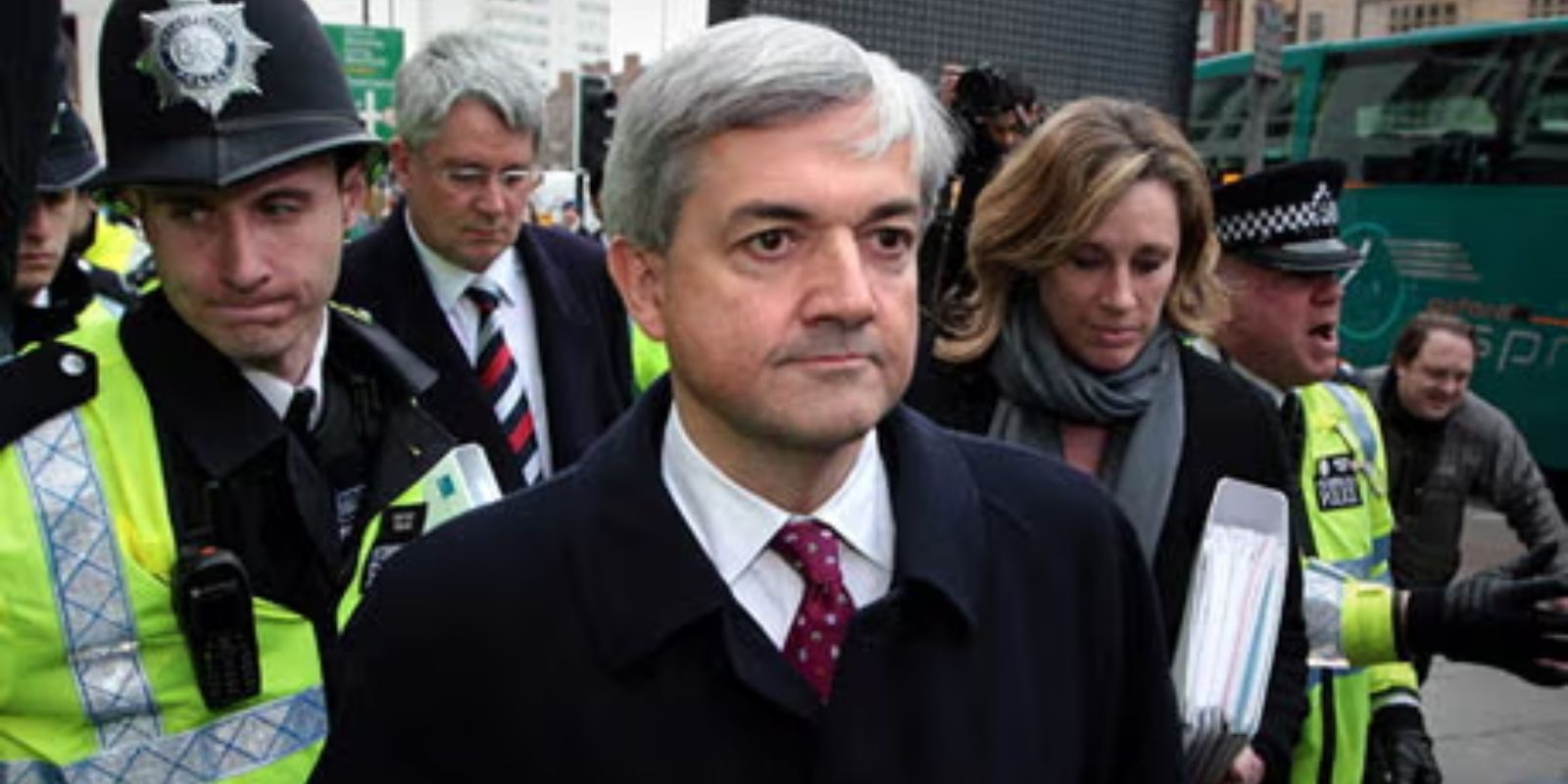
In 2012, Chris Huhne became the first Cabinet minister in British history to resign when facing criminal proceedings.
A high-profile Liberal Democrat MP, in 2011, he split from his wife for over a quarter of a century after an extra-marital affair with an advisor came to light.
In retaliation, ex-wife Vicky Price divulged information to The Daily Telegraph’s Isabell Oakeshott about an incident a decade earlier. To avoid a driving ban, Huhne transferred points on his driving license onto his wife, who claimed she had been driving.
The next year, Director of Public Prosecutions – future Labour leader Sir Keir Starmer – announced the Crown Prosecution Service would press charges.
Both Price and Huhne were charged, with Huhne pleading guilty. The judge remarked: “To the extent that anything good has come out of this whole process, it is that now, finally, you have both been brought to justice for your joint offence. Any element of tragedy is entirely your own fault.”
The former Secretary of State for Energy and Climate Change was sentenced to eight months in prison, of which he served nine weeks before being subject to an electronic tag.
Perhaps worse than the prison sentence was the publicity the case drew to his dysfunctional personal life. He allegedly forced Price into an abortion on one occasion and had an extremely fractured relationship with his 18-year-old son. Son Peter referred to his father as a “piece of shit” several times and replied to a Christmas Day message: “I hate you…fuck off.”
A similar fate befell Labour MP Fiona Onasanya in 2019.
However, she did not resign, instead noting that Jesus “was accused and convicted by the courts of his day, and yet this was not his end but rather the beginning of the next chapter in his story.” Nonetheless, after her imprisonment, a recall election was called and she was soon forcibly booted out of her seat.
Bobby Sands

This may be more like a criminal who became a politician but it is an interesting story nonetheless.
A member of the Provisional IRA, Sands was sentenced to 14 years in prison in the 1970s for possession of a gun near the scene of an IRA bombing.
Since 1976, IRA inmates had been stripped of their special category status. No longer deemed political prisoners, they were now force wear prison uniforms and carry out prison work. Forms of dissent such as dirty protests became popular amongst those who had participated in paramilitary acts.
In 1981, Bobby Sands led a hunger strike that aimed to raise awareness of their plight.
Shortly after, Frank Maguire, MP for Fermanagh and South Tyrone died, opening up a seat.
In the ensuing by-election, Sands stood as the Anti-H-Block candidate, with the Social Democratic and Labour Party standing down in his favour. Sands won the seat, a result that made international news, including the front page of The New York Times.
He would never take the seat, dying less than a month after winning it and 66 days into his hunger strike. Officials from the European Commission of Human Rights and Pope John Paul II tried in vain in the days before to bring an end to the situations. At the time of death, Sands weighed less than 100 pounds and was deaf and blind.
After Sands’s death, his election agent Owen Carron won the seat, running for the same party. He was able to win an increased majority and took over Sands’s mantle of the youngest MP in the Commons.
The Thatcher government’s stubbornness faced foreign opposition, with cities such as Paris and Tehran dedicating street names to Sands.
In Ireland, Sands remains a nationalist hero. As many as 100,000 people are thought to have attended his funeral whilst The Undertones and Manic Street Preachers’s Nick Wire have paid tribute through song.
Many credit Sands’s electoral success with the viability of Sinn Fein as a mainstream political party, especially relevant this year (2024) where the country’s first nationalist First Minister has come to power.
Imran Ahmad Khan

The 2019-present government has been described by Carol Vorderman as the most corrupt in modern history and it is true that it has been rife with scandal.
This session has seen several key by-elections held after events of Tory sleaze – from breaking lobbying rules to deliberately misleading the House to watching porn in the Commons. Several MPs were removed for sexual misconduct, from Chris Pincher to Peter Bone, but few were as disturbing as the lesser-known case of Imran Ahmad Khan.
Not to be confused with the Pakistani former PM who was convicted in 2024, Imran Ahmad Khan was one of several Conservative MPs who won usually Labour-voting constituencies in 2019. Breaking the so-called “Red Wall”, he was the first Tory to win the Wakefield seat in the post-war era.
Not long after election, allegations came to light that he had sexually assaulted a 15-year-old boy over a decade earlier. In the event, he had forced the boy upstairs where he forced him to consume alcohol, before making him watch pornography. He then groped the underage boy.
The young man later remarked that he was left feeling “scared, vulnerable, numb, shocked, and surprised” in the aftermath. The situation had led him to suicidal thoughts.
On April 11th 2022, a verdict was delivered in the two-week trial, convicting him of sexually assaulting a minor. He was consequently expelled from the Tory party and resigned as an MP.
His seat was filled by Labour’s Simon Lightwood, the last MP to swear an oath of allegiance to Queen Elizabeth II before her passing.
Chair of the All-Party Parliamentary Group on LGBTQ+ Rights Crispin Blunt caused controversy when he called the result a “serious miscarriage of justice” that was “reliant on laze tropes about LGBT+ people.” In retaliation, three MPs on the committee – Stewart McDonald, Joanna Cherry, and Chris Bryant – all resigned their positions. Blunt himself was arrested on suspicion of rape in 2023.
Khan was sentenced to 18 months in prison, serving nine. Leaving prison in 2023, he had by then grown out long hair and a beard.
The 2008 grope case may very well not be his only sexual infraction as in 2015, he reportedly approached a 16-year-old. During the interaction, he asked the boy if he had taken double penetration, propositioned him for “the best blowjob of his life”, and suggested they “buy lots of cocaine and a prostitute and fuck all weekend.”
Today, he will forever live with the label of convicted sex offender, pedophile, and felon.
GRIFFIN KAYE.
Leave a Reply