Hello everyone and welcome back to another edition of Lace ‘Em Up’s Presidential Election series and I’ll be going over the election of 1968; Wars, Protests and a general election not too far away…Nope I’m not talking about the present day, but instead one of the most tumultuous elections during the most insane years in modern American history.
A Nation Under Fire

After his landslide victory in the previous election, President Lyndon B. Johnson went on to implement important achievements like Medicare and Medicaid as well as signing into law the Voting Rights Act of 1965 which prevents any racial discrimination when it came to voting.
Despite Johnson’s best efforts, his signing of the Civil Rights Act the year before and the Voting Rights Act was the last straw for many Conservative Democrats who were fed up with the federal government increasing in size under presidents like FDR, Truman, JFK and now LBJ which led to many Southern Democrats shifting their political loyalties to Republican Party.
Things didn’t get much better when on April 4th 1968, Dr. Martin Luther King Jr. was shot and killed at the balcony of his hotel room in Memphis Tennessee leading to the Civil Rights Movement suffering a major blow in momentum and numerous race riots in places like New York, Michigan, Washington DC and the Watts District of Los Angeles California…But if things were becoming turbulent for the Johnson Adminsration on the domestic front then things were getting even worse internationally with the Vietnam War.
America’s Quagmire: The Vietnam War

Despite promising to not sent ground troops into Vietnam during the 1964 election, LBJ would instead commit American into the conflict and report tha things were going well for U.S. forces in the area.
That all changed in the early months of 1968 with the ‘Tet Offensive’ which saw the North Vietnamese sneak attack the South during a ceasefire and it began to show that things weren’t under control as intially claimed. As more American troops were deployed into Vietnam, many of them returned home in caskets or body bags much to the sorrow of their loved ones.
This led to a growing anti-war movement surging in the U.S. with many young people burning their draft cards or activately protesting the war in the streets with chants of “Hey, Hey LBJ…How Many Kids Did You Kill Today?” just outside of the White House, that’s how bad things were getting.

Even with all of the problems breathing down his neck, LBJ believed he could get his party’s nomination or that was until the New Hampshire Primary as Johnson narrowly won in the state which made it clear that Johnson’s grip was slipping which eventually led to New York Senator, Robert F. Kennedy announcing his bid for the presidency.
With battles raging both at home and aboard plus his own health not being in the best of shape due to his smoking habit, President Johnson made an announcement on March 31st 1968 saying that he would not seek or accept re-nomination for a second term which soon opened the door for his Vice President to run in the upcoming election.
Fighting For the Nomination

Following Johnson’s shocking announcement to not run for another term, Vice President Hubert H. Humprhey decided now was the time to run for the Democratic Party’s nomination for president, but he did have some competition along the way.
For starters there was Eugene McCarthy, a junior Senator from Humprhey’s homestate of Minnesota who emerged as the anti-war candidate in the Democrat Party after shocking everyone with his impressive performance in the New Hampshire primary coming in at close second place behind Johnson.
It was thanks to McCarthy’s shock results in the primary that led to RFK announcing his bid for the nomination, yet despite the fact that McCarthy opened the flood gates for other Democrats to run, most people threw their support behind Kennedy due to him being the more well known candidate between the two of them. As the Democratic primaries continued, both Kennedy and McCarthy were running to see who could win the most states going into the convention all while Humprhey was instead focusing his efforts on getting as much delegates to his side.
By the time of the California primary it was going to be a close race for the most delegates in the state which ended up going for Kennedy with him winning with 46% compared to McCarthy in a close second place with 42%.

Tragically, not long after giving a victory speech following his win in the primaries Robert Kennedy was shot by a twenty something year old Palestianian man by the name of Sirhan Sirhan who disagreed with Kennedy’s support for the nation of Israel. Unfortunately Kennedy wouldn’t recover from his shooting as he was declared dead on June 6th 1968 at just the age of 42.
In the wake of RFK’s passing, George McGovern who was the Senator of South Dakota announced that he would be running for the party’s presidential nomination as a candidate that all of the Kennedy supporters could get behind.
Sadly McGovern’s last minute entry into the race didn’t generate the surge of momentum he was hoping for as his involvement only manage to split the support Eugene McCarthy was getting from young voters and anti-war supporters which had the unfortunate consequence of helping Humprhey get the upper hand.
Chaos at the DNC

The 1968 Democratic National Convention took place in the Windy City of Chicago Illinois which also was the location of protest and police brutality taking place right outside of the DNC as many of the Anti-War Protestors and members of the Hippie Movement descended to Chicago to let their voices be heard regarding the Vietnam War and this led to a combination of Chicago policemen and military soldiers begin pummeling and beating up protestors.
By time things got underway, it became clear that McCarthy nor McGovern would be able to get enough of the delegates to their side as the party bosses within the Democratic Party had already set things in place for Vice President Humprhey to emerge as the victor despite him not competing at all in the primaries which only further added to the discord as reports of the violence outside of the DNC leads to people booing and shoving inside the convention.
While madness takes over the DNC and protesters are being hit with fists, night clubs, tear gas and mace while chants of “The Whole World is Watching” echoes throughout the night, Hubert Humphrey walks in on the last day of the convention to accept the Democratic Party’s nomination for president with Edmund Muskie, the Senator from Maine as his running mate.
Although he didn’t know it yet, Hubert Humprhey’s moment of truimph in securing the nomination will come back to haunt him during the election as the events in Chicago and his association with the now disliked Johnson adminisration leaves him and the Democrats politically wounded.
Nixon’s Back!!!!

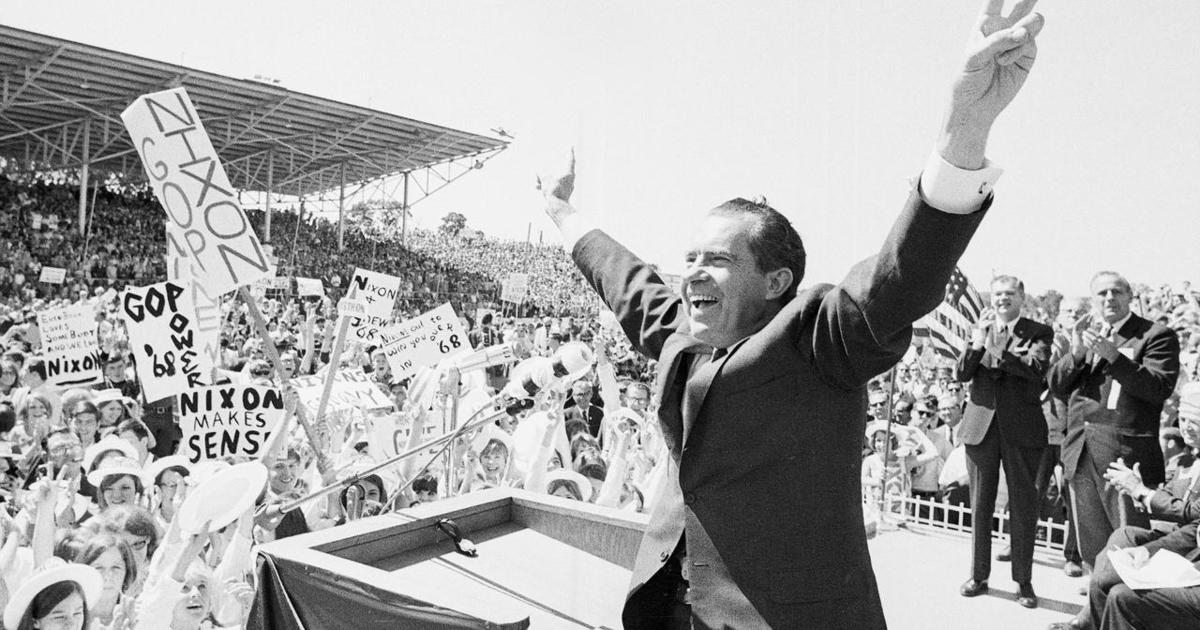
Following his lost to John F. Kennedy in the 1960 election and a failed attempt to win the Governorship in his home state of California in 1962, former Vice President Richard Nixon appeared to be persona non grata in the world of politics but with the Democrats fractured and the Vietnam War raging on, Nixon was given another opportunity to make a comeback and so he decided to run once again for the presidency.
Unlike the 1960 election, Nixon decided to rely on the help of the Conservative wing of the Republican Party which had only increased since the defection of many South Democrats to the GOP.
After defeating the likes of George Romney, Nelson Rockefeller and Ronald Reagan, Nixon once again became the Republican Party’s nominee for President with his running mate this time being Spiro Agnew, the Governor of Maryland.
Now you’d think that this election couldn’t get any more crazier up to this point, but there is one more divisive character in this story that needs to be brought up before we go into the election.
George Wallace Goes Independent

To add more fuel to this flaming shitstorm known as the 1968 presidential election, former Alabama Governor George C. Wallace decides to leave the Democratic Party and run as a third party candidate for the newly developed American Independence Party.
Because of segregationists policies during his governorship, many looked at Wallace’s bid for office as nothing more than a repeat of Strom Thurmond’s presidential run back in 1948 which ended up dividing Southern support for the Democrats with the plan being to win enough states to prevent the two major candidates from getting the amount of electoral votes needed to win (which was 270 or more by 1968).
In doing so, the election would be thrown into the House of Representatives where Wallace would have the power to decide the winner. After announcing his bid for the presidency, Wallace then had to find someone to be his running mate in this election as the story surrounding that is quite interesting.
Wallaxe first considered Happy Chandler, the Comissioner of American Baseball at the time not to mention a former Senator and Governor of Kentucky in the 1930’s and 40’s; Unfortunately, neither man could come to an agreement on when it came to race related issues, so Chandler was out.
Another name that was considered was Harland Sanders…Yup…Colonel Sanders of KFC fame was once thought of as a potential running mate in a presidential election. However the Colonel turned it down as the association would alienate many of his customer and in particular African Americans.
Ultimately, it was Curtis LeMay the former U.S. Chief of Staff for the Air Force and military general who agreed to be Wallace’s running mate in this election.
Campaigns & Polling Numbers

Richard Nixon had a big lead throughout the majority of the electionas he lead in the polls by 45% to Humphrey’s 29% and Wallace’s 18%. This may have something to do with the fact that Nixon claimed to have a “secret plan” to end the Vietnam War and that he was looking to bring back ‘law and order’ to the United States after years of riots and civil unrest.
In addition to this, Nixon is also trying to attract Southern voters with a method infamously known as ‘The Southern Strategy’ which was basicially a politician using coded language that appealed to many in the Deep South who were more far right in their conservative beliefs. With Nixon’s campaign looking like a well oiled machine compared to the others and with the previously mentioned issues within the Democratic Party and Wallace’s third party bid sucking away Southern states from the Democrats…Gave Nixon the belief that he could do what he wasn’t able to do before and that’s win the election.
Meanwhile, Humphrey is running on the ideas of continuing President Johnson’s Great Society programs even expanding them as a means to help African Americans and the poor who were still struggling while also promising to pass more liberal policies.
Unfortunately his campaign continued to be dogged by chants of ‘Stop The War’ and ‘Dump the Hump’ by anti-war protesters who were disatisfied with the Democrats for their refusal in speaking out against the Vietnam War out of fear of angering President Johnson who still had the power to undermine his own VP’s hopes of winning.
Things begin to take a seismic shift for the Humphrey campaign on September 30th when he gives a televised speech in Salt Lake City, Utah where he mentions that if elected president he would end the boming in Vietnam if it meant coming one step closer to peace and if it could help in negotiating an end to the conflict. By October Humphrey’s poll numbers begin to increase as more and more people including the anti-war movement are beginning to give him a chance.
George Wallace for his part has been doing better than most would have expected as the former Alabama Governor was reaching around 21% in the polls between late September and October and he even gained some support in some Northern and Midwestern states thanks to his populist rhetoric that appealed to Union workers and White Americans.
His campaign began to falter however when Curtis LeMay answers a question regarding the use of such weapons in Vietnam during a press conference and his repiles ranged from the incorherent to the dangerous and this made many voters shift their support to Humphrey.
Spoiling the Peace Talks

With Humphrey making a last minute comeback in the polls and President Johnson announcing that all aerial and naval bombings in Vietnam have been halted with a peace treaty between the U.S. and the Vietnamese being discussed, Richard Nixon and his team realize that they need to do something to prevent this election from getting too close as it was in 1960.
So Tricky Dick decides to disrupt the peace negotiations with the help of Henry Kissinger who was President Johnson’s Secretary of State and was also feeding the Nixon team details on how the peace talks were going.
Nixon then instructs a Vietnamese woman and conservative by the name of Anna Chennault to tell the Vietnamese President to refuse all of the peace deals the Johnson Adminsration are making as they could get a much better deal with Nixon as president.
This action by Nixon violated the Logan Act which was to prevent private citizens or politicians from interventing in foreign policy matters regarding the U.S. and other foreign nations…So Nixon’s actions might of saved his chances in the election but it also meant that the war would go on with more and more lives dying as a result.
Election of 1968: The Results

To say that things were chaotic going into election ’68 would be an understatement as no one knew how things would turn out or who would emerge the winner, in fact the voting seemed to be close in the minds of so many Americans that an amendment was proposed to eliminate the electoral college, but it didn’t pass.
When it was all said and done, Richard Nixon won and became America’s 37th President; From an electoral standpoint, Nixon pulled off decisive victory as he carried 32 states for a total of 301 electoral votes while Hubert Humphrey carried 13 states plus DC and received 191 electoral vote.
The popular vote was much closer with Nixon getting 43.4% and Humphrey 42.7%, making this the first election since 1912 in which multiple major candidates failed to win 50% of the popular vote.
George Wallace came in third place carrying five Southern states (Arkansas, Louisiana, Mississppi, Alabama and Georgia) plus he even won a vote in North Carolina to end with 46 electoral votes and 13.5% of the popular vote.
Since this election, Wallace is the last third party candidate win electoral votes in a general election; Not only that but this election would be the last time a politician could announce their candidacy for president without competing in the primaries and it would also be the last time until 21st century in which a non Southern Democrat would win the presidency.
If you like this kind of content, be sure to leave your thoughts down below in the comment section and be sure to follow Lace ‘Em Up on X @laceemupoffice you can follow me also on X @hakeemfullerton and I’ll see you in the next article.
Leave a Reply