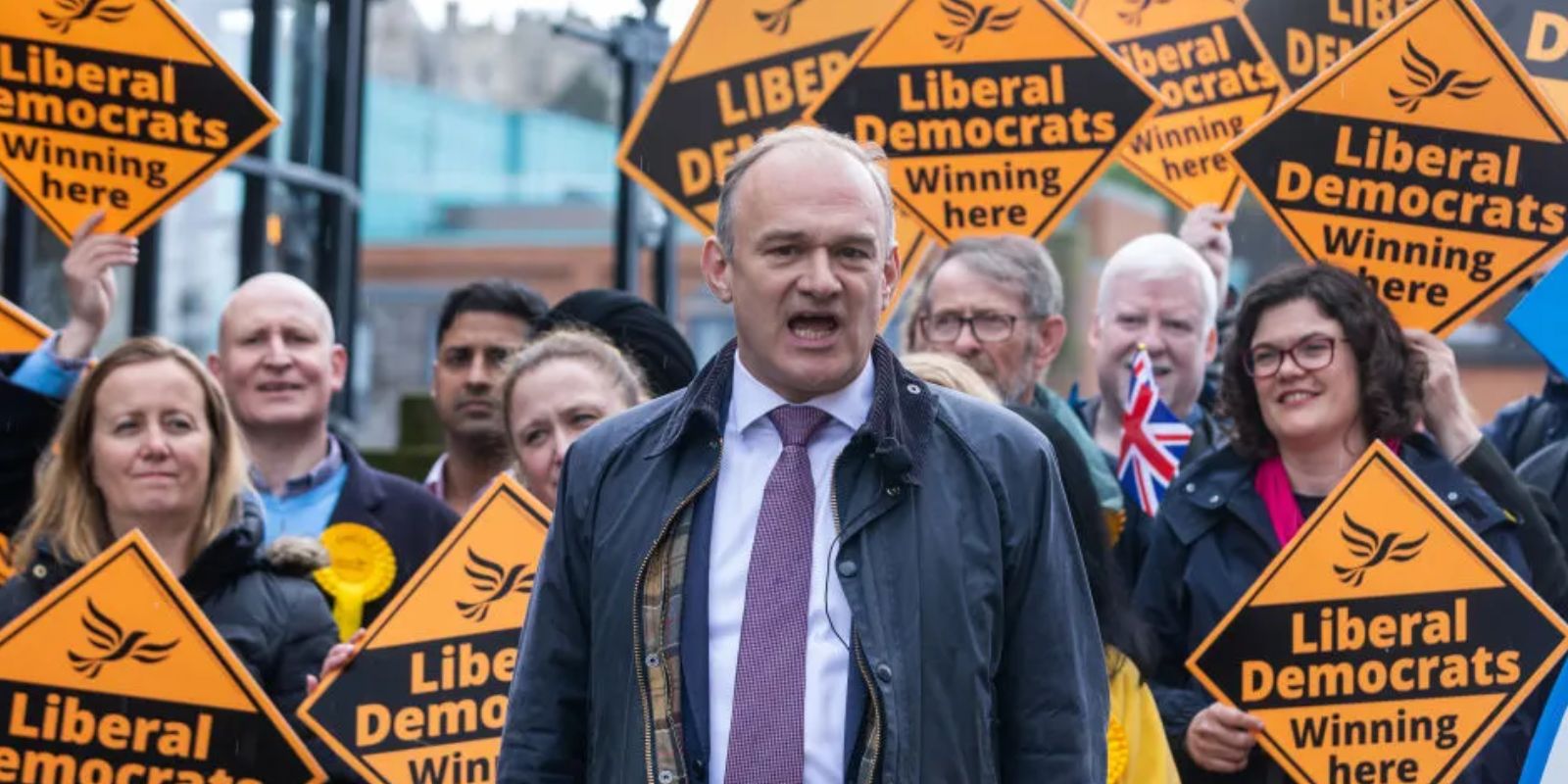
If they are mentioned at all, the Liberal Democrats are usually used as a political punchline, seeing a decline over the last decade despite their high public profile. In order to evaluate the importance of the Lib Dem Party in Britain, it is important to examine factors such as their status as a political alternative, their influence on policy, and electoral performances. The following will determine if the party has a definitive and justified place in the modern-day UK political system.
FOR:
Firstly, the Liberal Democrats can be seen as key to British politics as an alternative from the two main parties.

Lib Dems political stances can be unique to Labour or the Conservatives, advocating policies that are not offered by the larger parties. For example, during the Brexit campaign, the Liberal Democrats were the only of the main parties to conclusively support Remain, outright backing scraping the plan to leave the European Union after the referendums in their 2017 and 2019 manifestos. In the former they wrote:
“Where the Liberal Democrats are fighting every step of the way, Labour is holding Theresa May’s hand as she jumps off the cliff edge of a hard Brexit,”
in response to Labour leader Jeremy Corbyn’s lack of presence in the campaign. This proved to be effective in the 2016 Richmond Park by-election where the Liberal Democrats pulled off an upset victory, campaigning on anti-Brexit sentiment in a constituency that voted 72% Remain. Moreover, in 2023, the Liberal Democrats were the only major UK-wide party to back a ceasefire, which both the Tories and Labour did not. All 15 Lib Dem MPs backed a Scottish National Party (SNP) motion, the party stating the need for an immediate bilateral ceasefire with leader Sir Ed Davey explaining the need to
“get aid in, get the hostages out, and provide space to realise a political solution: Hamas out of Gaza, a two-state solution and a lasting peace.”
The latter can be compared to the current situation with the US Green Party, who are staging themselves in the 2024 presidential election as the anti-genocide party, citing popular support for a ceasefire to end the deadly conflict. The Lib Dems policies being distinct from those of the two biggest parties serves to highlight the importance of a third, unique voice in various political debates.
In a similar vein, the Lib Dems can serve as a protest vote against the two main political parties.
For those disillusioned with the main options, the Lib Dems provide an option for voters to oppose the main political machines for something else. One notable example was in 2005, when the party picked up 62 seats, the most of any third party since 1923. In this election, the party focused on their opposition to the Iraq War, with Kennedy famously talking at the 2003 Hyde Park rally and Lib Dem MPs voting against the motion in the Commons, unlike most Labour and Tory MPs.
One MORI poll found that 33% of Lib Dem voters who defected from the Labour Party cited Iraq as the key factor in their voting switch. By-elections also serve to further indicate this point. In 1993, the Lib Dems took the Tory seat in Christchurch in the biggest swing against a government on record, winning nearly over 60% of the vote to the Conservatives 31.4% and Labour’s 2.7%. Meanwhile, in 1983, the Liberal Party scored the largest swing ever achieved in a by-election when Simon Hughes took the Bermondsey seat on a 50.9% swing.
Problematically for the Lib Dems, in the 2024 election, projections show they are losing ground in the 2024 race to a different outsider, the far-right populist Reform UK party, showing how the Liberals appeal has already been overtaken by a relatively untested third party who are shaping themselves as something different. Nonetheless, serving as an outlet for protest votes against the main parties shows that the Liberals do still have a function within today’s political landscape.
Thirdly, the party’s influence has been proved by its ability to hold the balance of power on numerous occasions in the past few decades.

During occasions of a hung parliament, the Liberals have had a key role in determining not just the majority or minority status of the ruling party but the governing party altogether. The most famous instance was in 2010 when under the leadership of Nick Clegg, they formed a coalition with the David Cameron-led Conservative Party over Gordon Brown’s Labour Party. In the late 1970s, Labour had lost their majority and formed a brief Lib-Lab Pact but once this fell apart, the Liberals – the party vital to propping up Labour – voted against them in a motion of no confidence. Five years earlier, the party had helped Labour get into power when the party refused a coalition with the Conservatives, allowing a 301-seat minority Labour government to take power. This can be problematic for several reasons such as the weakened state of the Liberals in power (as will be touched on later) and democratically, as surely the government should be elected by the people not a few dozen third-party members.
In the case of 1974, this is even more apparent as a Conservative-Liberal coalition would have represented the vote of 57% of the electorate, the Labour minority government instead meant the party won with just 37% of the popular vote. Nonetheless, this underlines the role that the Liberals can play in the direction of the UK government, effectively crowning the new leader even if not ruling themselves.
Moreover, the Liberals can have a great influence on matters of policy.
MPs from the Liberal Democrats have been able to pass some notable legislation to land on the statute book. Some of their most notable legislative achievements came during their time in a coalition, including their push for legislation of same-sex marriage. Nick Clegg backed the move, explaining it created:
“the kind of liberal society that I believe in where everybody is free to express themselves, is free to live out their lives how they want regardless of who they are,”
and has described its passage as one of his proudest achievements. Also in government, the Liberals put electoral reform in the political mainstream with a nationwide referendum on adopting alternative vote. Although unsuccessful, it did bring the rarely-discussed issue to the forefront of British politics.
Like many backbench MPs, Liberals have also introduced Private Members Bills (PMBs) which became law, most notably David Steel’s 1967 Abortion Act which – backed by the Labour government – decriminalised early-stage abortions in the United Kingdom. In the 21st century, they have successfully passed PMBs relating to topics such as carers and forced marriages. An obvious limitation of this is that the Liberals have rarely been in government at all over the past 100 years and even when in from 2010-2015, had their legislative plans diluted by the more dominant Tory party. Plus, any PMBs that Lib Dems may put forward only stand any chance of passing if they are non-controversial, non-partisan measures. In spite of such constraints, the Liberals have still somewhat proved their legislative oomph, indicating how the party does have a level of relevancy today.
AGAINST:
However, in order to balance whether the Liberal Democrats truly are relevant in today’s society, it is important to look at both sides, including arguments that they are no longer needed in today’s UK political system.
Perhaps the most commonly cited statistic to show the Liberals’s state of affairs is through their electoral performances, which have been lacking, to say the least.

The Liberals have not had a prime minister since 1922 and an administration since 1918, in recent years falling far short of Labour and the Conservatives. 2005, the year of the party’s highest vote count in nearly a century, saw them still take less than 10% of seats. One of the big obstacles for the party has been Britain’s flawed first-past-the-post electoral system, as demonstrated in 1983 when the Liberal-SDP Alliance won 25% of the vote but less than 5% of seats; Labour won just 2% more votes but nine times as many seats. Prior to that election, Liberal leader David Steel told the party conference to “prepare for government” in a now-infamous comment Steel has never quite managed to outlive which The i described as “a moment of staggering political hubris.” This is not even to mention the party’s poll collapse since 2015, which will be discussed further later on.
All these signs point towards a UK Liberal party whose importance has dipped over the past few decades. It could be argued though this electoral success is not everything. Perhaps the party is in its trough like all parties have been, and they have made the Conservative government look over their shoulders with big by-election wins since 2019, overturning large majorities in seats where only Lib Dems had a competitive chance.
Secondly, the party suffers from a lack of a clear platform, which distances them from more mainstream political organisations.
As Bloomberg wrote: “Most of the media can’t make up its mind whether to mock the party, which has currently only 14 members of parliament — or ignore it altogether.” Their lowly status can be seen in the 2019 election campaign, where the Lib Dems were a background character, not invited to the ITV leadership debate between Boris Johnson and Jeremy Corbyn, which drew over seven million viewers. Only one national newspaper, The Economist, backed the Lib Dems and even that was less than convincing, writing: “There is no good outcome to this nightmare of an election. But for the centre to hold is the best hope for Britain.” Despite limitations in Britain, a third party has more of a media presence in the UK compared to the US, where no third party has participated in a presidential debate since 1992, no national papers supported third parties, and candidates can struggle to even get on the ballot. That said, the Liberal Democrats are still undoubtedly hindered by their lack of mainstream political presence, one of the main factors holding them back.
In addition, the Lib Dems have suffered from a leadership crisis in the 21st century.

Although giving the party their best performance, Charles Kennedy was pushed out by his own party over his drinking. His replacement Sir Menzies Campbell never contested an election and was seen as too old to lead the party, with a similar fate befalling future leader Vince Cable. Although starting off with popularity equated to that of Winston Churchill, Nick Clegg faced criticism upon entering coalition, seen as spineless, imperilled, and deceitful, particularly after voting to raise tuition fees despite his 2010 campaign promising to abolish them. His tenure in particular doomed the party as they fell from 57 to just eight seats – in line with their wilderness years of the mid-20th century when their numbers were in the single digits. Tim Farron took over in 2015 but despite their strong anti-Brexit support, failed to win many seats in 2017 before resigning later that year, feeling his Christian faith was out of line with the party. Next leader Jo Swinson was the party’s first female leader but failed to draw voters in spite of the increasing ideological gap between Labour and the Conservatives. She became the first incumbent to lose her seat, with ex-leader Clegg had similarly been booted out in 2017. Leader since 2020, Ed Davey has had a rocky 2024 thus far: feeling the heat of his role as Minister for Postal Affairs during the Horizon scandal, the party losing their deposit in both February by-elections, and losing out in the polls to the newly-established Reform UK. This era of unreliable and unsteady leadership has served to undermine the Lib Dems, with leadership that fails to have voter appeal in terms of personality and popularity.
Fourthly and finally, the Liberal Democrats appear to have a rather fragile support base which hampers not just their party but others too.
An example of the party’s unstable base is their 90,000 party membership as of 2023, which makes it trail behind even the Scottish National Party. Their sub-100,000 membership figures were in stark contrast to Labour who had the highest membership in all of Western Europe at over half a million. Talking of Labour, the Liberal Democrats can be accused of splitting the progressive vote, especially since the Labour Party’s move across the political spectrum to become the party of the centre-left. Polling has shown Lib Dem voters are more than twice as likely to back Labour than the Conservatives. Although this can work when they agree to co-operate and help the Liberals such as in 1906 and 1997, it can also be disastrous. The New Statesman notes: “Labour and the Lib Dems have tended to rise or fall together. At the 1997 and 2001 elections, both parties benefited from the UK’s anti-Tory turn. In 2015 and 2019, both were savaged by its pro-Tory one. The same trend is witnessed in some earlier contests: in 1951 it was the collapse in the Liberal Party vote (from 9.1 per cent to 2.5 per cent) that helped pave the way for Winston Churchill’s defeat of Clement Attlee.” This is not without precedent, with the 1884, 1912, and 2000 US presidential elections all dictated by third parties who split the vote. 2019 has too been cited as the Lib Dems removing votes from Labour, with the columnist and journalist Sir Simon Jenkins stating in the aftermath that the Libs should disband. Prior to Reform, there was no other large right-wing party to siphon off votes from the Conservatives, meaning the Liberals were playing a part in invertedly letting the least desirable party have an easier road to victory.
Conclusion
To conclude, it would be an overstatement to say there is zero need for the Liberal Democrats in the modern UK political system. Although at the parliamentary level far less successful than the two major political parties, they still have a vital role to fulfill in supplying the mid-way between Labour’s social liberalism and Conservative’s economic conservatism. Although Labour and Tories jump between how far-left and far-right they may be, the Liberals tend to remain fairly consistent in the centre of the political spectrum, where most voters tend to be. Apathy to the two-party system and the opportunity for an alternative stand out as the Lib Dems strong points, even if never likely to form a government on their own. Although they can sometimes be an afterthought or laughingstock, they do still have value in providing more choice, free will, and autonomy – surely the ultimate aim of liberalism.
Leave a Reply