Hello and welcome back to another edition of Lace ‘Em Up’s Presidential Election series. Today we will be going over the Election of 1980, President Carter’s got a handful of problems going into the election day including the former actor and Democrat who wants to become the new commander-in-chief.
The Good & Bad of President Carter

Four years after squeaking out a win in 1976, President Jimmy Carter had one of the most polarizing presidencies since Richard Nixon and this could be seen through his truimphs and failures as commander-in-Chief.
Since taking office, Carter began negotiations with the People’s Republic of China and helped broker a peace agreement between Israel and Egypt, he signed several acts into law which gave us the Department of Energy and the Department of Education, he also returned the Pamana Canal back to the Panamanians and temporarily eased tensions with the Soviet Union as both sides signing an arms reduction treaty.
While all of this is happening, Carter has also dealt with low economic growth, an energy crisis and a continuing bout of stagflation in the United States while also failing to pass reforms and work programs to help decrease the problem due to his poor relationship with Congress including those in his own party.
Combined with scandals involving his brother Billy and his Budget and Management Director Bert Lance, on top of implementing a grain embargo that lost Carter support with farmers and his decision to boycott the 1980 Olympics in Moscow, all led to many Americans feeling that there was a lack of confidence in the nation and things would only get worse when it came to Iran as it soon became a major issue for the Carter administration.
The Breakdown in Iran

To say that America’s relationship with the Middle East is problematic is like saying being strung by bees is a little bit painful; The U.S. has on more then one occassion inserted itself into the affairs of places like Iran and the origins to this conflict can be traced several decades ago.
During Dwight Eisenhower’s first term, the CIA was given freerange by the President overthrow foreign leaders in the name of stopping Communism from spreading to other countries and one of those leaders was Mohammad Mosaddegh, the then Prime Minister of Iran who looked at nationalizing important resources in his nation only to overthrown by a combination of American and British agencies.
From this, Mohammad Reza Pahlavi became the new Shan of Iran and was a major ally to the United States until things began to fall apart in Iran due to opposition against the Shan’s rule in his country. This then spurred the rise of Ayatollah Ruhollah Musavi Khomeini and paved the way for the Iranian Revolution and the Iranian Hostage Crisis where over 60 Americans were kidnapped by the Iranians in exchange for the return of Pahlavi who escaped to the U.S. for treatment regarding cancer.
After Pahlavi succumbed to cancer in July of 1980 and an attempt at rescuing the hostages failed spectacularly, President Jimmy Carter now had to deal with issues both at home and aboard just as the election of 1980 was getting closer.
Liberal Lion vs. Peanut Farmer

At first it looked like President Carter and Vice President Walter Mondale were going to secure their party’s nomination, but on November 7th 1979 Massachusetts Senator, Ted Kennedy announced that he would be challenging the incumbent president of his party as Kennedy (like many Americans at the time) mainly found Carter and his more conservative policies unpopular.
For six months, Carter and Kennedy battled it out for the nomination with things getting so tense that some tried to persuade the Secretary of State, Edmund Muskie to run as a compromise candidate as way to maintain some peace with the Democratic Party, but he refused to do so.
Carter’s use of the Rose Garden Strategy leads to the president’s polling numbers going up and helps to carry Carter into victory by August of 1980.
There were still divisions in the party, so the decision was made to have Ted Kennedy come on stage and hold Carter’s arm as a symbol of unity in the party, but instead he shows up and shakes Carter’s hand before congratulating him and then quickly leaves which only further showed the issues within the Democrats…Regardless, Carter got enough support to win his party’s nomination for a second time.
The Republican Nominees

The 1980 GOP Primaries saw a bunch Republicans trying to win the nomination which included names like Bob Dole, Howard Baker, George Herbert Walker Bush, and Ronald Reagan who was making his third bid for presidency after not winning the nomination in 1968 and 1976.
Reagan was already seen as the front runner throughout the GOP primaries so when he decided not to attend the debate in Iowa, it backfired as George Bush won the Iowa primary and started to look like a threat to the former California Governor going into New Hampshire.
This momentum push for Bush was quickly snuffed out when Reagan challenged Bush to a one-on-one debate before the primary in New Hampshire and at the last minute Reagan also asked the other Republican candidates to join in; Needless to say, his performance in the debate and his wins in the primaries help to secure nomination for Ronald Reagan.
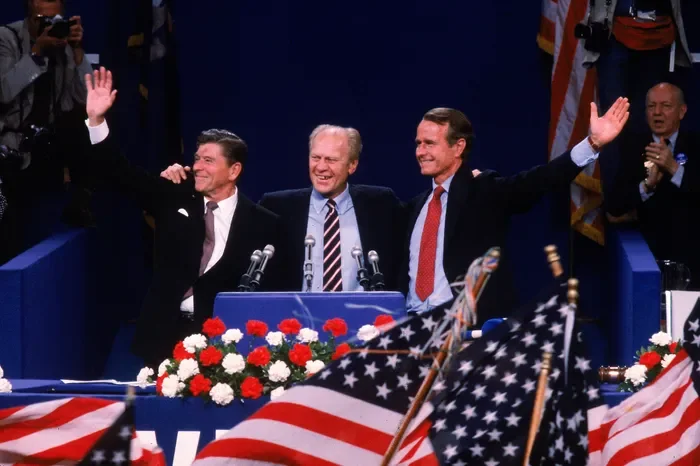
When the time came for GOP Convention in 1980 no one knew who would be Reagan’s running mate? Some believed that former VP and President, Gerald Ford would be offered the job, however when Ford talked about a co-presidency if offered the position results in Reagan choosing George HW Bush as his running mate instead.
John B. Anderson

Another name who ran for the Republican Party’s presidential nomination was John B. Anderson, the U.S. Representative of Illinois whose responses during the debates about policies like lower taxes, balancing the budget and increasing defense spending couldn’t happen all at once garnered him a lot of media attention…Sadly it wasn’t enough to help him win his party’s nomination.
After losing the nomination to Reagan, Anderson decided to leave the Republican Party to begin his run as an independent or third party candidate in order to appeal to voters who were not satisfied with either Reagan or Carter.
Anderson’s platform called for supporting the Equal Rights Amendment, cutting social security taxes and cutting taxes for small businesses while at the same time raising taxes on gas prices for environmental reasons and to cut down on America’s usage of gasoline which was a big problem at this time.
Anderson chose the former Governor of Wisconsin and Ambassador to Mexico in Carter administration, Patrick Lucey as his running mate.

Anderson’s polling numbers saw him pulling in around 26-22% at the time, in fact he became the first third party candidate to be involved in the Presidential Debates, however Carter decided not to attend because of Anderson’s involvement.
This resulted in the first and only time a presidential candidate from a major party debated a presidential candidate who was an independent.
Many saw Anderson’s performance in the debate with Reagan as good, but it wasn’t enough to get him out of his position in third place and his numbers would actually drop in the months that followed.
Campaign Strategies & Debates

Reagan ran his campaign with a sense of hope for a better America while also promising smaller government and more military spending to win the Cold War while Carter’s campaign on the other hand, was more negative as they attacked Reagan for his far right policies and claimed that Reagan would roll back the advancements made in Civil Rights and the New Deal.
Throughout the campaign Reagan attempts to use his charm to win over voters but mistakes like his ill-fated jab at Carter regarding the KKK turned a few Southerners against him and his proclaimation that trees cause pollution made him look very ill-informed with crowds of people chanting “Educate Reagan” as a result.
Following his no show at the first debate, Jimmy Carter decides to debate Reagan in the final debate which Reagan wins thanks in no small part to quips like: “There You Go Again”
As well as his closing line in the debate: “Are You Better Off than You Were Four Years Ago?.
It should be noted that right before the final debate, Reagan’s team got hold of some documents that detailed President Carter’s response to questions for the debate…and it’s unclear if Reagan’s knowledge of Carter’s debate strategy helped it him out in the debate.
It’s wildly speculated that Paul Corbin, a loyal aid and associate to the Kennedy family got a hold of the documents and sent them to the Reagan campaign team with the end game being that Reagan gets elected president in 1980 only for Ted Kennedy to oust him out of the White House in 1984.
Election of 1980: The Results

With only a few days before the election, the Carter administration get word that the Iranians have proposed a deal in exchange for the hostages which includes among other things eight billion dollars in assets and immunity for all of their actions throughout the hostage crisis.
Carter however refuses the offer depsite his administration’s best attempts as he believes the lives of all those Americans who were held hostage in Iran shouldn’t be used for political gain…A noble decision, but one that cost him the election as Ronald Reagan easily won to become the 40th in American History.
Reagan carried 44 states, won 489 electoral votes and received 50.8% of the population vote. Reagan’s electoral vote total is largest for any president elected for the first time since FDR in 1932 and this win also made the 69 year old Hollywood actor, the oldest man ever elected president.
Jimmy Carter only carried six states plus DC to get 49 electoral votes and 41% of the popular vote. Carter’s loss in the electoral vote is the worst showing for a president seeking re-election since Herbert Hoover and he also became the first U.S. President post World War Two to not get a second term…however he wouldn’t be the last.
John B, Anderson received no electoral votes but pulled an impressive 6.6% of the popular vote which is the best performance in the popular vote for a third-party candidate since George Wallace in 1968.
Released Hostages & Allegations

On the very same day Reagan was being sworn in as President, a plane containing the hostages were pulling up at the runway and they were greeted by loved ones, cheering Americans and of course the newly elected, President Reagan.
If the timing of this release felt coincidental to you then you’re not alone as claims have been made for decades about who was responsible for hostages being released on inauguration day.
Some believe that George H.W. Bush used his connections as the former head of the CIA to stop the release of hostages in order to prevent Carter from winning re-election.
In March of 2023, a former Lieutenant Governor of Texas named Ben Barnes discussed a mission he was on in the Middle East in the Summer of 1980 when he and John Conally, a former Democratic Texas Governor who joined the Republicans used a back channel to convince the Iranians to hold off on freeing the hostages until the new guy was in charge and they could offer them a better deal…similar to what Nixon and his allies did during the Vietnam peace talks around the time of the ’68 election.
In return, Conally hoped this would allow him to become the new Secretary of State or Defense in the Reagan administration, but instead he was offered the Secretary of Energy position and he refused to take it…This information would be released not long after it was announced that Jimmy Carter would go into hospice care in 2023.
If you like this kind of content, be sure to leave your thoughts down below in the comment section and I’ll see you in the next article.
Leave a Reply