2024 has been on of the craziest election seasons in recent memory and keep in mind the last prsidential election took place in during a freaking global pandemic.
While it’s too early to predict on who will win, the race certainly does look to be a close one and America has had it’s share of elections that come down to the wire as the following ten entries will demonstrate.
Before we get started, here is my criteria for how I am ranking these elections:
- How Close were the candidates in both the Electoral and Popular Vote?
- The Number of Votes seperating the candidates
- The Impact of the Swing States: Which States helped to decide the outcome of the election
Honorable Mentions
- 1888
- 1968
- 1812
- 1848
- 1892
- 1868
#10. The Election of 1960

The 1960’s could easily be seen as the height of the Cold War; As the decade saw the United States and the Soviet Union threat each other with nuclear destruction while espionage and propaganda on both sides were just pare for the course.
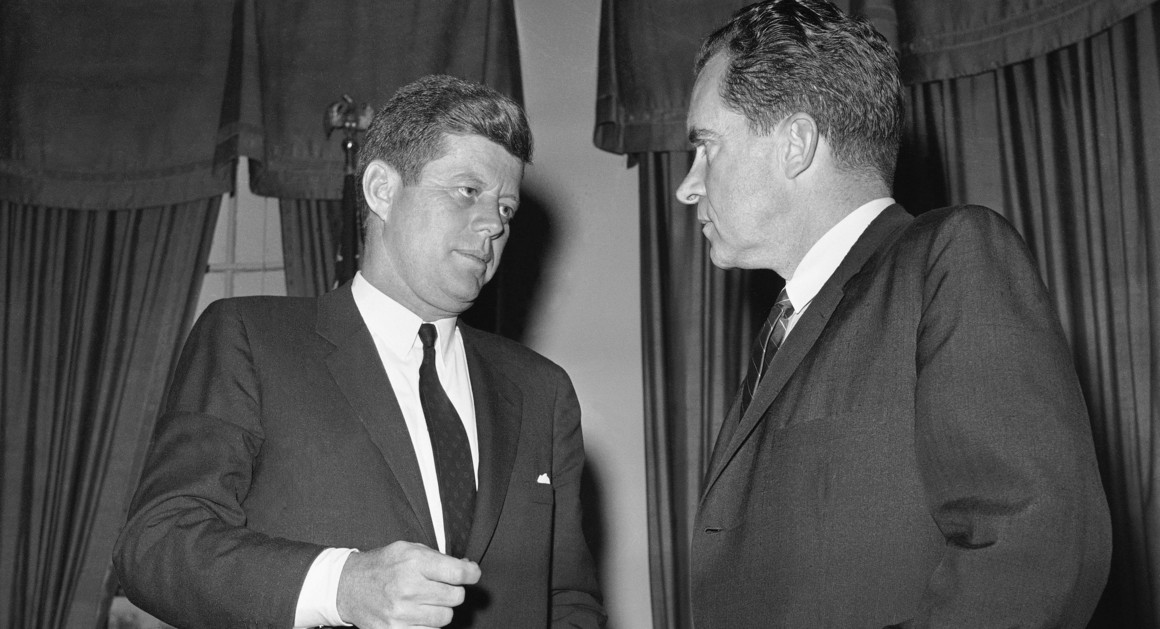
Following eight years of Dwight D. Eisenhower in the oval office, Vice President, Richard Nixon decided to run for the top job while the Democratic nominee for president in 1960 was Massachusetts Senator, John F. Kennedy.
Heading into election night things appeared to be neck and neck between JFK and Nixon but by the time results were all counted, John Kennedy emerged the victor with 303 electoral votes compared to Nixon’s 219.
Despite this, the race was still incredibly tight with Nixon winning 26 states compared to Kennedy winning 22 states, plus in the popular vote JFK got 49.7% and Nixon got 49.5% with 112,827 seperating the two of them.
In states like Hawaii, New Jersey and Illinois with Kennedy winning those states by 115 votes, 22 thousands votes and roughly 8 thousands votes respectively…In fact, Nixon’s homestate of California was going to go to Kennedy until abscentee ballots were counted which resulted in Nixon winning all of Cailfornia’s 32 electoral votes by just 35,623 votes.
Even though many Republicans and Nixon supporters believed that their was voter fraud in key states like Texas and Illinois, Nixon refused to contest the results…But by decade’s end it’s safe to say Tricky Dick would do just find in his next bid for the presidency.
#9. The Election of 2004

About three years after the September 11th attacks occurred in New York, President George W. Bush was seeking re-election and easily won his party’s nomination, becoming the first wartime president to do so since Franklin D. Roosevelt.
With the Bush Adminsration in full swing with their War of Terror which lead to the Invasions of Iraq and Afghanistan, the Democrats needed a candidate who could compete with the incumbent president especially when it came to experience in the military and foreign policy.
Even though a number of candidates ran for the party’s nomination, it would Massachusetts Senator and War Hero, John Kerry who became the Democratic nominee.
The 2004 Election was quite similar to the Election of 1988 as it not only saw a George Bush running for the highest office in the land, but the negative campaigning (mostly by Bush’s team) saw Kerry’s crediblity and record being dragged throw the mud regardless if the claims were true or not.
When it was all set and done, George W. Bush narrowly won re-election with 286 electoral votes and 50.6% of the popular vote while John Kerry walked away with 251 electoral votes and 48.3% of the popular vote…and a faithless elector from Minnesota voted for someone else, in this case it was John Edwards who was Kerry’s running mate.
Unlike like many of the other entries on this list, there weren’t a lot of States with close votes except for Wisconsin which Kerry won by 11,384 votes which is 0.37% of the vote. As of the timing of this article, this election marked the last time a Republican was re-elected to the White House and it also marked the last time a Republican won a presidential election with more of the popular vote.
#8. The Election of 1976

Following the calamities that were the Watergate Scandal and Nixon’s resignation, President Gerald Ford announced one month after ascending to the oval office that he would be pardoning Nixon for his crimes which went about as well as you could imagine.
Regardless, Ford narrowly beat then California Governor and former Hollywood Actor, Ronald Reagan to win the Republican Party’s nomination for president; Ford’s rival in the 1976 election was Jimmy Carter, a former Governor of Georgia and Peanut Farmer who ran as an outsider compared to the more establishment politicians in Washington D.C.
By time the dust settled, Carter became the 39th President of the United States winning 297 electoral votes and 50.1% of the popular vote; Gerald Ford meanwhile got 240 electoral votes and 48% of the popular vote…Ford could’ve ended up with 241 votes, but one elector in Washington state voted for Reagan instead.
Much like the 1960 Election, the Republican candidate for president ended up winning more states than the Democrats with Ford winning 27 compared to Carter winning 23 plus the District of Columbia.
In terms of the swing states in this election, Jimmy Carter won the state of Wisconsin by 35,000 votes out of 2,045,219 and in the state of Ohio, Carter won with 11,116 votes out of 4,012,126; In other words Jimmy Carter won the Buckeye State by just 0.27%.
#7. The Election of 1844

By the mid 1840’s, the Whig Party had control of the Senate, Congress and nearly had the presidency too had it not been for the passing of Whig President, William Henry Harrison which led to his VP, John Tyler soon becoming the president and eventually led to Tyler being kicked out of the Whig Party due to his constant vetoing of Whig legislation.
Around the same time, the question of whether Texas would added to the United States became a hot button issue as slavery was starting to become a major focus in presidential elections and by adding Texas to the Union it would not only be a slave state but it would disrupt the balance of anti slavery and slavery states in the U.S.
Henry Clay, the leader of the Whig Party was nominated by his party to run for the presidency again and many believed that this race was going to be another victory for the Whigs until a dark horse candidate emerged for the Democrats in James K. Polk who much like Clay was a former Speaker of the House.
Although he was known as ‘The Great Compromiser’ during his lifetime, Clay couldn’t properly find a solution to the issue of annexing Texas into the Union and instead it was Polk who manage to find a compromise with ‘Young Hickory’ proposing that Texas could be brought into the union provided the new territories of Oregon could also be included with the latter becoming an anti slavery state.
By the end of the election, James K. Polk became 11th President of the United States with 170 electoral votes to Henry Clay’s 105 electoral votes as you need 138 or more votes to become president this time around. In terms of the popular vote, the race was closer with Polk winning 49.5% to Clay’s 48.1%.
When it came to the states that had the closest votes there were a few of them; For starters, Tennessee (Polk’s state of residents) had a vote total of 119,957 and Clay won the state by 123 votes out or 0.10%, in New Jeresy Clay won with 823 votes of 75,813 or 1.09%, but the biggest state to win was New York with Polk winning 5,106 votes or 1.05% to secure the presidency.
Had it not been for the anti-slavery third party known as the Liberty Party sucking away votes from the Whigs in that state then Clay would’ve won the 1844 Election with 141 electoral votes…Spoiler Alert, this will not be the last time a presidential election on this list was decided thanks to closest of the vote in the state of New York.
#6. The Election of 1884

About forty years after our previous entry, the Republican Party had dominated the White House since the election of Abraham Lincoln in 1860 and at first they felt confident of victory once again as they nominated James G. Blaine who was the reform minded Senator from Maine as their nominee.
For their part, the Democrats nominated the Governor of New York, Grover Cleveland due in large part for his record as an anti-corruption fighter and he was also the Governor of a state that had a large number of electoral votes.
Much like the 2004 election, mudslinging was rampant throughout the campaigns with Cleveland having an illegitimate child with a woman who might’ve been sexually assaulted by Grover while Blaine was accused of accepting bribes from the railroad companies for special favors and attempting to cover it up by having the letters that contained this information burned.
In the end, Grover Cleveland defeated James Blaine with 219 electoral votes to Blaine’s 182 as you needed 201 or more votes to win the at this point in time. While the electoral results might make you think this was a decisive win for Grover, the popular vote and the votes in the state of New York would beg to differ.
Cleveland barely won the popular vote with 48.9% to Blaine’s 48.3% with about 57,579 votes separating the two. Not only that, but when it came to the state of New York Cleveland won with just 1,149 which is 0.10% of the vote.
Had Blaine won New York, he would’ve won the election with 218 electoral votes thus making him the new president. Nevertheless, New York would become the state to win for both major parties in the elections of 1892, 1888 and 1880…Speaking of which.
#5. The Election of 1880

When it became clear that the candidates who were trying to run for president weren’t getting enough support from the delegates, some of them soon convinced former U.S. Representative of Ohio, James Garfield to run for the presidency which he does albeit reluctantly. After thirty-six ballots, Garfield become the GOP’s nominee for president in 1880.
The Democrats meanwhile nominated Winfield Scott Hancock, a Major U.S. Army General during the Civil War making this election the first since 1852 that the two major party candidates both served during a major war.
James Garfield would end up winning and became the 20th President of the United States; In terms of the electoral vote, Garfield won decisively with 215 electorals votes to Scott Hancock’s 155 votes as you needed 185 or more votes to win.
However, If you look at the popular vote between Garfield and Hancock then this election is much closer than expected with the newly elected Garfield getting 4,446,158 votes which adds up to 48.31% and Hancock got 4,444,260 votes which adds up to 48.2%, meaning that 1,898 votes seperate the two thus making this the smallest margin of victory in the history of the popular vote.
While both men evenly won 19 states in this election, at many of those states were extremely close with Hancock winning New Jeresy by 2,010 votes or 0.85% while in California he won by just 95 votes or 0.06%. Garfield though won Connecticut by 2%, Indiana by 1.41%, Oregon by 1.64% and the he won the state of New York by just 1.91% or 21,033 votes.
#4. The Election of 1916

As many European nations are their allies soon become engulfed in the Great War aka World War One, the United States attempted to stay netural when it came to involvement in the war with incumbent Democratic President, Woodrow Wilson using the slogan “He Kept Us Out of War” to emphasis were he stood on this issue during the 1916 election.
The Republican Party Establishment went with the former Governor of New York, Charles Evans Hughes as their nominee as Hughes’ views on the war were not known as he spent last several years serving as the Associate Justice of the Supreme Court which makes Hughes the only Supreme Court Justice to ever be nominated by a major political party for president.
Unlike Wilson, Hughes supported the idea of military preparedness when it came the United States and War World One as it becomes clear to some that America would soon get involved in this conflict. Even though the various newspaper outlets published headlines believing Hughes would win, the results prove that to be false.
While the popular vote wasn’t close, the electoral votes were with Woodrow Wilson winning 277 votes and Hughes winning 254 votes as you needed 266 or more to win.
At least five states made this election such a close one with Hughes winning Indiana by 6,942 votes (or 0.97%), West Virginia by 2,721 votes (or 0.94%) and he won Minnesota by just 392 votes (or 0.10%). The two states that helped Wilson win were New Hampshrie and California; Wilson barely won New Hampshire by just 56 votes (or 0.06%) and he won California (the state that helped him win the election) by just 3,773 votes (or 0.38%).
Many experts agree that had a meeting between Hughes the Governor of California at the time, Hiram Johnson went down then it’s highly possible that the state’s 13 electoral votes would’ve gone to the Republicans meaning Hughes would’ve finished with 267 votes to Wilson’s 264 votes.
#3. The Election of 1796

The first contested election in American History saw the Federalists and the Democratic-Republicans attempting to undermine the other with the hope that one of their own could become the new commander-in-chief.
While many candidates from both parties ran for the presidency, only Vice President and Federalist, John Adams as well as Former Secretary of State and co-founder of the Democratic Republicans, Thomas Jefferson were the ones who got the most votes and seen as the likeliest to win from their parties.
After taking the votes were all counted, John Adams managed to squeak out a win with 71 electoral votes and Jefferson with 68 votes. Of course this election came years before the 12th Amendment to the Constitution was made and thus Jefferson became Adams’ new VP…For more on that and the election as a whole, click this here.
Anyhow, the amount of votes needed to win this election was 70 or more votes and Adams manage to so carrying nine states to Jefferson’s seven states and it’s the state of Pennyslvania that helped Washington’s VP to victory as Adam won the state by just 89 votes or 0.4%.
#2. The Election of 2000

If you thought the last election was close and contraversial, then the last two entries on this list take that to the next level with the results of these elections leading to consequences were still feeling today.
In the 2000 presidential election Texas Governor, George W. Bush took on Vice President, Al Gore in what would be the closest president election in recent memory as Bush defeated Gore with 271 electoral votes to Al Gore getting 266 votes althought how we got to that point is still disputed even now.
After an election night that saw news channels call the state of Florida too soon for either Bush and Gore, after an unprecedented move where Gore called to concede the election only to call back and rescind that concession and after a lawsuit by the Gore campaign and many recounts (both electronic and hand counted) the decision was made to have the Supreme Court make a ruling on who should win the remaining and undecided votes in Florida.
Florida you see had 25 electoral votes and the voting in that state was soo close recounts had to be done under Florida law and whoever got those votes would have enough votes to win the election. So when the mostly conservative Supreme Court ruled in favor of Bush thus making him the 41st President of the United States…many Americans felt there had been a sour taste in the mouth with how Bush had won as he won Florida with 537 votes or 0.009%.
If wasn’t enough, Gore actually beat Bush in the Popular Vote with 48.4% to Bush 47.9% with a difference of 543,895 votes seperating the two; Considering the actions, Bush would take during his two terms as president, many still to this day wonder what America and parts of the world would’ve looked like had Al Gore won the 2000 election.
#1. The Election of 1876

And here it is…The closest Presidential Election in American History, in 1876 President Ulyssess S. Grant and the GOP were rife with scandal and the economy was tanking thanks to widespread corruption leading to the Democrats believing that the 1876 election was going to be their time to get back into the White House.
The Democrats nominated on the first ballot, Samuel J. Tilden who was not only the Governor of New York but also a massive anti-corruption politician in other words, his the exact kind of candidate the Democrats would want at time like this.
The Republicans nominated the lesser known Governor of Ohio and Military General in the Civil War, Rutherford B. Hayes; Much like Tilden, Hayes was also an anti-corruption reformer but with the GOP’s reputation damaged amongst the scandals and a growing recession, many expected Tilden to emerge on top.
When election day finally emerged, it turns out that Hayes had won the election with 185 votes to Tilden’s 184 votes and you need 185 or more to win meaning that Hayes won the cloest president election in all of American History by just one vote.
Much like the 2000 election, the results were disputed due in large part to Democrats using intimidation and murder of African American voters to swing the votes while the Republicans were accused on straight up refusing to count Tilden votes.
Eventually, an electoral commission was chosen to sort out this mess as the states of Louisiana, South Carolina and Florida (naturally) had heavily disputed votes and sure enough, the commission (who had more Republicans than Democrats thanks to a scheme by the Democrats to bride one of commissioners backfired), all of the 19 electoral votes of those three states went to Hayes.
The Democrats still refused to accept this outcome and threatened to start a second civil war if Tilden wasn’t sworn in; Ultimately, an agreement was made known as the Compromise of 1877 which allowed Hayes to become the new president so long as the Republicans removed military soldiers in various Southern States that were placed there to protect the rights of African Americans in the area.
In the end, Hayes was president for four years, the soldiers packed up and left the South and worst of all a period of segregation and racial discrimination against black people took hold in the South for almost 100 years until it thankfully came to an end with signing of the Civil Rights Act of 1964 and the Voting Rights Act of 1965.
If you like this kind of content, be sure to leave your thoughts down below in the comment section and be sure to follow Lace ‘Em Up on X @laceemupoffice you can follow me also on X @hakeemfullerton and I’ll see you in the next article.
Leave a Reply