Hello, and welcome back to another edition of Lace ‘Em Up’s Presidential Election series today we will be going over the Election of 1892. Grover Cleveland is looking to get back his old job, Benjamin Harrison has to defend record over the last four years and a new political movement has risen to take on the two major parties.
Harrison’s Presidential Woes

Following the events of the 1888 election, President Benjamin Harrison has seen his time in office filled with so much problems that he began to question if he should run for another term.
During the Harrison administration, a large amount of federal spending was done and coupled with the passing of the McKinley Tariff and the Sherman Silver Purchase Act left the American economy in a rather shaky situation going into election day.
Another event that occurred under the Harrison administration saw the intervention and killing of Native American tribes in December of 1890; Known as ‘The Wounded Knee Massacre’, U.S. forces were sent to kill around 146-150 Lakota natives in what would be the future South Dakota.

Much like his predecessor, Harrison’s view on Native Americans was to assimilate them into Western (White) society which was popular to some at the time but a horribly outdated idea today.
As this was occurring under his administration, President Harrison dealt with international matters regarding the overthrowing Hawaiian monarch, Queen Lili’uokalani and the annexation of the island all this while also dealing with disputes regarding fishing rights between the U.S., Canada and Britain and even dealt with a crisis involving the Chilean government all of which was thankfully resolved.
The biggest blow to Benjamin Harrison occurred in October of 1892 when his beloved wife, Caroline died from tuberculosis at the age of 60 right in the middle of the election which led to much of the campaigning coming to a temporary halt and leaving the President in deep sadness.
Harrison’s New Running Mate

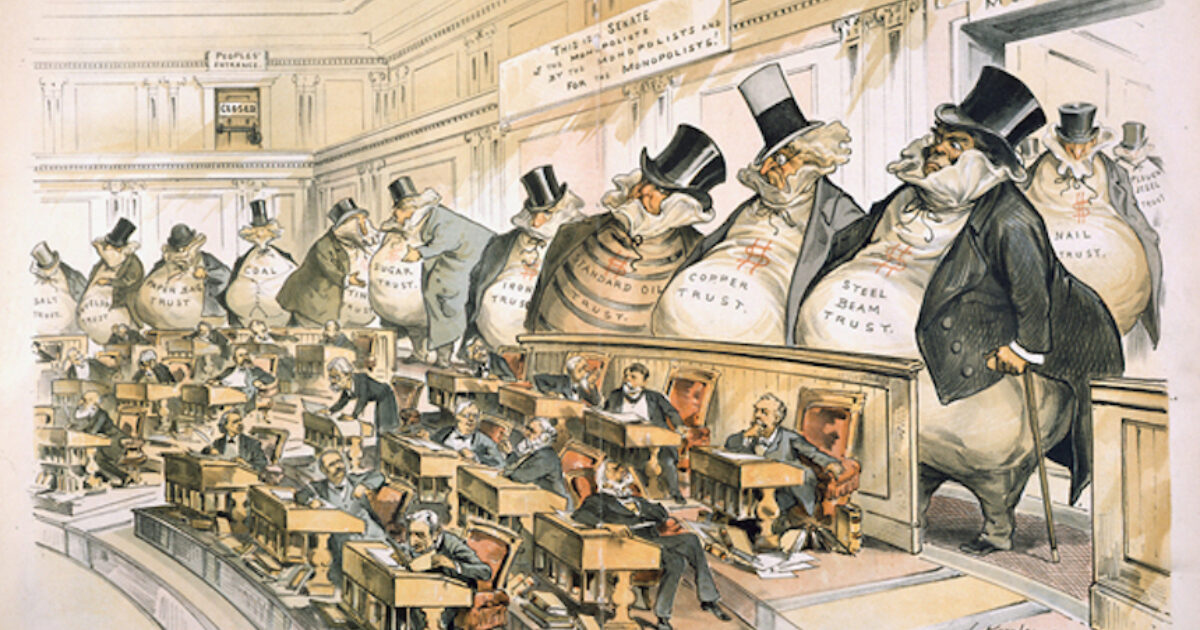
While the economy and international matters became a spotty issue for Benjamin Harrison, he did have a few good accomplishments like the modernization of the U.S. Navy, signing the Land Revision Act of 1891 which opened the door to conservation work for national forests. This would be expanded on by future President, Theodore Roosevelt and his passing of the Sherman Anti-Trust Act was used to crack down the corrupting influence by monopolies.
Harrison was also a major proponent of Civil Rights when it came to African Americans and this led to the proposal of the Lodge Force Bill which would allow voting rights for African Americans in the South.
Unsurprisingly there was a lot of pushback to this bill and when it came time to decide its fate, Levi Morton who was Harrison’s Vice President refused to support it thus leaving the bill to die on the Senate floor.
Harrison blamed Morton for the bill not passing into law and as such he dropped Morton upon running for re-election and replaced him with Whitelaw Reid, the U.S. Ambassador to France and editor of the New York Tribune which he took control of after usurping the founder of the newspaper and former Presidential candidate, Horace Greeley in the early 1870’s.
Grover’s Back!!!

After losing re-election despite winning the popular vote, Grover Cleveland returned to get his old job back after believing the financial policies of his successor could lead to an economy crisis.
Once Cleveland’s name was thrown into the mix, he was overwhelmingly seen as the frontrunner to get the party’s nomination with his only real challenge being the former Governor and current Senator of New York, David Hill who attempted to bring together a coalition of supporters who opposed Cleveland’s policies.
While the results were narrow, Cleveland once again became the nominee making the first of three Democratic candidates to get their party’s nomination a third time.

Cleveland’s running mate in this election was Adlai Stevenson, a former U.S. Representative and Postmaster General from Illinois.
Stevenson and Cleveland seemed like an odd pairing to some as Cleveland was a big supporter of the ‘Gold Standard’ aka using gold as currency while Stevenson was in favor of using ‘Free Sliver’ aka unlimited amounts of sliver into currency.
However, Cleveland was more than fine with Stevenson on the ticket in order to have some balance while also preventing any possible divisions within the Democratic Party over the currency issue.
The People’s Party & The Prohibition Party

For much of the late 1870’s-80’s various groups like the Greenback Party, Union Labor Party, the Knights of Labor, the Grangers and the Farmer’s Alliances supported ideas like a new monetary plan, decreasing railroad rates, direct election of U.S. Senators, a gradual income tax, unionization for laborers and farmers, and government control of warehouses that’ll allow farmers to store their crops.
After many of these groups gained a small number of support when it came to the previous elections, the 1890’s is when things started to change as all of these politically minded groups came to together to form a new political party called ‘The People’s Party’ also referred to as ‘Populists’.
By the time of the 1892 election, the populist had their first nominating convention in Omaha Nebraska and the party nominated James B. Weaver, the former U.S. Representative from Iowa who ran with the Greenback Party in the election of 1880; Weaver’s running mate was James G. Field who was a former Confederate Major during the Civil War and the Attorney General of Virginia.
To give you an idea of how popular the people’s party was around this time, The Prohibition Party which had been around for a while, at first decided to join forces with the Populists but for one reason or another it never came to fruition and so the Prohibitionists nominated former U.S. Representative of California and pioneer, John Bidwell as a candidate for president with religious figure, James B. Cranfill as his running mate.
The Campaigns

The issue of tariffs were once again the biggest talking point in this election with Harrison supporting the previously mentioned McKinley Tariff which was a protectionists act that increased tariff rates on imported goods by 50% which the President signed into law.
Cleveland came out in support of the Gold Standard, reducing the amount of tariffs that were passed and he even opposed to the idea of the Lodge Bill in order maintain the support of many southern states that have become known as “The Solid South”.
The Populists are running on the ideas mentioned previously while also getting the support of not just farmers and a few factory workers but also many middle-class voters who are sick and tired of the two major parties ignoring the issues that can help them out and many Americans are seeing this new political party as perhaps the answer to those problems…But who will emerge victorious in this election? Let’s look at the results.
Election of 1892: The Results

Since the previous election, the states of Wyoming, Montana, North Dakota, South Dakota, Idaho and Washington were now added to the Union with the electoral votes needed to win in this race being 223 or more.
By the end of the election Grover Cleveland won, making him not only the 24th President in U.S. History but the first and so far only president in American History to be elected to two non-consecutive terms in office.
Cleveland received 277 electoral votes and 46% of the popular vote which was his worse showing in the popular vote compared to 1888 with 48.6% or 1884 with 48.9%. In fact, this makes him the first of three Democratic Presidents to get elected and re-elected with less than 50% of the popular vote.
Benjamin Harrison became the first Republican President to lose re-election with 145 electoral votes and 43% of the popular vote; Despite losing the highest office in the land, Harrison reported to friends that losing the re-election was “Like being freed from prison”.
James Weaver got 22 electoral votes which were the states of Nevada, Idaho, Colorado, Kansas, an electoral vote in Oregon and North Dakota where Weaver won by a very slim margin. He also got 8.5% of the popular vote making the People’s Party the only third party since 1860 to win both electoral and popular votes in a Presidential election.
John Bidwell and the Prohibition Party got no electoral votes but 2.2% of the popular vote which was the best performance by the yet since its inception.
This election would be the only one until the 20th century in which the incumbent president would lose in back-to-back elections.
If you like this kind of content, be sure to leave your thoughts down below in the comment section and be sure to follow Lace ‘Em Up on X @laceemupoffice you can follow me also on X @hakeemfullerton and I’ll see you in the next article.
Leave a Reply