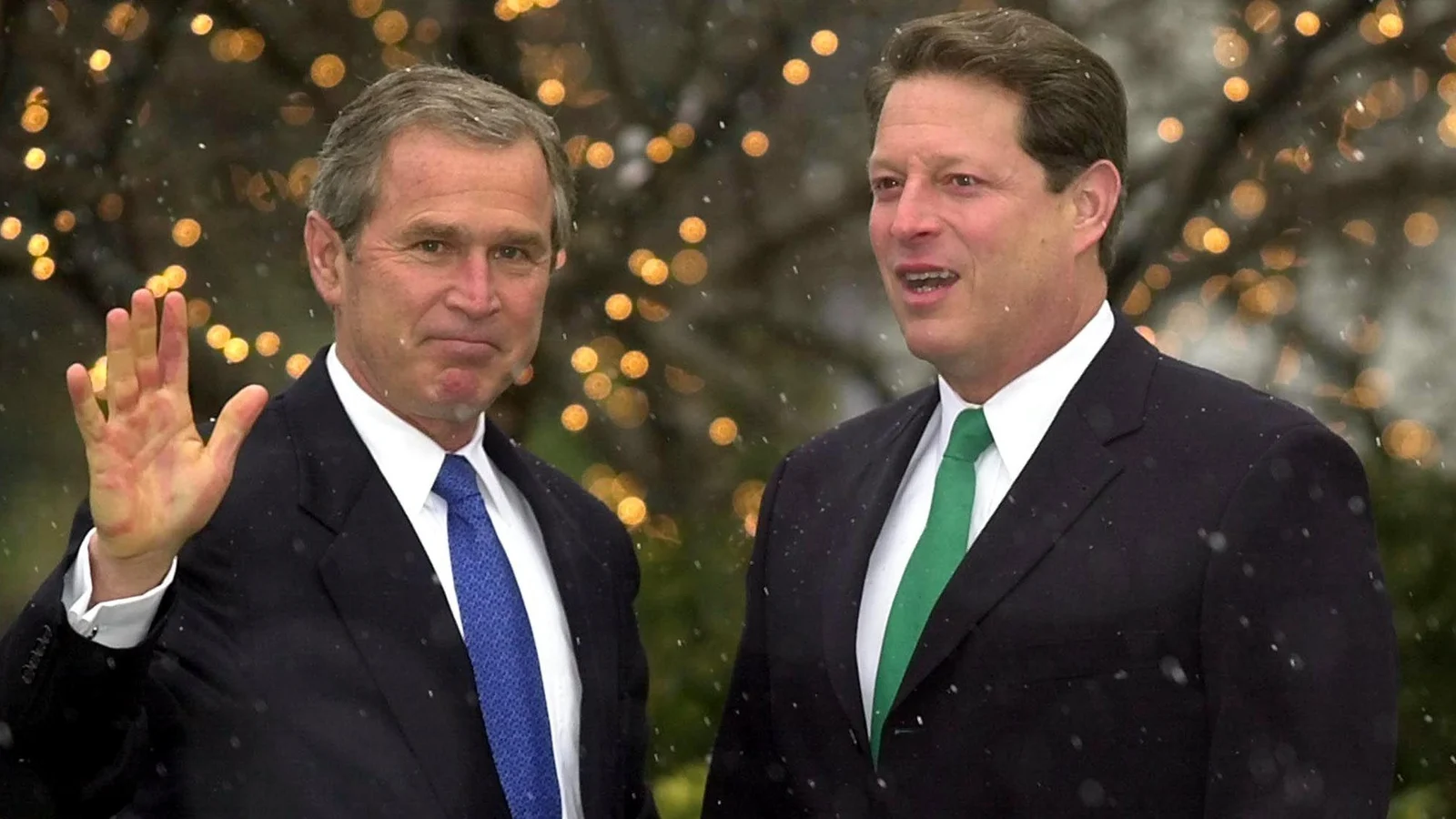
Hello and welcome back to another edition of Lace ‘Em Up’s Presidential Election series and today we will be going over the Election of 2000; American has entered into a new millennium with high hopes for the future, but it will end the year in what might still be the closest and most controversial election in U.S. History.
Bill Clinton’s Tumultous Second Term

President Bill Clinton’s second term in office had some of the biggest highs for any commander-in-chief since Reagan and HW Bush, but it was only matched by some massive low points.
When it came to his successes, Clinton appointed Ruth Bader Ginsburg to the Supreme Court, he oversaw a burgeoning economy whilst also signing acts that dealt with issues for like healthcare, paid family leave, adoption and foster care. On foreign matters, Clinton helped to bring an end to the Bosnian War and helped usher in peaces talks between Britain and Ireland as well as Israel and Palestine.
When it came to his lows, Bill Clinton had a bunch: His handlings of conflicts in Rwanda and Somalia were heavily criticized and reports of genocide happening in Kosovo which led to U.S. involvement were deemed falsified and exaggerated by journalists.
The president signed acts like the 1994 Crime Bill which paved the way for harsher prison sentences and the continuation of systemic racism by police officers. He also signed the Gramm-Leach-Bliley Act which repealed the Glass-Steagull Act of 1933 and resulted in banks having more control over commercial and investment banking since the 1920’s and it not only led to the early 2000’s recession but it is also seen today as one of the many factors lead to reckless banking practices in the U.S. thus leading to future recessions and financial woes in the decades that followed.
By far the biggest blunder of the Clinton Presidency would have to be the president’s affair with intern, Monica Lewinsky and the impeachment trial that proceeded it after Clinton strongly denied that he had any sexual relations with Lewinsky…Although he was aquitted by the Senate, the scandal and impeachment trial tranished his legacy.
Al Gore For President
In spite of the problems surrounding the president’s second term, Al Gore (Clinton’s VP for eight years) decides to make another run for the presidency.
Gore’s only opponent in the Democratic primaries is Bill Bradley who was the former Senator from New Jersey and a former professional basketball player for the New York Knicks; Bradley ran as a more liberal candidate compared to Gore and supported important causes like gun control, campaign finance reform, an increase to the minimum wage and universal health care.
Despite high hopes in the beginning of his campaign and getting the endorsements of many influencial sports figures and politicians, Bradley was no match for Gore when it came to the Iowa Caucus and the New Hampshire Primary and thus dropped out in March.
Al Gore became the Democratic Party’s nominee for president and he chose Joe Liberman, a Senator from Connecticut as his running mate; Liberman became the first Jewish candidate to be on a major party’s presidential ticket beating out other names like John Kerry, Evan Bayh and Dick Gephardt to get the position.
George Dubya!!!

The Republicans had a number of people running for their party’s nomination including Steve Forbes who is back at it after not getting the nomination in 1996, former Vice President Dan Quayle sought the presidency and launched his campaign in April of 1999 and even Alan Keyes, the former Assistant Secretary of State for the Reagan Adminsration once again went after the nomination…But the two candidates who got the most attention out of everyone else was Arizona Senator, John McCain and Texas Governor, George Walker Bush.
McCain who was a war hero due to his service in the Vietnam War became well known in the 90’s for work in politics and his crusade against the Ultimate Fighting Championship aka the UFC for what he called “Human Cock Fighting” and went to great lengths as Chairman of the Senate’s Commerce Committee to prevent states from allowing the UFC or any kind of MMA from host shows or being aired on TV.
Bush on the other hand was the son of former president, George HW Bush and brother to Florida Governor, Jeb Bush before he ran for public office and pulled off a political upset when he beat Democratic Governor of Texas, Ann Richards in the 1994 gubernatorial elections.
When it came time for the 2000 presidential election, Bush ran as a passionate, reform minded conservative aka a more moderate Republican compared to his opposition and he won the Iowa Caucuses but lost the New Hampshire, Michigan and Arizona primaries to McCain; Following a smear campaign against the Senator in the South Carolina Primary and coming out on top around Super Tuesday, Bush became the GOP’s presidential nominee.
Dick Cheney, the former Secretary of Defense for Bush Senior was chosen to lead a team that would help in finding a running mate for George W. Bush in the election, but ultimately Cheney thought he himself would be a great running mate for Bush and the Texas Governor accepted which meant that Cheney had to change his voting registration back his homestate of Wyoming as both men were living in Texas at the time and having a presidential nominee and his running mate from the same state would make the votes in that state invalid.
Third Party Candidates

This election saw a number of third party candidates run for office, but the two biggest were the Green Party and the Reform Party.
The Green Party ran with Ralph Nadar, who was a political activist and lawyer from Connecticut who managed to get a number of consumer protection laws passed and who also ran for the presidency in 1996 but got less than one percent of the vote; Nadar’s running mate was Winona LaDuke who also was an economist and activist but from the state of Minnesota, she was also the running mate for Nadar back in 1996.
Following his performances in the last two elections, Ross Perot refused to run for president again leaving the Reform Party to find someone else to be their nominee and while names like Donald Trump, John B. Anderson, Ron Paul and former wrestler turn Governor of Minnesota, Jesse ‘The Body’ Ventura were all considered as potential candidates, but they all declined. Ultimately, it was Pat Buchanan who ran for the Republican Presidential Nomination in ’92 and ’96 became the Reform Party’s nominee with Ezola Foster, an activist from California as his running mate.
Despite having the most federal funds of any other third party and being on the ballot in 49 states, Buchanan’s presidential bid was dead on arrival due to controversial statements he made the past, in-fighting within the party on who should be the nominee and running ads that were could be considered racist led to him ending up with 0.4% of the popular vote and ending any chance of the Reform Party being seen as serious threat to the Democrats and Republicans.
Nadar and the Green Party were on the ballot in 43 states (plus D.C.) and held massive rallies in places like Madison Square Garden and ran to the left of both Gore and Bush, with the endgame being that he if could finish with around 5% of the popular vote, then the Green Party would be able to get a large sum of federal funds for the next presidential election.
Presidential Campaigns & Debates

Despite being a popular president to most of the general public following Bill Clinton’s sex scandal and impeachment, Al Gore tried to distance himself from Clinton even going so far as to not appear with the president on the campaign trail which some believe was a mistake on the VP’s part.
Gore ran on ideas like maintaining the budget surplus by putting Medicare and Social Security in a methodical ‘Lockbox’, lower drug prices for those in Africa who were suffering from AIDS, balancing the budget on a year basis, lowering taxes for middle class Americans and paying down the national debt while also criticizing Bush for his lack of foreign policy experience and numerous gaffes.
George Bush continued to run as a compassionate conservative and promised to end the partsianship that was quickly developing in Washington; Bush also pledged to bring “Honor and Diginity” back to the White House following President Clinton’s numerous scandals and also disagreed with Clinton’s foreign policy of sending troops overseas and intervening in conflicts or as he referred to it as “Nation Building”.
During the Presidential Debates Gore came off more intelligent and calculating compared to Bush which helped him in the eyes of some viewers but it also hurt him as many pundits and voters felt Gore came off as cold and aloof while Bush was more folksy and down to earth in terms of their personalities.
It also probably didn’t help Al Gore’s case that he constantly rolled his eyes, sighed and basically came off as condescending in the debates when Bush attempted to response to the question…Nonetheless, the race continued to remain tight with it looking like it could go either way for Bush and Gore.
Election Night Fisaco

November 7th, 2000 was election day in the U.S. but little did anyone know at the time that what should’ve been a standard night of election results being tallied up, ended up being one of the polarizing events in American History.
As votes began to come in from each state, both Bush and Gore were getting closer and closer to reaching the winning number of electoral votes needed to win the presidency which is 270. Before the night was out, many news networks like FOX, CNN and MSNBC called the state of Florida for Gore which would’ve meant that he was the new president, but the vote was too close to call in Florida and Bush’s margin of victory was looking up as more votes came in, the news channels retracted their statement and place Florida in the undecided category, before calling the state for Bush by 10 PM.
The next morning, it appeared that more votes for Gore were being counted in three key locations in the state of Florida and the state again was placed in the undecided pile. Meanwhile Al Gore who has previously called to conceded the election to Bush, called the Texas Governor again to retracted his previous concession call as the votes were still being counted.
After doing a recount of the votes (by way of Florida Law if the margin of votes were too close to call), Bush reportedly won the state by 300 votes to 930 votes if you include overseas ballots but even that had some problems around it and this all led to Gore and his team calling for manual recounts in four key counties in Florida and even a lawsuit against the state’s Secretary of State, Katherine Harris (no relations to future VP Kamala Harris).
Supreme Court Ruling & Election Results

Following a deadline in which the Florida votes could be recounted were extended to November 26, the Supreme Court eventually got involved and the outcome of this decision would have ramifications that many of use are still dealing with today.
On December 12th more than a month after election day, the Supreme Court ruled in a 5-4 decision that the Florida Supreme Court’s decision at allowing recounts in the state passed the original deadline was deemed unconstitutional and with Bush ahead by just 537 votes in the state, he was given the victory in Florida by the Supreme Court.

By time this all came to an end, George W. Bush became the 43rd President in U.S. History and the second son of the president to become president since John Quincy Adams.
Bush narrowly secured victory with 271 electoral votes and carried 30 states overall; Al Gore carried 20 states (plus D.C.) and ended his campaign with 266 electoral votes…Even though Gore won the popular vote with 48.4% compared to Bush’s 47.9% with about 543,895 votes seperating the both of them and becoming the first time that the person who didn’t win the popular vote became president since the Election of 1888.
Ralph Nadar came in third place with 2.7% of the popular vote and no electoral votes (so much for getting federal funds in 2004); Many even to this day believed that Nadar and the Green Party spoiled the election for Gore leading to the race being so close as it was, plus Republicans airing ads of Ralph Nadar’s campaign in states to split the liberal vote probably didn’t help…But zero evidence of Nadar spoiling the election have ever real materialized.
Needless to say, this election was the closest in American History since 1876 and much like that election, the outcome of this race would change course of American History for generations to come.
If you like this kind of content, be sure to leave your thoughts down below in the comment section and be sure to follow Lace ‘Em Up on X @laceemupoffice you can follow me also on X @hakeemfullerton and I’ll see you in the next article.
Leave a Reply