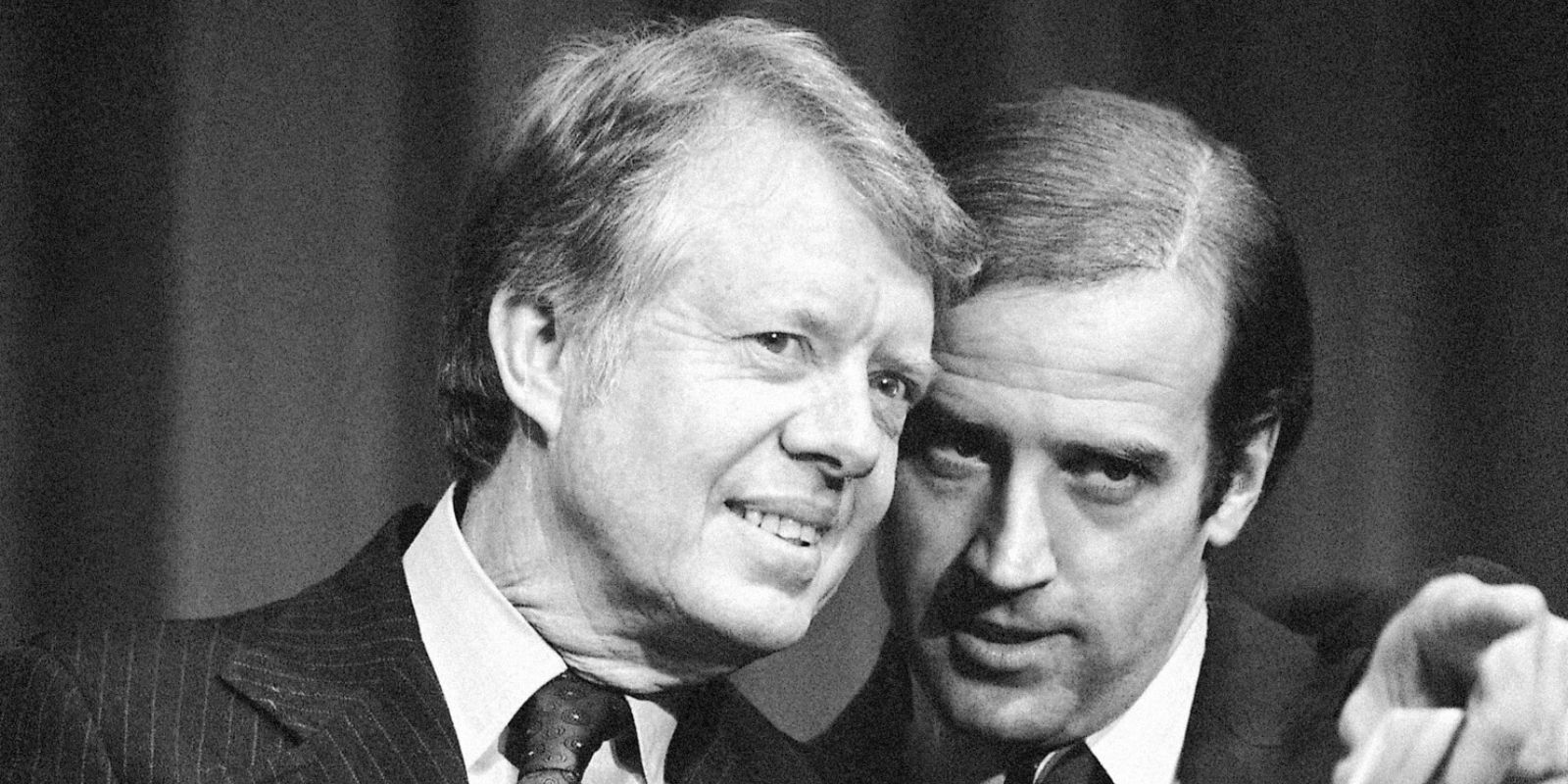
As the world says goodbye to President Carter for the first time just days away from Biden leaving office, it is easy to draw some parallels between the two men. Close friends, their political careers reflect the similarities between the two men’s presidential stories – both in successes and failures.
Relationship

It is important first to look at the relationship between Carter and Biden.
When Jimmy Carter ran for the Democratic nomination in 1976, the first senator to back his bid was a young, relatively unknown lawmaker from Delaware called Joe Biden. In return, two years later, Carter hosted a rare fundraiser for Biden.
In Carter’s later years, his closeness with Biden became even more evident.
During his presidency, Biden flew to Georgia to meet the ex-president, whose health meant he was able to travel to his inauguration. This happened during the marquee 100-day period of Biden taking office.
Biden would celebrate Carter’s 100th birthday in 2024, later in the year serving as president when he passed away. Biden had previously said Carter had wanted him to read his eulogy.
Parallel Presidencies

Beyond their friendship, looking at both men’s terms as president, they share some stark similarities.
One Term Presidencies
Both Carter and Biden would serve just one of two eligible presidential terms. Carter served from 1977-1981 whilst Biden did from 2021-2025. They – the other being George Bush Sr. – are two of only three men to serve exactly one term since the end of the Second World War (discounting President-Elect Trump).
Long Lives
Everyone knows Jimmy Carter became the oldest president when he reached the age of 100. Biden is the oldest president to ever hold office (although Trump will have been inaugurated at a later age and may serve long enough to break the record).
Carter’s age means he was outlived by just one Cabinet member (W. Michael Blumenthal) and outlived many of his contemporaries; he was also the first president born in a hospital and was alive at the same time as Harry Houdini.
Middle East Foreign Policy Causes Loss
In his 1980 re-election bid, Jimmy Carter was defeated in a landslide by Ronald Reagan, a loss caused in the short-term by the Iran hostage crisis, where revolutionaries held 53 diplomats and citizens hostage.
Although he would withdraw from re-election before the election, Joe Biden’s handling of the Israel-Gaza conflict since October 7th had drawn significant criticism. As YouGov polling revealed, it was the single largest reason (at 29%) detracting 2020 Democratic voters from voting the same way in 2024.
Hostage Releases During Outgoing Period
After losing the 1980 election, Jimmy Carter still devoted himself to securing a hostage release deal. As he noted in his memoirs: “The release of the American hostages had almost become an obsession for me…Before God and my fellow citizens, I wanted to exert every ounce of my strength and ability during these last few days to achieve their liberation.”
In 2025, the long-running Israel-Gaza conflict came to an end after 15 months. Despite having tried to negotiate a ceasefire for over a year, it was not until his outgoing period that Biden was able to speedily seal a deal. In a speech announcing the deal, Biden noted how he laid out the plan and “my diplomacy never ceased…to get this done.”
Economic Struggles Help Win The Presidency
Jimmy Carter was propelled in 1976 by his opponent, Gerald Ford, being handed a bad economy on the back of a previous recession linked to the 1973 oil crisis. By election day, inflation was at 6% while unemployment was near 8%, no doubt a factor aiding Carter to the White House.
2020 saw the Covid pandemic hit the US economy. As a result, under Donald Trump, unemployment peaked in April at 14.7%, with 20 million citizens losing their jobs in the worst figures since the Great Depression. Moreover, the economy shrank by 3.4%, marking the largest decline in 74 years while the wealth gap further widened. Against this backdrop, Biden won the election with the largest amount of votes ever cast for a presidential candidate.
Economic Struggles Help Lose The Presidency
While poor economic circumstances boosted both men to the presidency, it played a factor in toppling them too.
In 1980, Carter was facing an economy far worse than 1976. Issues such as the 1979 oil crisis and a recession in early 1980 hurt Carter. The ordinary citizens suffered stagflation as unemployment failed to drop significantly under Carter while inflation was at 12.6%. Challenger Ronald Reagan capitalised on the economy, famously asking the question “are you better off than you were four years ago?” The electorate firmly replied that they were not.
Polls leading into 2024 showed Biden slipping behind, with the economy undoubtedly a major factor. Although strong, this would not be felt by ordinary citizens, with prices rising due to inflation, a hangover from the Covid pandemic. Inflation hit 9.1%, the highest since 1981. Whilst Biden would drop out before the election, it was largely him who presided over it and whose efforts had failed to reduce the impact.
Congressional Struggles
Whilst being an outsider was an advantage to Carter’s election, it really hurt his presidency. As The New York Times noted in 1979, “from the Capitol Hill viewpoint, Mr. Carter has failed to establish personal relations with key legislators, and that failure lies at the heart of his continuing struggle with Congress.” Policies such as tax and healthcare reforms failed, while Congress did little to move towards a balanced budget or lowered defence spending as had been pledged. Perhaps the nadir in relations was in August 1980 when a veto was overridden by 401-5 in the House and 85-0 in the Senate, the first override of a presidential veto by his own party since Harry Truman.
Biden meanwhile had a harder task of trying to push through his agenda in a 50-50 split Senate where he had to appease both socialist elements like Bernie Sanders and conservatives like Joe Manchin. His tenure was marked by a failed attempt at increasing the southern border and adequately protecting abortion rights while even while controlling both chambers, he could not pass his flagship Build Back Better Plan.
Southern Success
Since 1960, the once-reliable Solid South had been slipping away from Democrats. In 1976, the Georgia-born Carter would win back the South, becoming the final Democrat to win Alabama, Mississippi, and Texas. In his home state, he won every county.
While far less successful, in 2020, Biden put in one of the best performances in the South in the 21st century. Case in point, Biden emerged victorious in Georgia, a state unwinnable for Democrats since 1992 and the first non-southern to win a Deep South state since 1960. This has been attributed to the urbanisation of the state, whose black populous firmly supported Biden.
Uneasy Primaries
Sitting presidents tend to have an easy primary in their re-election campaign but both Carter and Biden had troubled paths to being renominated.
Carter undoubtedly faced the harder challenge when Ted Kennedy threw his hat in the ring to contend Carter, citing the economy, the party moving too far right, and poor leadership. Although he said he would “whup his ass”, Carter emerged bruised from the challenge; as well as his homestate of Massachusettes, Kennedy won high-profile primaries in Pennsylvania, California, and New York. In the end, Carter won 24 primaries to Kennedy’s 10 but Carter nonetheless noted how his opponent’s “irresponsible and abusive attitude” divided the party. Carter had to stomach a party plank he opposed, broke apart the Democratic coalition, and pushed back measures like healthcare for generations.
In 2024, Biden faced a symbolic primary, if nothing else. Biden still won convincingly but faced obstacles. Dean Philips ran due to concerns about age, Jason Palmer won in Samoa (making Biden the first incumbent president to lose a primary in a state since Carter), and – most ominously – over 700,000 votes were cast as ‘uncommitted’, a protest at the administration’s handling of the war in Gaza. Although hardly competitive, it is the biggest challenge to a sitting president in the 21st century. In 2020, Trump won 94% of the vote and lost just one delegate; in 2024, Biden got 87% and lost 44.
Until Robert Kennedy Jr. pulled out of the primary race to stand as an independent, it looked like both men would have had a strong challenge by a Kennedy family member.
Failed Vice Presidential Runs
During his tenure, Carter provided great power to his Vice President Walter Mondale, including having weekly one-to-ones and allowing him to attend presidential meetings. When he left office, Mondale would be the next challenger for the role in 1984 though he would lose in a landslide, only winning the state of Minnesota.
Kamala Harris was also an important Vice President under Joe Biden, casting the most tie-breaking votes in the history of the office. When Biden withdrew in 2024, Kamala was quickly made the Democratic nominee but would ultimately fall short in her quest for the highest office.
Divergences

Yet it is also important to point out some of the differences between the two men.
Outsider vs Insider
Arguably the single biggest difference between the men is their status in Washington.
On December 12th 1974, Georgia Governor Carter announced his candidacy for president. His status as an outsider, a regional rather than national figure, aided him in an election race taking place in the aftermath of Watergate. It would help him become a dark horse candidate, defeating names like George Wallace, Jerry Brown, and Mo Udall and picking up 24 states in the primary and aid him in beating Gerald Ford, the Vice President to the tainted Nixon.
Whilst being an unknown in Washington aided Carter, the opposite helped Joe Biden, the consistent favourite to win the 2020 Democratic primary. After winning, his experience and calm demeanor helped in win the election itself over the inexperienced and more unpredictable Trump.
Biden had been a Senator since 1972 and had become a household name long before becoming president thanks to his time as Chair of the Judiciary Committee, Chair of the Foreign Relations Committee, and Vice President. Unlike Carter, Biden was perhaps the insider, having served for nearly five decades in the public political limelight.
Another factor in this is the fact Biden was a middle-class northerner from Delaware compared to Carter who was a peanut farmer living on a dirt road in Georgia.
Stepping Down
After defeating Ted Kennedy in 1980, Jimmy Carter would go on to contest the election although lost emphatically to Ronald Reagan. Despite the pressure and his unpopularity, he soldiered on, even if a loss seemed inevitable.
2024 saw Joe Biden win his primary race but pull out after reaching the delegate threshold for nomination. After a disastrous debate performance, he was advised to drop out by top Democrats both privately and publicly.
This means that unlike Carter – today perhaps remembered most for his decisive loss to Reagan – Biden has never lost an election (though he has withdrawn his name from a number of presidential primaries).
Palestine vs Israel
Jimmy Carter is a unique figure in presidential history due to his support for Palestine.
The Carter administration’s greatest success was perhaps the Camp David Accords, which obtained peace between Israel and Egypt. That said, he has been an outspoken opponent of Israeli policies since including in the book.
Carter has referred to the situation in Israel as “a terrible human rights persecution” and noted how both Israel and American interest groups have covered up the true horrors occurring in the region.
Carter’s attitude towards the state can be summised by his book Palestine: Peace Not Apartheid.
In particular, he has opposed Israeli settlements in the West Bank. As President. In 1978, his administration concluded they violated international law whilst two years later, the US voted in favour of a resolution that the settlements were illegal in the only occasion the US has voted against Israel on the subject.
He has since called these “a horrendous example of apartheid” and “one of the worst examples of human right deprivations”, adding they are the biggest obstacle to Middle East peace.
While the Carter Center called for a ceasefire in October 2023, Joe Biden did not call for a ceasefire until April, six months after the start of the conflict.
Taking over a year to resolve the conflict, it came as Biden – as well as members of his administration like Lloyd Austin and Anthony Blinken – supported Israel seemingly unconditionally. Wanting to free the hostages, punish Hamas, and ensure long-lasting peace, numerous resolutions were vetoed by the US as the nation continued to arm Israel and claim international law had not been violated.
Despite the tens of thousands of civilian deaths – a number comprising largely of women and children – the US continued support, with Biden stating the US-Israel relationship was “ironclad” and labelling himself a Zionist.
This topical and important foreign policy difference highlights a unique ideological separation between two men largely in political harmony.
GRIFFIN KAYE.
Leave a Reply