The 2024 presidential primaries for both the Democratic and Republican Party seemed to be over before they had even started. Indeed, both nominees for the race seemed to be shoe-ins with little competitive opposition. President Biden especially had a comfortable road to re-nomination, continuing the usual trend of the incumbent commander-in-chief facing little inter-party opposition. Despite that, internal insurgencies are not unheard of, with the following three challenges forcing sitting presidents into breaking a sweat.
This list will only include opponents who won at least one state primary, as such primary challenges such as that of Pat Buchanan to George H. W. Bush in 1992 will not be considered.
1. Theodore Roosevelt
- Year: 1912
- President: William Howard Taft
- Political Party: Republican

In 1909, President Theodore Roosevelt departed the White House, being replaced by handpicked successor William Howard Taft.
However, Roosevelt became disillusioned with Taft, who he saw as having eradicated his policies. The more conservative Taft favoured an anti-protectionist tariff and opposed Roosevelt’s plans to ‘curb’ Supreme Court power by allowing popular review of judicial decisions.
The 1910 elections proved a turning point; Democrats made gains and reclaimed the House of Representatives for the first time since 1894 whilst a strong showing from the progressive wing boosted Roosevelt’s resolve. Initially reluctant to run, he went against a previous promise and again went for the presidency, running for an unprecedented third term.
Roosevelt pitched his so-called “New Nationalism” programme, which sought a liberal platform, including women’s suffrage, national health insurance, minimum wage, social insurance schemes, and an eight-hour working day.
1912 marked the first year of presidential primaries. In these, the ever-enigmatic Roosevelt prevailed, winning nine of the 12 state primaries, including in Taft’s home state of Ohio.
The official Republican National Convention was a chaotic scene with author William Gregorio noting there were fights and “concealed barbed wire guarded the rostrum.” Despite Roosevelt’s primary victories, party bigwigs were able to manipulate the voting in favour of preferred candidate Taft. He would be re-elected over “Teddy” by a vote of 561-107 delegates, with 348 abstentions.

In his book on the 1912 election, James Chace notes the Convention allowed the narrative that “the people had called on him to lead them and give him the right to accuse Taft of being a creature of political bossism.”
Roosevelt pursued an outside bid for the presidency through the third party outfit, the Progressive Party. Nicknamed the “Bull Moose” Party, the campaign was notable for an attempt on the former President’s life when Roosevelt was shot before addressing a crowd, with his life saved by a thick wad of paper featuring his speech in his pocket.
The war between Roosevelt and Taft proved invaluable for Democratic candidate Woodrow Wilson.
Wilson became the first Democrat elected president since 1892. He would storm the Electoral College, winning 435 Electoral College Votes (ECVs). It has been remarked Wilson won less from popularity and more from vote-splitting, with Wilson winning with a lower proportion of the vote than previous Democratic Party candidate William Jennings Bryan obtained in unsuccessful campaigns in 1896, 1900, and 1908.
Although not winning his party’s nomination as hoped, Roosevelt was still able to cause serious damage. With Progressives pushing him off the ballot in some states such as California, Taft won just 23% of the vote and eight ECVs, only winning Utah and Vermont. Roosevelt had the best performance of any third party in the post-Civil War era whilst Taft had the worst performance of any sitting president ever.
2. Ronald Reagan
- Year: 1976
- President: Gerald Ford
- Political Party: Republican

The mid-70s proved to be a headache for the Republican Party.
In 1974, mounting pressure on President Nixon, including an inevitable impeachment effort over the Watergate scandal, forced him to resign from office – the only president to ever do so. Vice President Ford, the only entirely unelected president in history, would take the reins of the presidency.
President Ford almost immediately made himself unpopular by pardoning his successor and was further hampered by a poor economic outlook. With this, the incumbent’s Gallup polling showed him struggling to get above 50%.
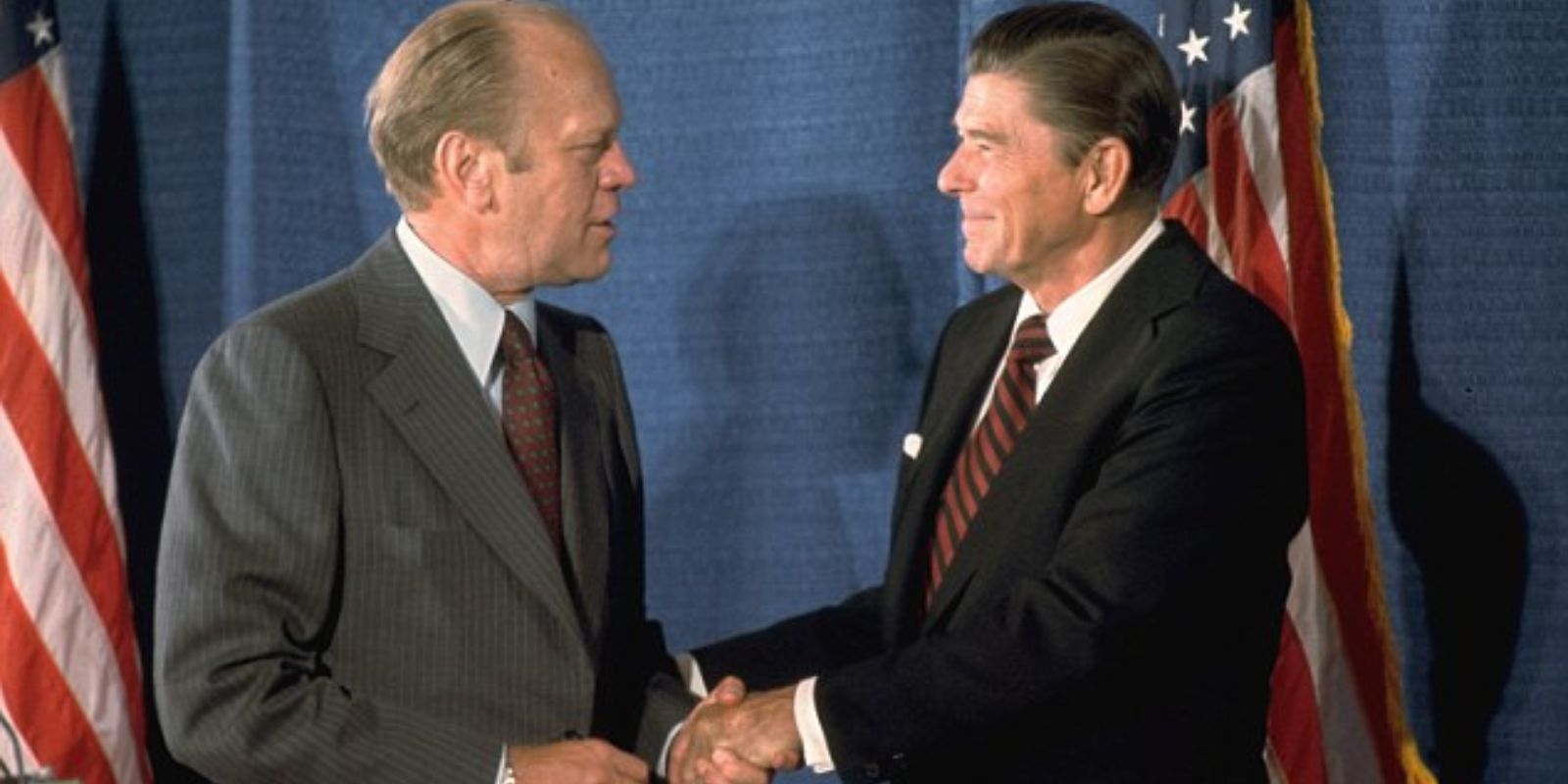
Against this backdrop, the more hardline Ronald Reagan staged a challenge. A former Hollywood actor and Governor of California, he took aim at excess government spending and Ford’s detente foreign policy stance, noting the country had “become number two in military power in a world where it is dangerous – if not fatal – to be second best.”
Supported by the American Conservative Union and publicly backed by John Wayne, Reagan was a competitive challenger. In his book A Time To Heal, Ford recalls that by December Reagan had the support of 40% of Republicans and just 32% supported him, noting how “I was a part of the ‘buddy system’ of Washington and he, Reagan, was the fresh face that the country was looking for.”
Reagan won primaries in 24 states largely across the south and west, capturing California and Texas.
His attempt to win over conservative Republicans was undermined by a few factors, such as his choice of the more moderate Senator Richard Schweiker and Ford’s endorsement by high-profile right-wingers such as former Republican presidential nominee Barry Goldwater.
In the end, Ford eked out a victory by 1,187-1,070.

He conceded however that “the Reagan challenge had required an awful lot of time, money, and energy. It had forced me to take some positions that I suspected would hurt me in November and it had delayed me some substantive accomplishments.”
The more conservative revolt was not a total lost cause that year as the right-wing had forced moderate Vice-President Nelson Rockefeller off the ticket; he would be replaced by Senator Bob Dole. The convention too adopted Reagan’s foreign policy plank in an embarrassing loss for Ford.
Ultimately, Ford would fight an uphill battle, being over 30 points behind opponent Jimmy Carter after the Democratic Convention. His decision to challenge his opponent to a debate, the first incumbent to do so, too turned out to be flawed.
On election day, Carter triumphed, able to clinch states on the southern coast and in Carter’s home of the deep south.
Notably, despite not getting the nomination, Ronald Reagan won one Electoral Vote from a faithless elector in Washington State.
3. Ted Kennedy
- Year: 1980
- President: Jimmy Carter
- Political Party: Democratic

By the time Carter was up for re-nomination, the economy had not made a marked improvement, with climbing inflation worsened by an ongoing energy crisis.
With the sitting president having a 28% Gallup poll approval rating, some Democrats feared heavy election losses if they continued with Carter. The only major candidate to step up to the plate was Ted Kennedy, the youngest brother of former President John F. Kennedy.
In the early going, Kennedy was beating Carter by a more than 2:1 margin with 62% approval. Nonetheless, the president said he would “whip his ass.”
Kennedy had the support of various Democrats, such as Senate Majority Leader Robert Byrd, Senator “Scoop” Jackson, and 1972 progressive nominee George McGovern. He too had support from various labour unions such as the AFL-CIO and celebrities such as author Norman Mailer, actor Jack Lemmon, and musician Andy Williams.
The Massachusetts Senator managed to win a double-digit number of states, including his home state as well as California, Pennsylvania, and New York, to name but a few.
Although the Kennedy family name was popular, he notably came into the race with baggage. In 1969, the Chappaquiddick incident occurred, in which Kennedy drove a car off a bridge, killing 28-year-old Mary Jo Kopechne, before leaving the scene. In the aftermath, the tragedy was seen as a killer of any chance he had to obtain the presidency.
As well as his own poor showing in a CBS interview, Carter benefitted from a spike in his poll ratings after the Iran hostage crisis. Strangely, the event that lost him the presidency perhaps helped him hold onto his party nomination.

The nomination was not decided until the 1980 Democratic Party Convention. Carter won 2,129-1,146. Kennedy managed to overshadow the victor however, with his memorable “Dream Shall Never Die” speech, regarded as one of the great political declarations of the late 20th century.
A blistering half-an-hour defense of liberalism, he espoused: “To all those who inhabit our land from California to the New York Island, from the Redwood Forest to the Gulf stream waters, let us provide new hope that prosperity shall not be purchased by poisoning the air, the rivers, and the natural resources that are the greatest gift of this continent. We must insist that our children and our grandchildren shall inherit a land which they can truly call America the beautiful…For all those whose cares have been our concern, the work goes on, the cause endures, the hope still lives, and the dream shall never die.”
Factors such as the baron economic situation and Iran hostage crisis led Carter to a crushing defeat in 1980, winning just six states and losing the Electoral College to Ronald Reagan 489-49.
Kennedy may have lost but he still attained 37% of the vote and, as of 2024, remains the last challenger to an incumbent president to win a state, carrying 13.
GRIFFIN KAYE.
Leave a Reply