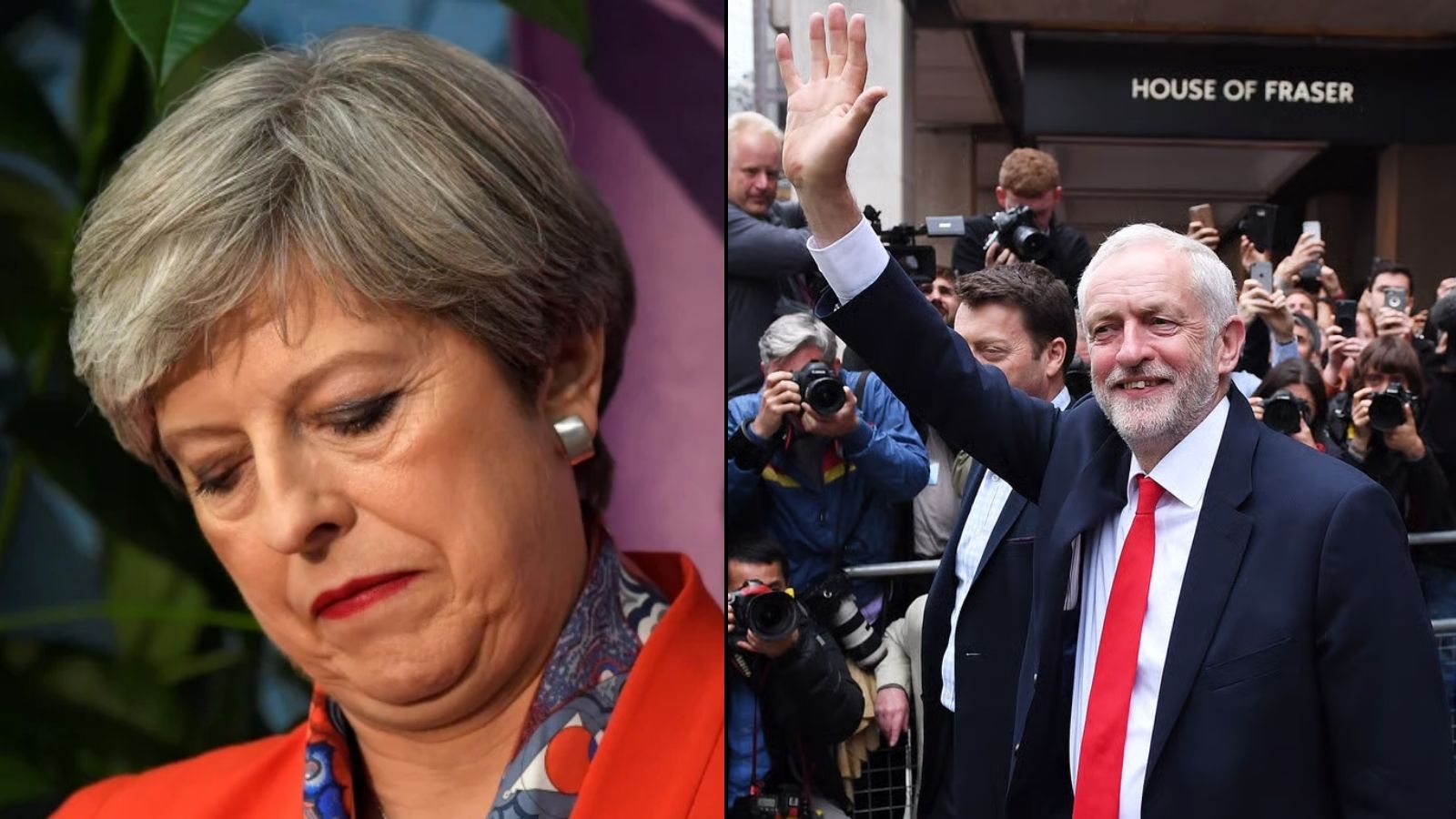
By 2017, everything in British politics had changed since 2015. Taking place less than a year after the historic Brexit vote, this election was shaped by the reaction to the UK’s departure from the European Union. With David Cameron out and Theresa May in, the new prime minister called an election, eager to strengthen her hand in withdrawal negotiations. Despite one poll showing a 25% poll lead over a divided Labour Party now led by socialist Jeremy Corbyn, on election day, Mrs May found her majority slashed and pushed into a weakened minority government.
1. The Highest Two-Party Vote Total since 1970

A consequence of the Brexit vote was a more polarised electorate. With Remainers voting Labour and Leavers voting Tory, the vote share won by the two big parties was the biggest since 1970.
Indeed, Britain seemed poised to return to a two-party system with the Tories and Labour amassing a combined 82.3% of the vote, up from just 67.3% two years earlier.
The real victims of this were the two biggest third parties at the 2015 election, the SNP, who lost the most seats of any party, and UKIP, whose vote share plummeted from 12.6% to just 1.8% (they also lost representation in the House of Commons).
2. Highest Labour Vote Share Since 1997

If any election result in UK history needs no introduction, it would be 1997’s. Winning over 400 seats, wiping the Tories out in their worst result since 1906, Tony Blair’s party won 43.2% of the vote.
Despite winning the 2001 and 2005 elections, Jeremy Corbyn’s remarkable comeback during the campaign tipped Labour over 40%. The feat is all the more incredible considering the opposition from senior Labour figures against Corbyn, his landslide loss in a non-binding no-confidence motion, and a high-profile leadership challenge.
The 9.6% vote increase under Corbyn was the largest vote increase percentage for the party since 1945 when Labour went from 38.0% to 49.7% and formed a government with a majority of 146.
3. Highest Tory Vote Share Since 1983

Despite actually losing seats, the Conservatives benefitted from the collapse of third parties, such as UKIP.
Their 42.3% was the highest since 1983, when Margaret Thatcher won the party a second term in power, easily mowing over Michael Foot’s Labour Party and winning 42.4%.
Notably however while the Tories won 317 seats with 0.1% less votes in 2017, Thatcher won nearly 400. While May was forced into a minority government, Thatcher obtained a massive 144-seat majority. This discrepancy can partly be credited to the role of the new Social Democratic Party (SDP), a breakaway movement from the Labour Party’s right-wing ‘moderate’ flank, who won over 25% of the vote, cutting into Labour’s support.
4. Two Former Major Party Leaders Lost Their Seat

In a highly unusual move, two former major party leaders lost their seats.
In Gordon, Scotland, former Scottish National Party leader Alex Salmond lost his seat to the Tories in the biggest swing of the night, over 20% to the Conservatives.
Elsewhere, in Sheffield Hallam, the once ultra popular Liberal Democrat leader Nick Clegg lost his seat by over 2,000 votes to the Labour Party candidate. It was a bruising night for the party who, although the most openly anti-Brexit, failed to make much traction from their 2015 rout.
This also meant that of the four leaders of the biggest arties in 2010, none were in Parliament any more after Brown stood down in 2015 and Cameron resigned in 2016.
5. The Conservatives’s Best Result in Scotland since 1979

In 2015, the Scottish National Party swept Scotland, taking 56 of the nation’s 59 seats on the back of the successful “No” vote a year earlier.
Popular Scottish Conservative leader Ruth Davidson helped the Conservatives to win a result in Scotland not seen in decades.
The party won 13 seats at the SNP’s expense, including the aforementioned Salmond and SNP Westminster leader Angus Robertson.
Coming second for the first time since 1992. It was its highest number of seats since 1983 and highest vote tally since 1979.
Managing to claw back more seats than Labour, the Conservatives became the largest unionist party north of the border since 1955 under Anthony Eden.
6. The Liberals Wiped Out in Wales for the First Time Since 1859

As mentioned, the Liberal Democrats’s results were a slight improvement on 2015 but as well as Clegg, the last Liberal in Wales found himself unseated.
Since its creation in 1859 from the remnants of the Whig Party, the Liberals had managed to hold at least one seat in Wales.
Its last MP was Mark Williams, who had held the seat since 2005. In an incredibly close-knit race, Williams lost his seat to the Welsh nationalist party Plaid Cymru, with Ben Lake edging out the Lib Dem by just 104 votes out of the nearly 40,000 votes cast. Lake won the election with a historically low 29.2% of the vote.
100 years on from David Lloyd George becoming prime minister and his home country was without a single Liberal.
7. 31 Constituencies Won By Under 1% of the Vote

Just under 5% of all seats were won on a thin margin of under 1%.
11 seats were won by less than 100 votes, an increase of eight from 2015.
The most eye-catching result of the night was a shock Labour victory in the wealthy London constituency of Kensington, where the party won by just 20 votes in a result that was announced a day later than everywhere else due to a number of recounts.
Elsewhere, the Conservatives would win back Richmond Park by just 45 votes after having lost it in a by-election the previous year.
In North East Fife, one of the closest ever results took place in which the SNP’s Stephen Gethins hang on by the skin of his teeth, defeating the Liberal Democrats by just two votes.
High profile MPs who came within 1,000 votes of losing their seats include Home Secretary Amber Rudd, Lib Dem leader Tim Farron, Tory leadership contender Stephen Crabb, SNP stalwart Peter Wishart, and Remainer and future Change UK founder Anna Soubry.
Minister John Gummer and upcoming Tory star John Gummer lost his seat by just 831 votes while Labour-turned-Independent backbencher Rosie Duffield was elected in Canterbury by just 187 votes.
However, it would be erroneous to claim this was an election dictated by marginal seat gains.
8. 35 Seats Won By Margin of Over 50%

Up from 21 in 2015, the number of seats won with a majority over 50% grew, another consequence of the two-party squeeze.
34 of the 35 seats were held by the Labour Party. The only non-Labour seat with a majority above 50% was Belfast West, held by Sinn Fein.
The five safest seats were in the North West, though London seats of Labour figures such as Jeremy Corbyn (Islington North) and future Labour leader Keir Starmer (Holborn and St. Pancras) were also won with majorities topping 50%.
By contrast, the Conservatives’s safest seat, Christchurch in Dorset, is only 37th.
The largest majority was over 42,000 in Knowsley while the largest majority was in LiverpoolWalton with an astonishing 77.1%. Talking of which…
9. Liverpool Walton Had the Largest Vote Share Won in 21st Century

Liverpool Walton holds the title for being the safest seat in the coutry and in 2017, it made history.
Dan Carden was elected for the Labour Party on 85.7% of the vote, a 77.1% majority over the Tories, who won just 8.6%. Carden’s 85.7% was an increase of 4.4% from 2015.
His vote share fell 1% in 2019 and crashed to just over 70% in 2024, with Reform storming ahead of the Tories into second place.
With the UK party system becoming increasingly fragmented, it is unlikely any vote percentage so high can be won in a contested general election constituency again.
10. The Most Lost Deposits of Any UK Election

Another result of the two-party squeeze was the highest ever number of lost deposits.
In order to stand, an individual or party puts down a £500 retainer, which they can get back if they win more than 5% of the vote.
The Liberal Democrats had a haemorrhage at this election, losing their deposit in 375 seats, accounting for nearly 60% of their candidates. The 2017 election report by the House of Commons notes between 1983-2010, the party normally lost five deposits.
Similarly, third parties faced a bloodbath. UKIP lost nearly 90% while the Greens lost 98% of their deposits, retaining just 11of the 46 seats contested. This amounted to £228,000 lost for the party.
Perhaps the most notable candidate to lose their deposit was Labour MP Simon Danczuk. Suspended by the party for alleged sexual impropriety, he stood as an independent in his Rochdale seat but won just 1.8% of the vote.
In all, 47.5% of candidates lost their deposit.
By contrast, the Conservatives lost just seven (all in Northern Ireland, where Tory support is negligible) and Labour lost none for the first time since 2005.
GRIFFIN KAYE.
Leave a Reply