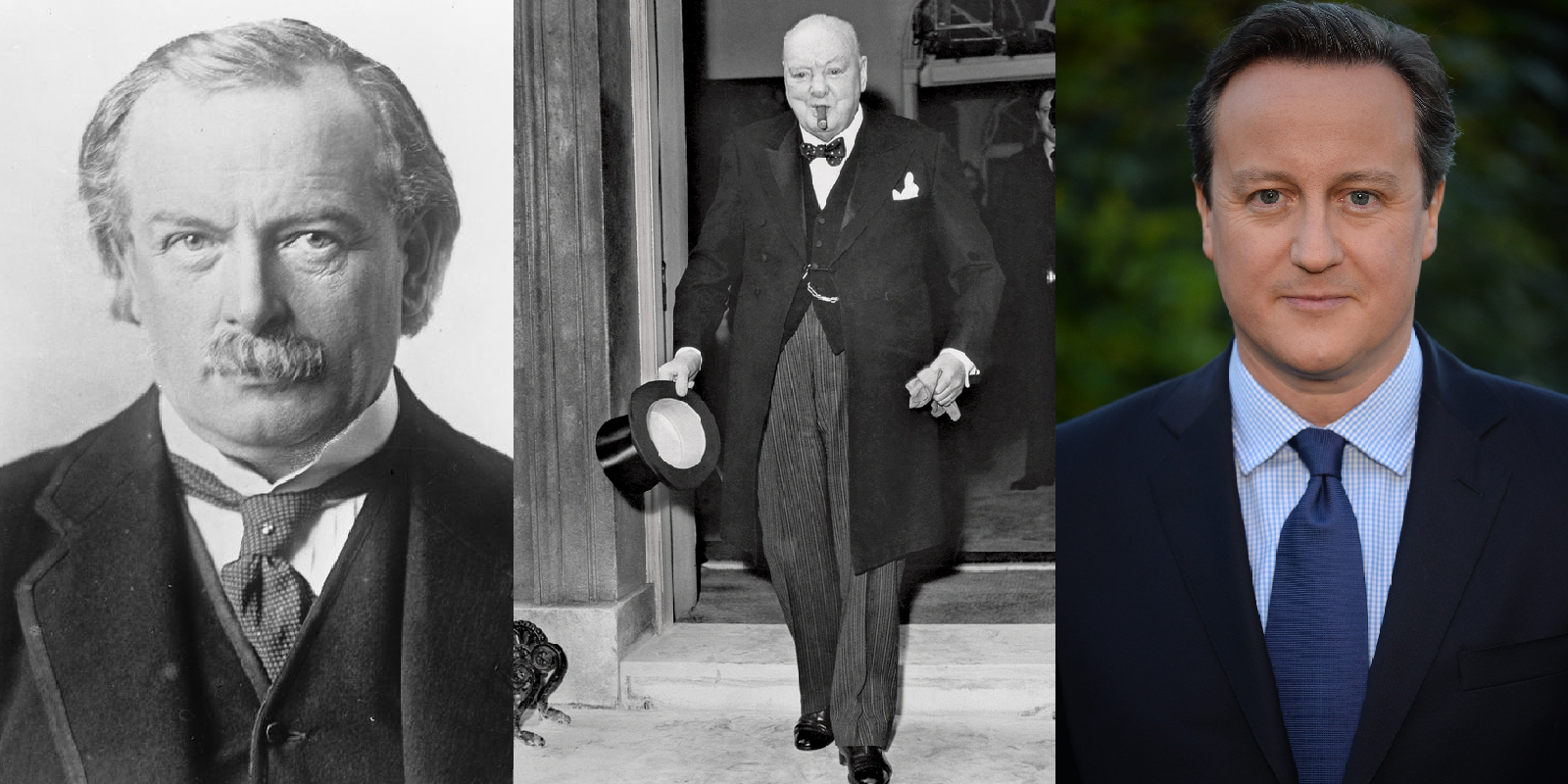
#11. Clement Attlee

Up there with Churchill in the prime slot for Britain’s greatest PM, the end of his premiership is an interesting albeit unfair bit of trivia.
Winning the 1945 general election in a landslide win – in which the Conservatives won less than 40% of the votes despite winning the war – Attlee’s promises of post-war reform led to a huge swell of Labour support. Attlee’s government went on to implement a number of popular socialist policies such as the establishment of the National Health Service and the nationalisation of industries such as coal, iron, and the railways.
After just being able to clasp onto a majority in the 1950 election, another was called the next year in the hope of increasing this majority.
However, despite Labour scoring the highest-ever vote tally (not surpassed until the 1990s) and the highest percentage of any party in post-war Britain at nearly 49%, the Conservatives won despite having nearly a quarter of a million fewer votes. This was due to the country’s first-past-the-post system which helped the Tories gain more seats with many seats uncontested by Liberals allowing an easier route to a Conservative victory. Despite the most impressive post-war showing for any party to this day, Labour still lost.
#12. Anthony Eden

Although a big wartime presence, Anthony Eden is regarded as perhaps Britain’s worst PM due to the Suez Crisis.
A skilled dresser may be Eden’s biggest legacy, wearing a black Homburg hat with a silk brim in a look that quickly became a trademark of Eden’s, even referenced in letters by a young John F. Kennedy. The hat is today probably most associated with on-screen characters from mid-20th century television programmes such as Albert Steptoe in Steptoe and Son and Sergeant Arthur Wilson in Dad’s Army, with the hat also worn by the likes of Tony Hancock and – strangely enough – President Eisenhower at his presidential inauguration.
Along with what Time described as “pin-stripe trousers, modish short jacket, and swank black felt hat,” he became nicknamed as one of the “glamour boys”; he has been described by Rab Butler as “half mad baronet, half beautiful woman.”
Eden is thought to have taken great care of his looks – thought to have even varnished his fingernails, often described as the only PM to do so – it worked with Lewis Broad writing how upon a trip to New York in the ‘30s, he was “deluged with fan mail from teenage college girls to elderly matrons.”
#13. Harold Macmillan

PM from 1957-1963, Macmillan served during a time of economic resurgence in Great Britain, capitalising on Keynesian and mixed economic models leading to low unemployment whilst also presiding over one of the most heated periods of the Cold War.
Macmillan was the final PM to bear any facial hair, possessing a moustache. Ever since this, it has become arguably politically unacceptable for major politicians to wear facial hair. Unelectability may lie in the fact it makes the wearer look lazy, uncleanly, or even pro-communist, with no PM rocking a full beard since Salisbury.
This dying out of facial fuzz is odd considering that from 1922-1957, a moustached PM always succeeded a clean-shaved one, and vice versa.
The facial hair seems to be dying out in politics – Jeremy Corbyn a recent exception – with Macmillan putting in the last shift for hirsute politics.
#14. Alec Douglas-Home

Had Macmillan resigned a year earlier, the idea of the 14th Earl of Home, sitting in the House of Lords, serving as PM would be out of the question. To be applicable for this role, Home has Tony Benn to thank.
In 1963, future Labour Cabinet minister Tony Benn successfully lobbied to revoke his hereditary peerage, instigating the Peerage Act 1963 which let members disclaim their peerages within a year. During this time, Macmillan resigned, allowing Home a “constitutional possibility” (as D.R. Thorpe wrote) to become prime minister.
Although winning the leadership of the Conservative Party, Sir Alec had not been elected to represent a constituency so quickly needed to win a seat. ADH was then pencilled in as a candidate in a by-election in Scotland’s safest Tory seat in Kinross and Western Perthshire. He won decisively with a majority of over 9,000 votes – 14,000 out of over 24,000 – equating to 57% of the vote, with Douglas-Home uniquely serving as prime minister for 20 days when not yet elected. (As an aside, an interesting note from the 1963 by-election is that ADH ran against Independent candidate Willie Rushton, the co-founder of Private Eye and I’m Sorry I Haven’t A Clue panellist; he won 45 seats.)
His win in 1963 was controversial, with the next Conservative leadership election instituting a secret ballot by the party in the aftermath. Home proved to be controversial with up-and-coming Tories such as Enoch Powell and Iain Macleod refusing to serve in his Cabinet whilst Leader of the Opposition, Labour’s Harold Wilson, successfully framed Home as an aristocrat out of touch with the British public prior to the 1964 general election, which ADH lost.
#15. Harold Wilson

Ex-civil servant Harold Wilson was first elected to Parliament in 1945, the Labour landslide, and quickly found himself amidst the Labour in-crowd.
At the young age of 31, Wilson was appointed President of the Board of Trade. This appointment made Wilson the youngest Cabinet member of the 20th century. Becoming Labour leader upon the death of Hugh Gaitskell in 1963 and prime minister the following year, Wilson became the first PM of the 20th century to take office under the age of 50.
On the opposite side of the age spectrum, Wilson’s wife Mary became the first spouse of a PM to become a centenarian, living to 102, born in 1916 and dying in 2018. For reference, Mary lived through both the Russian Revolution and the poisoning of the Skripals at the hands of the Russian nerve agent Novichok.
As well as the youngest, he was the most numerous electoral winner, having won four (1964, 1966, January 1974, October 1974) – the most of any prime minister of the 20th century.
Leave a Reply