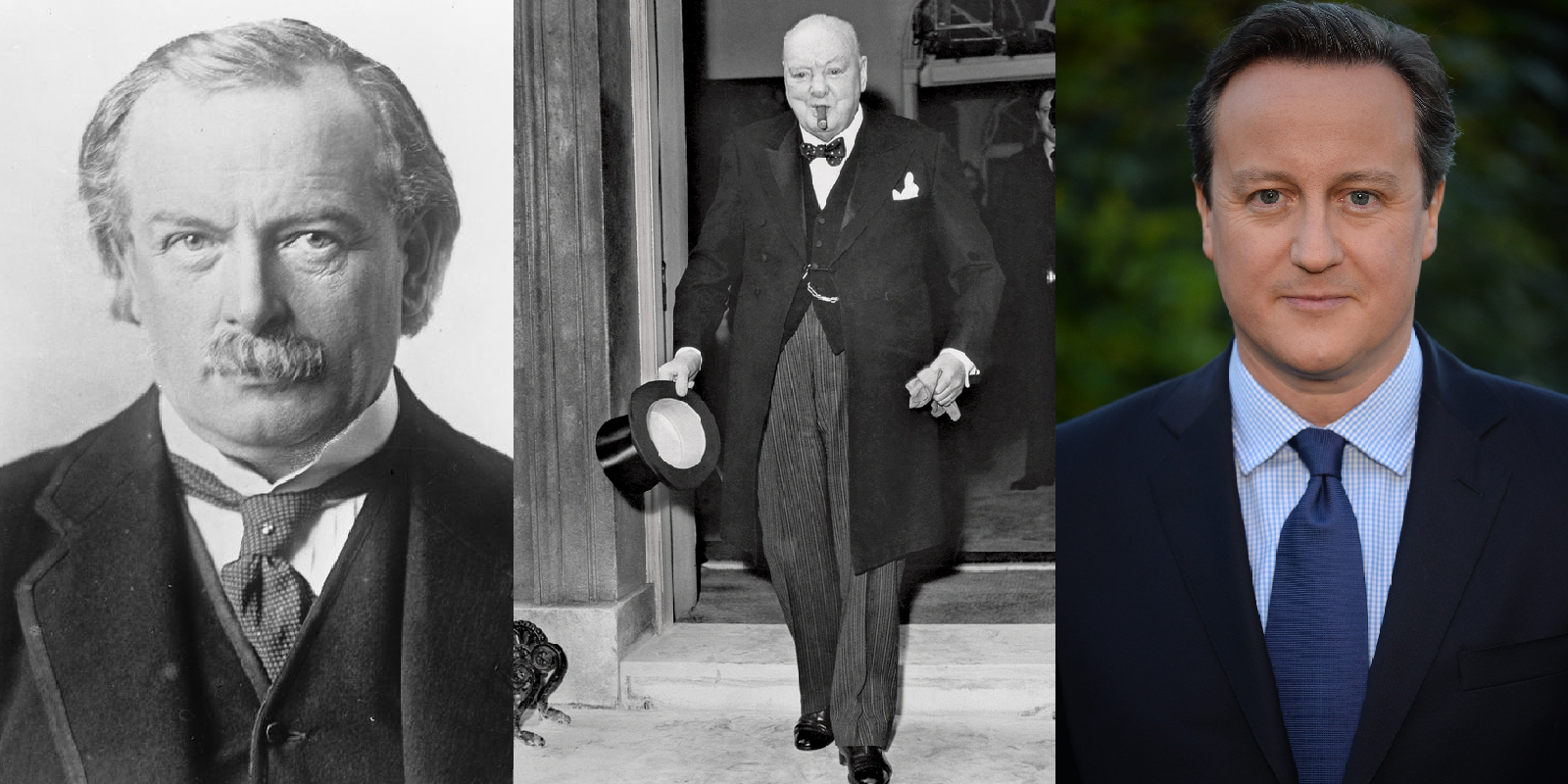
#21. Gordon Brown

Emerging as the only candidate for Labour leadership after Blair’s resignation, Brown’s appointment made him the only PM to have completed a PhD.
Brown completed his PhD in history in 1982, writing a thesis titled Labour Party and Political Change in Scotland, 1918-1929: The Politics of Five Elections. Brown graduated from the University of Edinburgh in 1972, with an undergraduate MA degree with First-Class Honours.
Having been elected Rector in 1972, Brown has stayed close to the education sector since. As well as a champion of educational funding when Chancellor and PM, he embarked on a stint as a lecturer and tutor for the Open University, which he has labelled a “national treasure.” He has gone on to hold onto positions such as a UN Special Envoy on Global Education and chaired the unpaid position of the International Commission on Financing Global Education Opportunity.
#22. David Cameron

Like the Labour Party in the ‘90s, the Conservative Party needed to undergo changes in the ‘00s. The party needed to adapt from its perception of the ‘nasty’ party to the ‘compassionate’ party which was instituted under David Cameron.
An interesting fact about Cameron is that in 2013, David Cameron lost the first foreign policy vote in over 200 years; the last occasion was in 1782 amid the American Revolutionary War. This vote was over Syrian intervention and while Cameron did not necessarily have to ask Parliament, he did so due to convention. The end vote was 272-285, a majority of 13 opposing the motion.
Cameron was also the first and only PM to date to host a pre-legislative referendum, of which he held two. Although Harold Wilson held a 1975 referendum on EC membership, this first-of-its-kind idea was post-legislative with Britain having entered in 1973 when the Conservative government did not offer the public a say in the matter. Cameron held two, memorably losing his desired effect of remaining in the EU in 2016 as well as a 2011 vote on implementing an alternative vote (AV) political system to replace first-past-the-post, which failed with apathetic turnout figures.
#23. Theresa May

Upon being appointed PM in 2016, the ex-Home Secretary Theresa May made history as the first female holder of two Great Offices of State.
May’s tenure is largely remembered for the dominant matter of Brexit although she was also in power during a number of crises such as terrorist attacks (Westminster, Manchester Stadium, and London Bridge), the Grenfell Tower fire, and a marked increase in knife crime.
Having to juggle a party divided over the EU withdrawal, May found herself disadvantaged further by lacking a majority after the snap election in 2017.
May faced an unprecedented number of resignations during her short stint with over half of these due to Brexit-related matters.
It may come as no surprise then that Brexit’s chances were stifled. Not only was her government the first found to be in contempt of Parliament over ministers’ refusal to publish the legal advice they have received on Brexit. Moreover, in January 2019, the rejection of her Brexit deal saw the biggest House of Commons defeat of any sitting government ever. Although no government in the post-war era had even lost by 100 votes, May’s first Brexit deal agreement lost 202-432, a majority vote of 230. The BBC’s Laura Kuenssberg described it as being “a higher figure than the wildest of numbers that were gossiped about before the vote.”
#24. Boris Johnson

A unique PM, Johnson instigated a number of records and accolades in British history.
Boris became PM in 2019, decisively winning the Tory leadership election. Born in the USA, he became the first prime minister to be born outside of a UK-owned territory although he was raised in England, famously joining the Bullingdon Club. Unlike the USA, PMs do not need to be born in the UK to serve as their head of government.
Johnson became the first PM in nearly 200 years to marry whilst in office, done in secret in 2021. This was the first marriage in office since Lord Liverpool in 1822.
Boris, during his stint in power, also became the first PM to break the law when he was issued a fixed penalty notice in 2022 over lockdown parties, often referred to now as ‘Partygate’. Fines were gifted to Boris, his wife, and Chancellor Rishi Sunak – the latter of whom got another fixed penalty notice in 2023 for being seen without a seat belt whilst filming a promotional video.
His tenure ended in July when a mass wave of resignations took place. In the space of about 48 hours, 62 MPs resigned from the government, triggered by the Johnson’s promotion of the known sexual deviant Chris Pincher but also likely caused by a build-up of hostility towards sleaze allegations such as ‘Partygate’ and the Owen Paterson lobbying case. Boris held on as long as possible until his position was officially untenable although giving one final flourish, sacking longtime ally Michael Gove, firing him at 20:58 after he gave Johnson an ultimatum to resign by 21:00. This was the biggest set of resignations in history.
#25. Liz Truss

Liz Truss will forever be synonymous with two things: Queen Elizabeth II’s serving PM at the time of her death and crashing the economy.
Trying to imitate the looks of Margaret Thatcher in her dress, the Les Echoes paper described her as the “Iron Weathercock,” in part referencing her political icon. Her attempts at the resemblance to Thatcher and following of Thatcherite policies (as well as her denunciation of the “anti-growth coalition” of unions, left-wing parties, and protestors at the Conservative Party Conference) were ironic considering her radical past where she seemed more Michael Foot than Maggie Thatcher.
Truss was a protestor in her younger years, chanting and singing anti-Thatcher rhetoric. She has since praised Thatcher as a “brilliant leader” with whose image she managed to win over the Tory Party membership.
President of the Oxford University Liberal Democrats, in the wake of her win, various past statements came back into the public eye. In the same era, Queen Elizabeth II passed away with Truss at the helm, clips resurfaced of the 1994 Lib Dem Conference when Truss stated: “We Liberal Democrats believe in opportunity for all. We believe in fairness and commonsense…we do not believe people are born to rule,” whilst calling the concept of the monarchy “disgraceful.” The motion of abolition was rejected whilst Truss’s anti-monarchy sentiment was said to have angered Lib Dem leader Paddy Ashdown due to Truss’s “hijacking of the conference.”
Born into a left-wing family, she also participated in marches with the Campaign for Nuclear Disarmament (CND) whilst campaigning on the legalisation of cannabis.
Since coming into the public eye, she has generally played down this radical side of her past – ironically something also done by Opposition leader Sir Keir Starmer – telling The Sun: “I probably didn’t know what I was saying. I was seven at the time.”
#26. Rishi Sunak

In 2022, Britain was given its first black prime minister when Rishi Sunak was chosen. Yet the win was far from Obama’s in 2008; Sunak was elected by only about 100 people, was chosen during a time many felt a general election should be held, and had lost a previous leadership election shortly beforehand with Keir Starmer remarking Sunak “got trounced by the former prime minister, who herself got beaten by a lettuce,” referencing the famous Daily Star campaign predicting correctly Truss would resign before a chosen lettuce wilted.
It is not an unknown fact but nonetheless an interesting one of Rishi Sunak’s wealth.
Virtually unknown until appointed Chancellor by Boris Johnson, the role was perhaps given to him on the basis of being one of the wealthiest people in the country.
Sunak met his future wife Akshata Murty whilst at Stanford University, with the couple marrying in 2009. Murty owns just under a 1% stake in her father, Indian billionaire businessman N.R. Narayana Murthy’s Infosys company.
With this, the couple is thought to have a combined wealth of £730 million. $830 million in US dollars, many people – especially foreigners – were surprised to learn that the newly-crowned PM was richer than King Charles III, with The Mirror referring to it as an “extraordinary fortune,” which makes him them the 222nd richest people in Britain. The King is estimated to have about £370 million.
Sunak is the richest ever PM, something netting him criticism especially as he navigates the UK through an economic crisis.
Prior to Sunak, the richest was the Earl of Derby, Edward Smith-Stanley. Elected in 1852, Guinness World Records puts his wealth at £440 million in today’s money. He owned 57,000 acres of land in Lancashire, born into one of the country’s wealthiest families.
Their wealth has seen controversies and scandals for the couple, however. One of the biggest was Murty’s non-dom status which meant that as she was registered in India, she had to pay a minimal amount of imposed tax, with CNBC stating that the family managed to legally dodge £20 million. Moreover, Sunak faced criticisms for the family’s continued operation in Russia after their invasion of Ukraine, deemed inappropriate for a member of the Ukraine-supporting British Cabinet. Sunak has more recently been attacked for taking unnecessary private jet trips between locations that could be reached in a more eco-friendly and modest way.
Leave a Reply