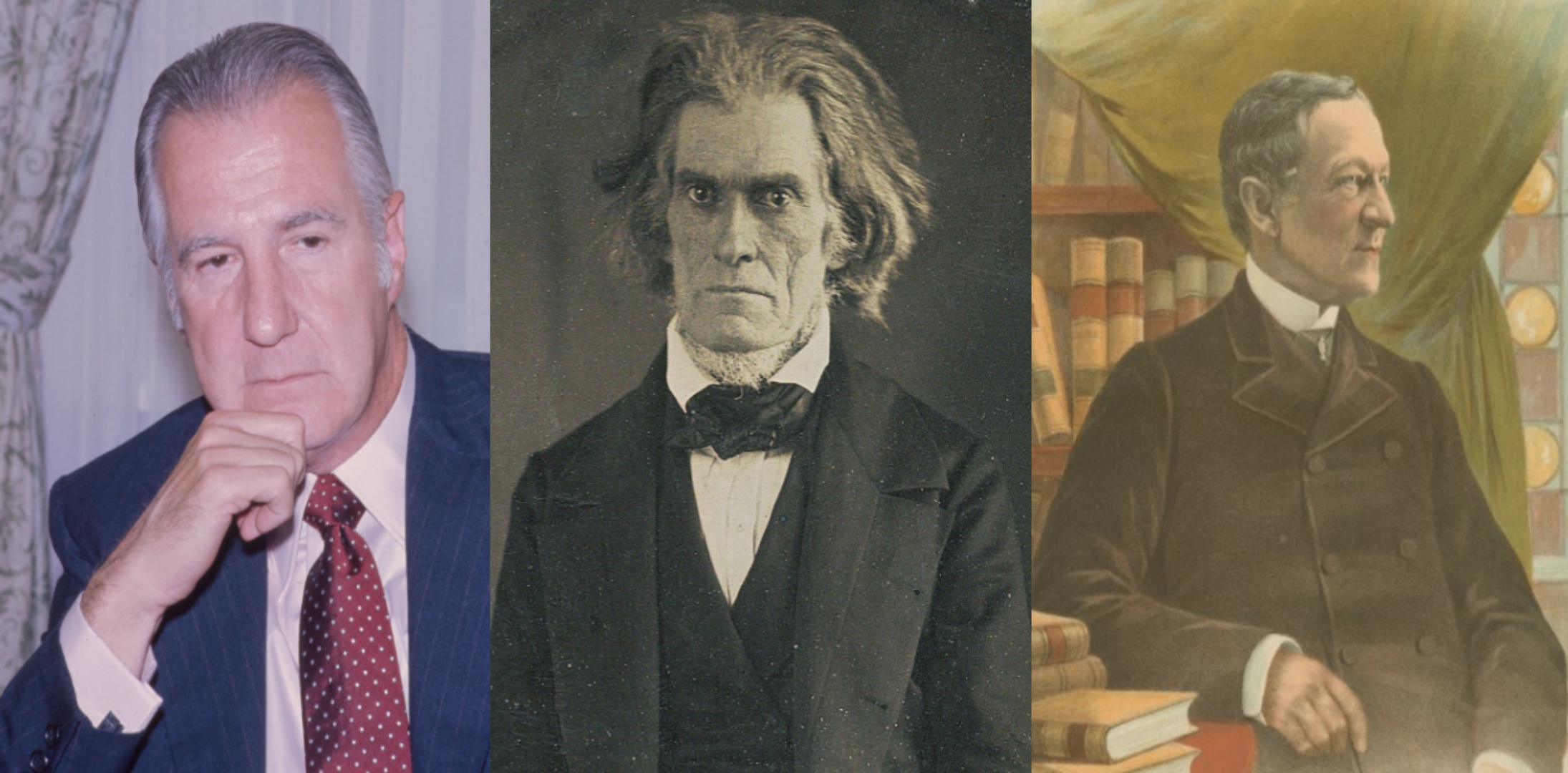
The Vice Presidents usually play second banana to the commander-in-chief with the VP’s role being that he or she is required to break any ties that occur in the senate and certifying the electoral count following a presidential election.
Some Vice Presidents have had great tenures in office and then you have those VP’s that tend to make the president’s life absolute hell…And that’s what will be looking at today with the Ten Worst Vice Presidents in U.S. History.
For this list, I will be ranking those VPs who are known for their scandalous but problematic terms in office and whose actions during and after their tenure. I’m excluding any vice presidents who became president and I’m also not including those that are still in office or recently got out of office, so JD Vance or Kamala Harris will not be making this list.
#10. Dan Quayle (Vice President: 1989-1993)

James Danford Quayle (or Dan Quayle for short) was the son of a newspaper magnate before being selected by then Vice President George HW Bush to be his running mate which was unusual to many due to Quayle’s limited experience, dodging the Vietnam draft plus his views on homosexuality, family values and a decline in morality were considered outdated.
After he and Bush won the ’88 election, he was known for making a number of outrageous comments that at best are hilariously bad and at worst completely inaccurate; Quayle infamously was caught on camera failing to spell the word potato only for a 12 year old school boy to correct him and he also gave a speech condemning a TV character named Murphy Brown, who was a recovering alcoholic and an unmarried female reporter…All of which led to further embarrassment to the Bush Administration.
Following Bush Senior’s defeat to Bill Clinton in 1992 and Quayle’s failed presidential run in 2000, the former Indiana Senator would become the chairman of a Republican action committee as well as the chairman of a private investment firm.
While Quayle’s bouts of humiliation weren’t the worst thing a VP has done in office, his political views were certainly behind the times and made him look like someone out of touch with the issues.
#9. Mike Pence (Vice President: 2017-2021)

Pence is another conservative turned VP who has a less than stellar track record with the LGBTQ community and much like his boss at the time, Mike had no problem stirring up some controversy.
For starters, he casted a tie breaking vote in the Senate that would’ve seen horrendous results for the nonprofit health organization Planned Parenthood, but the bill didn’t pass due to the House of Representatives soon being filled with Democrats after the 2018 midterms.
In 2020, Pence began spreading conspiracy theories over the president’s actions following the death of Iranian General Qasem Soleimani which saw Pence claim everything from Soleimani murdering thousands of Americans to connections with 9/11 and Al-Qaeda…None of which were true. Months later, the Covid-19 Pandemic made it’s way into America, Pence downplayed if not lied about the lives lost by the virus despite scientific evidence proving otherwise.
What keeps Pence from ranking higher on this list is the fact he refused to go along with Trump’s plan to not certify the electoral votes after losing the 2020 presidential election…And we know how that almost turned out for Mike.
Overall, Pence is similar to Quayle in a number of ways in that both served their bosses well (to varying degrees of success) and spend most of their time as VP making a bunch of misleading statements.
#8. John Breckinridge (Vice President: 1857-1861)

John Cabell Breckinridge was a House Member for Kentucky’s 8th District before he became the running mate to James Buchanan in the 1856 election; While Buchanan didn’t actively campaign (as most candidates didn’t due at the time), Breckinridge did campaign giving passionate speeches in a few swing states whilst warning that the Republican Party would cause the Union to divide if elected.
Buchanan won the election and Breckinridge became America’s youngest Vice President at just 36 years old. Despite this honor and the fact he was elected to the U.S. Senate while still serving as VP, both he and Buchanan didn’t get along so well which probably explains why the president didn’t have him do much during his tenure.
By the time of the 1860 election the Democratic Party was so divided, it had two candidates running for president with Breckinridge being one of them but he ended up losing to the Republican Party’s Abraham Lincoln who became the 16th President of the United States.
As Southern states began to secede, Kentucky decided to stay loyal to the Union, however Breckinridge wasn’t so keen on this idea as he resigned from his position as Senator to fight for the Confederacy in the American Civil War and briefly became the Secretary of War for the Confederates in 1865.
When it became clear that Union forces were going to win, Breckinridge escaped to Cuba, but eventually returned to the U.S. where he became a manager of an insurance company and continued his law practice, but never re-entered the world of politics before dying on May 17th 1875 at the age of 54.
#7. Schuyler Colfax (Vice President: 1869-1873)

One of two Vice Presidents to have previously served as Speaker of the House prior to becoming VP, Schuyler Colfax was a career politician who joined the Whig Party and later the Know Nothing Party before associating with the radical anti-slavery section of the Republican Party.
After Ulysses Grant won the election of 1868, Colfax (who was Grant’s running mate) became the 17th Vice President and….he didn’t really do much during his time in that position.
By 1870, Colfax announced he wouldn’t run for public office, although he secretly was planning to run for president in the 1872 election under the belief that Grant wouldn’t run for a second term. Well this plan backfired when it was revealed that Grant would run for re-election and this left Colfax scrambling to run for re-election for his VP spot, but by that point it was too late and he was replaced on the ticket with Massachusetts Senator, Henry Wilson.
Things went from bad to worst for Colfax when in September of 1872, a number of politicians were caught up in the Crédit Mobilier scandal; Even though Wilson was also implicated in the scandal, it wasn’t bad enough to ruin his career like Colfax who would die from a heart attack a little over a decade later whilst waiting at a train station.
#6. Levi Morton (Vice President: 1889-1893)

Levi Parsons Morton was a businessman turned politician who quickly aligned himself with Roscoe Conkling, a New York political party boss who led a corrupt but powerful faction in the Republican Party called the ‘Stalwarts’. In 1880, Conkling and the rest of the stalwarts were trying to get former president Grant to run for a third term, only for the Ohio Representative James Garfield to be the party’s nominee instead.
Realizing that he needed the state of New York to win the race, Garfield met with the stalwarts in order to find a running mate; Garfield choose Morton but Conkling told him to refuse which Levi did. Morton would be given another chance to become Vice President when he ran with Benjamin Harrison in the election of 1888 and became America’s 22nd Vice President.
What get’s Morton on this list is his actions during the Senate’s decision over the Lodge Bill, which would’ve granted African Americans voting rights in the South; When the bill was sent to the Senate, Morton had to cast the tie breaking vote as part of his role as VP and instead refused to support his fellow Republicans on this issue; He even refused to step down in order to let another Republican make the vote instead and this led to the bill dying on the Senate floor.
Furious over his actions (or lack thereof), Harrison and the Republicans kicked Morton off the ticket in the 1892 election in favor of newspaper editor and Minister to France Whitelaw Reid, but the ticket lost the election to Grover Cleveland.
#5. Spiro Agnew (Vice President: 1969-1973)

Another Vice President accused of corruption, Spiro Agnew became famous on the world stage when he was chosen to be Richard Nixon’s running mate in the election of 1968 and proved to be a very reliable asset for Tricky Dick, thanks to Agnew’s agressive and unpolished style of talking which allowed him to be Nixon’s attack dog throughout the election.
Upon winning the election, Nixon struggled to find a place for his VP, however it wasn’t until late 1969 when Agnew became known in the media and the GOP for his speeches criticizing the Democrats and Anti-War Protesters while also consolidating the Republican Party’s support within the Deep South.
Referred to as “Nixon’s Nixon”, Agnew would verbally support the presidents ideas as much as he would verbally attack his enemies which not only allowed Nixon to stay above the fray but also helped to build the VP’s name recognition for a future presidential run.
Unfortunately for Agnew that presidential bid never materialized as he was investigated for corruption charges which was traced all the way from his time as Baltimore Maryland’s County Executive to his time as Governor in that state and he was even still accepting bribes whilst serving as Vice President.
Eventually evidence against Agnew continued to build up, leading to him announcing on October 10th 1973 that he would be resigning from his position making him the first Vice President in over a century to do so.
#4. Richard Mentor Johnson (Vice President: 1837-1841)

Some Vice Presidents tend to generate contraversy while in office, some do so as there running for the job and some manage to do both; Former U.S. Representative and Senator of Kentucky, Richard Mentor Johnson is in the latter category.
After failing to win the Vice Presidential nomination four years earlier, Johnson would run for the position again in 1836 but was met with cynicism with many in the Democratic Party over his marriage to a slave named Julie Chinn and claims about him killing the Shawnee Indian Chief Tecumseh during the War of 1812.
With the support of Andrew Jackson and others, Johnson became Martin Van Buren’s running mate. By the time election day concluded, Van Buren did indeed win the election, but did so without four Southern States (South Carolina, Georgia, Tennessee and Johnson’s homestate of Kentucky); Even worst, Johnson failed to win enough votes to win the Vice Presidency which led to the first and only time the Senate had to choose who would be the VP.
Thanks to the Democrats having more control in the Senate, Johnson became the new Vice President, but if your expecting things to go even more downhill for Johnson while being the VP, well prepare to be impressed.
When the U.S. economy crashed thanks to the Panic of 1837, Johnson left for almost a year to recuperate his finances by opening a spa and tavern which went about as well as you could imagine when word of this was made known to many Democrats. He also got someone appointed to a position as a way to pay off a debt he owed, plus he rarely appeared in the Senate to cast a tie breaking vote and even refused to support some abolitionist legislation due to the fact he still owned slaves.
The Democrats refused to support Johnson as the running mate by 1840 and thus was dropped from the ticket despite Van Buren’s hesitation and Johnson’s own ill-conceived efforts to keep his job. Afterwards, he failed to win political offices from 1842-1848, until he became Representative again in 1850 but he died a few weeks later from a stroke at the age of 70.
#3. Aaron Burr (Vice President: 1801-1805)

You know your notoriety is something else when it becomes a part of a famous musical named after the person you murdered…such was the case of Aaron Burr, the former New York politician who nearly became commander-in-chief until one man’s decision changed everything.
During the election of 1800, Thomas Jefferson and Aaron Burr represented the Democratic Republican Party (no relation to the two major parties of today) with Jefferson expected to win the presidency and Burr being the Vice President; When the results emerged Jefferson looked ready to become the new president, except Burr had the exact amount of votes thus making it a tie and the House of Representatives had to decide the winner.
In the end, Jefferson won the vote and became the third U.S. President due in no small part to former Secretary of the Treasury, Alexander Hamilton who believed Burr was not the right choice and convinced many in the House to vote for Jefferson.
Burr’s time as VP wasn’t all that memorable (probably since Jefferson shut out Burr from all major decisions within his administration), but Burr did receive acclaim for his well mannered attitude when presiding over the Senate over issues like the impeachment of Supreme Court Justice Samuel Chase, not to mention his farewell address after being replaced off the presidential ticket in 1804 was met with a positive response.
What wasn’t so positive was Burr’s reaction to losing a race for the Governorship of New York in 1804, as Hamilton was somewhat connected to Burr’s defeat in the state leading to both men having the infamous duel that saw Hamilton dead and Burr’s political career end in disgrace.
A failed attempt to take over Spanish controlled territories in the Southwest led to Burr being tried by Attorney General William Wirt for Treason against the U.S., but the charges were dropped. Burr would travel to Europe before returning to New York where he lived the rest of his days before suffering a stroke and later dying on September 14th 1836.
#2. John Calhoun (Vice President: 1825-1833)

An agitator of presidential authority, the embodiment of states rights and supporter of slavery in the early 19th century, John Calhoun is recognized as one of the nation’s most important Senator’s alongside names like Henry Clay, Daniel Webster and Robert La Follette Sr., however his infamy can best be seen during his time as Vice President.
Upon realizing that his chances of winning the Oval Office were fruitless, Calhoun decided to go for the Vice Presidency in 1824, which he won and spent the next several years quelling with President John Quincy Adams over issues about high tariffs and U.S. involvement in foreign affairs.
This led to Calhoun resigning from his position in order to be Jackson’s running mate in 1828, Unfortunately Calhoun’s tenure as VP would only get worse as Jackson despised Calhoun thanks to the Petticoat Affair, the Nullification Crisis and revelations of Calhoun being the one to censure ‘Old Hickory’ during the latters military efforts in Florida in 1818.
Not long after denying fellow Democrat Martin Van Buren the opportunity to become the new Minister of Great Britain, Calhoun once again resigned from his VP spot ahead of the next election leaving Jackson to win re-election and choosing Van Buren as his Vice President.
Calhoun would continue to serve in politics where he pushed hard for the annexation of Texas while also maintaining his support of slavery and states rights until he died from tuberculosis on March 31st, 1850.
#1. Dick Cheney (Vice President: 2001-2009)

Many of the VP’s on this list are considered the worst due to a host of reasons: falsified claims, caught in corruption charges, killing a fellow politician and supporting the practice of slavery; Our last entry certainly was accused or allegedly implicated in at least three of those crimes and his impact on American politics can still be felt today.
Following the events of 9/11, Dick Cheney became a more integral part of the Bush administration when it came to foreign policy as Cheney would make misleading statements about Saddam Hussein being connected to Al-Qaeda and the September 11th Attacks even though there was zero evidence backing these claims.
He was dismissive against anyone who didn’t support George Bush’s invasion of Iraq and supposedly made money off of America’s involvement in Iraq, plus he had some connections to shady business people who worked in Enron and Halliburton (the latter of which got massive government contracts during the War on Terror).
Cheney defended the president’s plans on expanding the NSA’s efforts to spy on average Americans and supported the use of waterboarding as one of many woeful actions of enhanced interrogation to get information of their foreign enemies.
Overall, Cheney was a ruthless man who had no problem using his position in and out of government to benefit himself and his buddies thanks to needless wars that are still going on today.
Make sure to follow Lace ‘Em Up on X @laceemupoffice and on Bluesky Social @laceemupmedia.bsky.social. You can follow me on X @hakeemfullerton and Bluesky Social @hakeem96.bsky.social for politically themed articles such as these and I’ll see you in the next article.
Leave a Reply