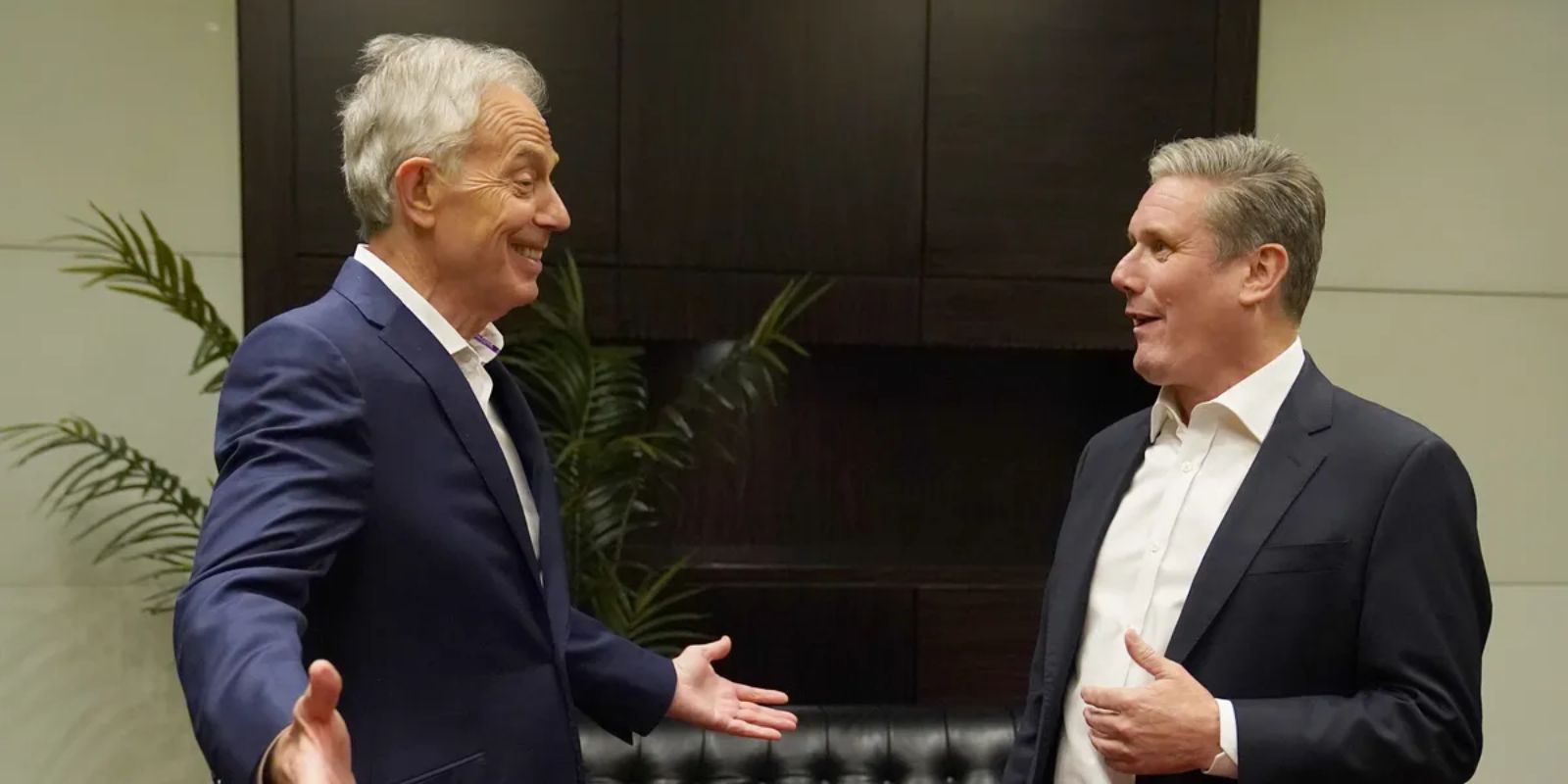
In his quest to become Prime Minister Keir Starmer has positioned himself as the next Tony Blair, an “the heir to Blair” to use his own words. As well as working closely alongside the former prime minister, everything from his pledge cards to his broad policy positions, he is making himself in the mould of New Labour’s frontman. However, how apt are the comparisons? This piece will examine how similar and different the two really are.
YES
The Third Way

(Photo: BBC)
Starmer’s leadership has reflected Tony Blair’s Third Way socialist approach. Popularised by the work of sociologist Anthony Giddens, this more radical centrist approach buys into the ‘revolution through evolution’ model, believing radical change can be achieved through constitutional alterations. Alongside Bill Clinton in the United States, Blair brought into this concept which argues for an openness to capitalism, greater democracy, and equality of opportunity
Starmer previous pledged to abolish the House of Lords and replace it with an elected chamber, building on the anti-aristocratic Blair reforms of the late 1990s. Moreover, he has hinted at giving the vote to EU citizens, decentralising power away from Westminster as Blair had done through devolution.
Policies such as more of a focus on arts subjects in school and breakfast clubs in every primary school show a commitment to equality of opportunity – and both in areas Blair had famously championed: “education, education, education.”
Perhaps the accommodation towards the centre is surprising considering both men started as left-wing Marxists. Later in life, they have come to realise pragmatism over ideology, with Starmer striving for realist policies, including altering his policies for a £28 billion green spending promise and free university tuition fees.
Both men have also stressed change, with Starmer distancing himself from Jeremy Corbyn’s leadership by bragging of a “changed Labour Party” whilst Blair rebadged the party New Labour, scrapping more antiquated policies such as Clause IV.
Deregulated, Low-Tax Economy

It has been a common point of attack from Labour that the current Tories tax hikes are the largest since the Second World War.
Labour, like in 1997, have pledged not to increase corporation tax. No Labour government has increased such tax since 1976 and that seems likely to continue under Starmer.
Moreover, Shadow Chancellor Rachel Reeves has stated Labour will not add the cap to bankers’ bonuses. An EU measure introduced after the 2008’s Great Recession, Labour had previously attacked its scrapping in the Liz Truss mini-budget. Labour also opposed a windfall tax on bank profits.
At the same time, they do have a hand in the economy. For example, Starmer has pledged to create a “genuine living wage”, a measure introduced by Blair in 1999. Although not raising tax, both men have spoken ardently about cracking down on those avoiding it.
A Strong Defence

Although we think of the New Labour revolution as influential over defence policies, it was adopted earlier. The previously pro-nuclear disarmament Neil Kinnock altered this policy when he was Labour leader and has been upheld since (with the exception of Jeremy Corbyn).
During his tenure, Blair supported the continuation of British nuclear weapons, stating it would be “unwise and dangerous” to do so. He too called for greater expanding NATO’s defence powers and renewed Britain’s main nuclear deterrent, Trident.
Similarly, Starmer has committed to a target of 2.5% of GDP spending on defence, making a “generational, multi-decade commitment” to “ensure our nuclear deterrent is properly equipped and armed to face the challenges of the decades to come.”
Despite the party’s pacifist roots and long-standing support from the party left, both men have pledged a harder line on foreign affairs, highlighting the closeness of the two’s policies.
Focus on Healthcare

During the Blair years, spending on healthcare skyrocketed, as illustrated by a £40 billion injection into the National Health Service in 2002. In all, spending in real terms doubled to well over £100 billion during his decade in power.
Starmer has too pledged to rebuild a flagging NHS, with 63% of the public wanting his government to improve the NHS in his first six months if elected. This covers a wide range of reforms such as doubling the number of CT and MRI scanners, providing 700,000 extra dental appointments every year, and recruiting 8,500 additional mental health staff. A major boon for Starmer came in April 2024 when Conservative MP and doctor Dan Poulter defected from the Tories to Labour, citing his own party’s poor NHS record.
Both men have heavily focused on waiting lists in particular.
One of the major focuses Blair was elected on in 1997 was reducing NHS waiting times by 100,000. By the end of his tenure were at the lowest level since records began, with Health Minister Andy Burnham noting that “figures show that the NHS has slashed waiting times and given patients the kind of certainty about their treatment that even up to a few years ago was not thought possible.”
Starmer has put NHS waiting times at the forefront of his six election pledges. The Labour leader has pledged £1.1 billion a year to help pay overtime and weekend workers in an effort to help his commitment to providing 40,000 more appointments a week, over two million a year.
Of course, that said, the circumstances are quite different; whilst waiting lists were at one million in 1997, by 2024, they are closer to eight million.
Unpopular Middle East Foreign Policy

A particularly contentious piece of Middle East foreign policy has led to unpopularity from both men, particularly with the Labour left.
In Starmer’s case, this was over his stance on the Israel-Gaza War. After the events of October 7th, Starmer controversially claimed in an interview that Israel “had the right” to cut off water and power in Gaza, Labour imposed a three-line whip telling its MPs to abstain on an SNP motion calling for an immedate ceasefire. The decision – in which Starmer went against calls from Labour bigwigs such as Scottish leader Anas Sarwar, Manchester Mayor Andy Burnham, and London Mayor Sadiq Khan – saw 56 MPs defy the whip with 10 Shadow Cabinet members doing so and losing their jobs including Jess Phillips.
Elsewhere, today, Blair’s tenure is often overshadowed by the Iraq War. Former Cabinet minister Robin Cook resigned in opposition, future Labour leader Jeremy Corbyn spoke at the 2003 Hyde Park anti-war rally, and Bob Marshall-Andrews lead the backbenchers’ revolt. Waging an invasion of Iraq alongside the US in the hopes of finding WMDs, in a conflict that may have taken as many as one million lives. After the Iraq invasion, his approval ratings would not top 50% again and he left office below 40%.
Moreover, both men suffered bruising constituency loses to the prominent anti-war socialist George Galloway. At the 2005 election, the so-called Old Labour left-winger used Muslim anger to dethrone Blair loyalist Oona King whilst 2024 saw him capture the Rochdale seat in the first major time the war in Gaza was on the ballot.
NO
Class Origins

Much of a man’s politics is shaped by his class. Although not always true, this adage allows us to read into the differing early lives of Starmer and Blair.
Upon becoming prime minister, Blair was arguably the ‘poshest’ Prime Minister in decades; even more so than predecessors John Major and Margaret Thatcher. In fact, Blair was the first public educated PM since Alec Douglas-Home in 1963.
The party long tried to scrub away battles between the classes, hailing a new era of the middle-class, winning support from more well-to-do figures such as Stephen Fry and Lord Attenborough.
As for Starmer, who was raised in a humble semi-detached apartment, the modern Labour leader has leaned into his working-class roots, noting his mum’s work as a nurse and his dad as a toolmaker.
This gives Starmer the ability to state he is more in touch with the electorate and can understand economic woes on working families in a way Sunak cannot.
Personal Popularity

Starmer critics point out that what the current Labour leader lacks is the popularity of Mr. Blair.
During his time as Leader of the Opposition, Blair won every opinion poll against incumbent John Major. Conversely, there is no great affection for Starmer, who almost resigned as leader after a disastrous 2021 by-election result in Labour stronghold Hartlepool. Moreover, an Observer poll from mid-2022 revealed Boris Johnson was still the public’s favourite choice as Prime Minister, even in spite of the cost-of-living crisis, Partygate, and a vote of no confidence in the premier. Even then, only 27% thought Starmer would be better due to his strengths.
In the 1997 election, Blair scored Labour’s second highest vote total ever whilst it has been reported this year that both parties may have the smallest vote share since 1945.
During his time as PM, Blair remained “uncannily popular” in the words of the BBC. In October 1997, he had a record approval rating of 67%. By 2001, a majority of voters – 51% – thought of the three major parties that Blair would be the best Prime Minister. Even Blair’s lowest rating of –11 is far higher than Starmer, who in one recent Ipsos poll had a –32 satisfaction rating.
Charisma

One reason Starmer may not be as popular is Blair is due to his perceived dullness.
Word clouds created from the words the public most associate with Starmer tosses up boring, dull, and bland, as some of the more prominent terms. During the election campaign, he was even asked by an audience member if he was too much of a “political robot.”
As such, he has been branded as “Blair without the flair” by Nigel Farage, himself generally seen as a more impressive orator than the Labour leader.
Blair meanwhile was seen as representing a new age of British politics as a charismatic, humourous, and young figure of hope.
In this capacity, he came up with memorable soundbites during his time as Leader of the Opposition, such “I lead my party, [Major] follows his” and “I didn’t come into politics to change the Labour Party, I came into politics to change the country.” This is as well as catchphrases such as his “education, education, education” line.
This is not to mention his speeches in government from his “People’s Princess” tribute to Princess Diana to his speech in the wake of 9/11.
For his part, Starmer has somewhat taken on the ‘boring’ mantle, boasting that such accusations mean they have no other policy points to attack him on.
Nationalisation

Famously, Blair scrapped the party’s nationalisation commitments as enshrined by Clause IV during his leadership. Wanting to modernise the party, nationalisation plans were shelved as they moved to the centre.
The railways had been privatised in 1993 under John Major after being pledged in their 1992 manifesto.
Although Blair had expressed some support for nationalisation of the rail industry in 1995, such ideas had been ditched by 1997, with no pledge to do so in their manifesto, citing extortionate costs.
Although Blair cited the initial privisation as a “disaster”, he stated prior to the 2001 election that the railway would not be privatised as doing so would mean taking on its debts whilst the overhaul would lead to a two-year paralysis of the service. In 2004, the Labour Party’s conference voted to renationalise the railway, with two-thirds supporting the motion; it never became official government policy though.
With Starmer’s Labour taking a noticable lunge to the right, the plans to nationalise the rail network stand out as one of the policies in place to appease the left.
Part of their “New Deal for Working People” – which also includes creating a genuine minimum wage and ending zero hour contracts – the pledge says that the entire rail service will be nationalised within five years. A publicly-owned company, Great British Railways, would take on the contracts owned by private firms.
Labour describe these plans as “the biggest reform of our railways for a generation.”
European Integration

When first elected in 1983, Blair ran on an anti-EEC (European Economic Community) platform but by the time he became premier, he – like predecessor John Major – became an ardent Europhile.
Stating Britain would be at the heart of Europe, he called for Britain to be a “wholehearted, not half-hearted, partners” with the EU as their future was “inextricably linked with Europe.”
In his role as PM, Blair supported greater European integration which included signing up to the EU’s social chapter, Charter of Fundamental Rights, and supporting the establishing of the European Constitution.
In 2005, he famously rebutted anti-European Union European Parliamentarian Nigel Farage, stating that the fellow nations were “our partners…our colleagues, and our future lies in Europe”
Blair has consistently spoken out against leaving the EU. He has stated that the international market will be dominated by giants such as China, the USA, and India going forward whilst smaller nations such as Britain will fall behind. The loss of such a trading bloc will make the UK too small to succeed alone and drag down its international standing as such.
Starmer’s EU views are more nuanced.
A Remainer during the initial EU referendum, he fought against Brexit as Shadow Secretary of State for Exiting the European Union, and was a proponent of a second referendum.
Since becoming Leader of the Opposition, Starmer has relinquished his support for EU entry. He has said that it falls on Labour to “Make Brexit work”, stating his party will not advocate European re-entry.
In 2023, writing for The Daily Express, Starmer added that he would not take the nation back into the single market, customs union, or return to the freedom of movement. Starmer has stated that Britain’s future is on the outside and “there’s no case for going back into the EU.”
The move is a controversial one, with Brexit being the elephant in the room ignored by the two parties. Especially so since Brexit has been responcible for Britain’s economic woes from thousands of pounds less per household to over a quarter of a million fewer jobs in London alone to the UK having the highest inflation and lowest economic growth of any G7 nation.
With EU re-entry favoured by many fellow Labour members, other progressive parties such as the Scottish National Party want to re-enter (Scotland voted 62% Remain in 2016) whilst the Liberal Democrats want to re-join the single market to aid a flagging economy.
Polls amongst the wider public have demonstrated a majority of the electorate would re-enter whilst 72% want closer EU ties – thus Starmer’s hard-fisted opposition to rejoining stands at odds with the closer integration goals of the man he is so often likened to.
Conclusion
To conclude, Keir Starmer’s leadership today is perhaps as close to what Tony Blair may have done had he been running today.
A moderate, cautious leader, critics would paradoxically say Starmer is both like and unlike Blair. Critics would say Starmer is like him in his betrayal of the Labour left, moving closer to the Conservatives by taking the middle ground as a pro-business statesman whilst also conceding Blair’s popularity and pointing out Starmer’s lack of personal appeal.
Ultimately, the comparison does so far seem fairly apt although the real analysis between the two may be better placed once we see Starmer’s leadership style. After all, they face fairly similar issues and stand closely aligned on matters of policy but it is yet to be seen just how alike they are when given the enormous responcibility of governing the country.
GRIFFIN KAYE.
Leave a Reply