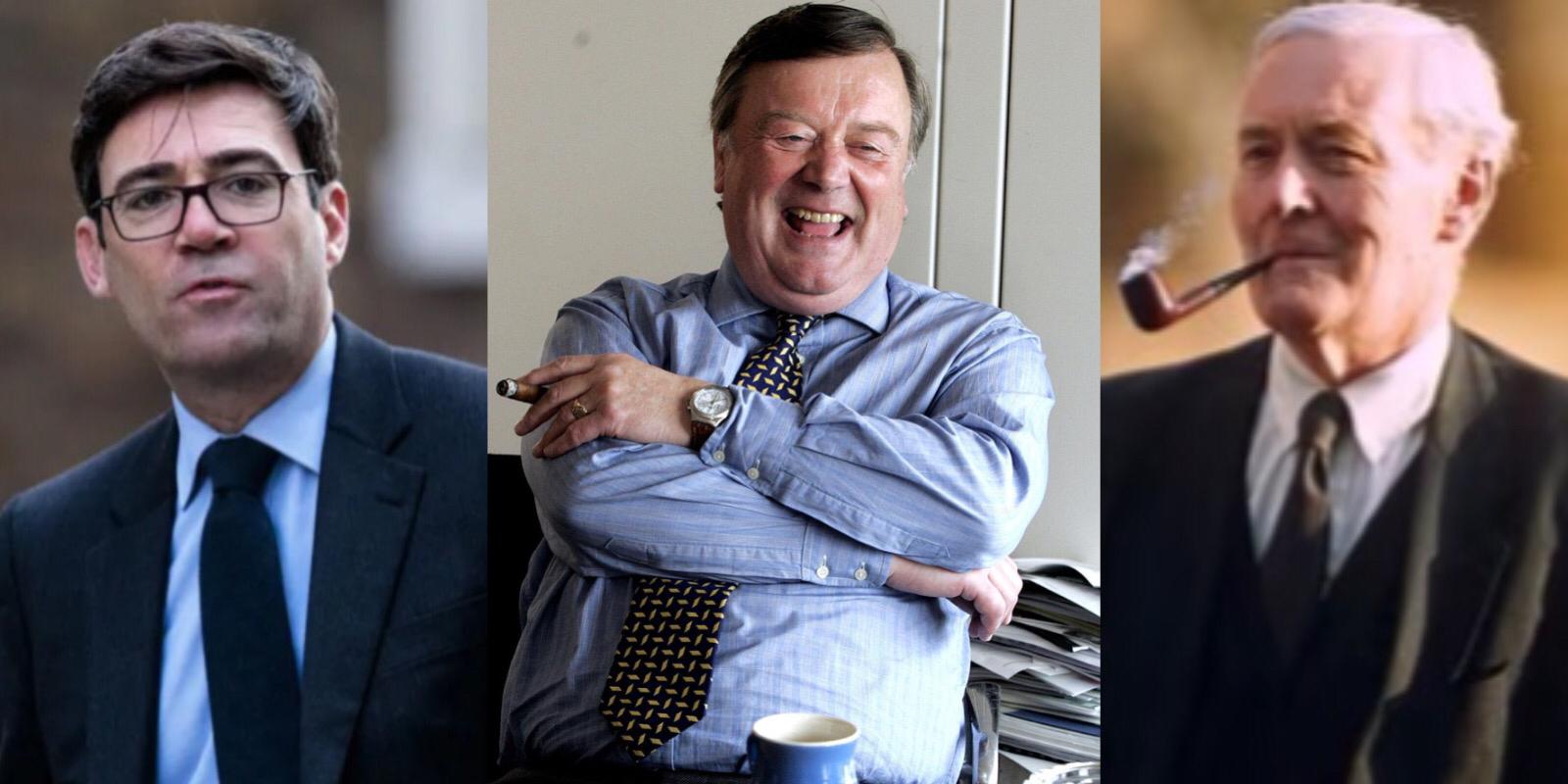
In 1868, upon ascending to the leader of the Conservative Party, prime minister Benjamin Disraeli famously quipped that he “climbed to the top of the greasy pole.” In regards to becoming the premier of their respective major political parties, these are the men who tried on several occasions but were always the bridesmaid and never the bride.
Note that this list will only focus on the major parties of Labour and the Conservatives. We thus will not include multi-time failed Liberal Democrat candidates such as Simon Hughes (1999 and 2006) and Chris Huhne (2006 and 2010). It will also only focus on the leadership and not the deputy leadership. We also will not include candidates who withdrew from or otherwise failed to reach the ballot stage in both of their campaigns (such as John McDonnell) or on one such occasion (such as Penny Mordaunt).
Kenneth Clarke (1997, 2001, 2005)

Ken Clarke is the only leadership candidate to run and fail on three occasions. With his moderate political stance and ‘bloke next door’ image, at various times, Clarke has been the most favoured Conservative MP amongst the British population. This success however which never translated to inter-party popularity.
The man many thought would win the 1997 Tory leadership election, Michael Portillo, could not stand after he famously lost his Enfield Southgate seat. The next most obvious choice was former Chancellor Ken Clarke, whose time in the role had seen the budget deficit, inflation, and employment all notably reduced.
In the first two ballots, “The Big Beast” emerged victorious. According to the UK Polling Report, amongst the public, Clarke was the first choice of more people than his four opponents combined! Yet despite support from the likes of Michael Heseltine, the majority of Tory constituency chairmen, and many Conservative peers, at the final stage, he fell short. Clarke underperformed against William Hague who, at 36, became the youngest Tory leader in over 200 years.
After the Conservatives failed to reverse their electoral fortunes in 2001, Clarke again stood in 2001’s leadership race but was again beaten in the finals. In the third position on the first two ballots, he pulled ahead of Portillo on the third to win. Clarke was supported by John Major yet, Tory members – now eligible to vote after reforms to the election process – voted instead for Iain Duncan Smith by over 60%.
Clarke did not stand in 2003’s race but did contest in 2005. Although his campaign was supported by Conservative notables such as Ann Widdicombe, John Bercow, and Sir Malcolm Rifkind, he was the first eliminated, polling just 38 votes in the first round and being eliminated.
Throughout his leadership bids, his age and his polarising support for European integration seem to be leading factors in his losses.
Herbert Morrison (1935, 1955)

With the only three-time losing candidate out of the way, we will now move chronologically, starting with Labour leadership hopeful Herbert Morrison.
At the 1935 election, Morrison regained his Hackney South seat and immediately challenged new leader Clement Attlee. The former Minister for Transport made it to the final ballot but was beaten conclusively by Attlee, who won almost double Morrison’s vote count. Morrison would blame the loss on members of the Labour Masonic New Welcome Lodge, of which fellow challenger Arthur Greenwood was a member. Once Greenwood was out, they allegedly voted to block Morrison from victory.
After the longest drought between leadership bids in modern history, Morrison stood again in 1955 to take over from Attlee. Morrison had played a vital role in the 1945-1951 Labour ministry, where he held the posts of Leader of the House of Commons and Foreign Secretary. Attlee did not step down until 1955, by which time Morrison was seen as too elderly, with John Campbell noting in Pistols at Dawn that this move was “purely to deny Morrison” the leadership.
Then-acting leader of the party, he came third and was a background character in the inter-party warfare between the Bevanite left-wing and the Gaitskellite moderates. The poor result lead to Morrison resigning as Deputy Leader later that year.
Denis Healey (1976, 1980)

In 1976, prime minister Harold Wilson stood down as Labour leader after 13 years.
In the subsequent star-studded leadership race, then Chancellor Denis Healey was the second favourite to win, with odds of 7/4. Yet Healey faced challenges. As the Chancellor, he was spending eight hours a day on what he called the most important budget since the war, giving him little time to campaign. Shortly before the race, he had savagely attacked the left-wing Tribune group of Labour MPs, which The Daily Herald called “suicidal to his changes of being elected the next leader.” In the first ballot he came fifth out of six candidates but fought on, eliminated in the second ballot where he was 95 votes away from his closest rival.
After a decisive 1976 defeat, by 1980, he was the obvious choice for leader. Healey was popular both within his party, winning the 1979 Shadow Cabinet elections, and amongst the general public, beating Thatcher in a public opinion poll over who would be the better prime minister. Although earning a first ballot victory, left-wing forces united at the final stage to hand the victory away from the former Chancellor and to Deputy Leader Michael Foot.
Although the decision was partly inspired by some thinking Foot was more likely to unite the party than Healey, such was not the case. The Social Democrat Party splintered off in 1981, taking several MPs with them. Foot’s time at the helm led to the party’s atrocious performance in the 1983 election.
Tony Benn (1976, 1988)

In the aforementioned 1976 campaign, Benn came fourth in the first ballot. Although he knew he never had a chance of winning, he was delighted to have defeated Chancellor Healey. He endorsed Michael Foot from there on. In his diaries, he wrote: “The case for standing is winning, or to win next time, to get an absolute policy across, to influence other candidates, to establish a power base.”
In 1988, Benn did not wait until a leader resigned but instead attempted a siege against incumbent Neil Kinnock. Kinnock was elected in 1983 in a race Benn could not compete in, having lost his Bristol East seat in that year’s election. The challenge came after Kinnock lost his first election and Labour’s third consecutive electoral defeat.
With the support of the Socialist Campaign Group and Eric Heffer challenging for the Deputy Leadership, Benn ran on a campaign of returning to the party’s socialist roots. He too was an opponent of Labour’s centre-ward shift across the political spectrum and the increasingly Kinnock-focussed party. Under the leadership election rules supported by Benn, he performed extremely poorly, winning 11% of the vote, including just 0.8% of the trade union vote. Thought to have cost £500,000, leader Kinnock called out Benn for causing a “stupid diversion” that could divide the party and hurt their public perception.
It was not Benn’s first rodeo at challenging for senior positions, having challenged for the Deputy Leadership against Denis Healey in 1981, narrowly losing by 0.4% of the vote. He had less famously done so previously in 1972.
John Redwood (1995, 1997)

During his premiership, John Major had a hard time fighting his own party. 1993 saw him call a no confidence vote in his own leadership to force the Maastricht rebels to vote in line with the PM’s European policy.
In 1995, he told his critics to “put up or shut up”, resigning as leader to rechallenge for the position. Only one contender stepped forward: Secretary of State for Wales John Redwood. Redwood’s crusade was supported by former Chancellor Norman Lamont and former Chairman Lord Tebbit as well as The Sun newspaper. In the end, his bid failed as he wo 89 votes to Major’s 218.
Redwood stood again two years later in 1997. After the Labour landslide that year, Major resigned, with the next leader needing to direct a party with their lowest seat count since 1906. Redwood came third in the race and also played a vital role in the final round. Despite being a Eurosceptic, he supported noted Europhile Ken Clarke – reportedly as Clarke has promised Redwood the role of Shadow Chancellor – in a bizarre alliance. Earlier in the campaign, Kenneth Clarke has said that the Conservative Party would never win an election “in 1,000 years” on Redwood’s “ultra right-wing platform.”
This pact prompted an intervention from Baroness Thatcher, with the former prime minister backing William Hague, who went on to victory.
David Davis (2001, 2005)

David Davis was very much a background character in the 2001 Tory leadership contest. A junior minister under Major and a backbencher during Hague’s leadership, he did beat former Chairman Michael Ancram in the first ballot but withdrew after the second. His 18-strong vote count was too distant from closest competitor Kenneth Clarke’s 39 and even if he had won all of votes from the eliminated Ancram, he would still be next for the chop.
By 2005, Davis had expanded his portfolio, serving as Chairman, Shadow Deputy Prime Minister, and Shadow Home Secretary. At the start of the contest, Davis – thanks in part to his high profile – was the favourite to win, having emerged in the lead after the first round of voting.
Despite a strong start, Davis was hindered by past actions such as supporting Section 28 and mulling over support for the reintroduction of the death penalty. He was perhaps most harmed by a poor performance at that year’s conference. The BBC noted: “he is not the best set-piece speech-maker amongst the candidates…And if the instant reaction from representatives in the hall was anything to go by, he did not dispel the image.” A YouGov poll afterwards found only 14% supported Davis’s campaign compared to 39% for eventual run-off opponent David Cameron. By the second round, Davis was already losing votes and he was eventually crushed by Cameron who won over two-thirds of the vote.
Since then, Davis has remained a thorn in his own party’s side. In 2008, he caused an unexpected by-election in his own seat, in 2022 he called for leader Boris Johnson to resign, and – as of 2021 – was referred to by The Times as “the most rebellious Conservative MP of this parliament.”
Liam Fox (2005, 2016)

Yet another 2005 candidate, that year’s metaphorical bronze medal winner was Liam Fox. The former Shadow Foreign Secretary and ex-Chairman would outlast Kenneth Clarke and had some support through the right-wing Conservative Cornerstone Group but would ultimately fall short of the final ballot.
When 2005 winner David Cameron eventually stepped down after 11 years, Fox stood again, although this time with more baggage. In 2011, as Defence Secretary, he became the first Conservative minister to leave the coalition, resigning in disgrace after misconduct in office, allowing lobbyist Adam Werritty access to Ministry of Defence files and overseas trips.
The most right-wing candidate in the pool, he was a noted Brexiteer, planning to have Britain leave the European Union by 2019. Earning just 16 votes, he was the first out before endorsing Theresa May. When PM, May made him Secretary of State for International Trade.
Andy Burnham (2010, 2015)

2010 marked the last year without a Labour government since 1997 and the last competitive leadership race since 1994.
In that election, the former Health Secretary ran on a campaign of so-called “aspirational socialism” and was backed by notable names such as ex-Home Secretary David Blunkett and Labour Party Chair Hazel Blears. Just picking up the minimum amount of MPs needed, he would outlast left-wing candidate Diane Abbott but would be the second knocked out of the contest. Interestingly, he was the only candidate in the race not favoured by a major trade union’s membership.
After losing the 2015 election, Burnham tried again. With support from former leader Lord Kinnock and former deputy leader Lord Prescott and the greatest number of MPs backing him, he was the clear favourite. The actor and comedian Steve Coogan described Burnham as “the only leadership candidate who has a radical leftwing vision plus the credibility to unite the party and win back power.”
However, during the race, veteran socialist backbencher Jeremy Corbyn led a successful grassroots campaign that was slowly gained traction. In June an Ipsos MORI poll revealed Burnham was the frontrunner with Corbyn at the bottom, polling 9%. Corbyn had only just scraped enough signatures to get on the ballot but by August, the New Labour rebel had pulled ahead by a large margin, having attracted support from various celebrities from the comedy, acting, and writing sphere. In the end, in the UK’s largest ever online ballot, Burnham suffered a crushing defeat when Corbyn won nearly 60% of the entire vote, with the Shadow Health Secretary winning just 80,000 votes to Corbyn’s 250,000.
Although no longer in Parliament, stepping down as an MP to serve as Mayor of Greater Manchester, he remains a party bigwig and candidate floated as a leader-in-waiting.
Michael Gove (2016, 2019)

2016 saw Michael Gove work alongside Boris Johnson in the Leave campaign for the European Union referendum. After the result caused David Cameron’s resignation, Mayor Boris became a favourite to succeed him with Gove likely to be a key asset in Johnson’s campaign before committing what The Telegraph referred to as “the most spectacular political assassination in a generation.”
Instead, Gove announced his own candidacy, causing Johnson to decide he would not stand.
It is postulated Johnson supported defected to Home Secretary Theresa May instead of the more obvious Gove, sabotaging Gove who they saw as a traitor. Gove was eliminated before the finals, coming third in the race.
Gove stood again in 2019 although this time, Johnson did stand. Gove, the then-Environment Secretary, had Betfair odds of 4/1. In a crowded 11-person race for the leadership, Gove remained running until the final three. Although in the fourth ballot he overtook Hunt to be in second place, on the fifth, he lost to Jeremy Hunt by two votes, falling short of the final hurdle. His campaign was not helped by the revelation he had previously taken cocaine as a journalist and President Trump criticising him despite praising both Hunt and Johnson.
Just for completionist sake, the Gove/Johnson feud ended in what Ian Hislop called a “last petty act of revenge” in 2022 during the mass government resignations. When Gove gave Johnson an ultimatum to resign by nine o’clock, Johnson sacked him at 20:59.
Jeremy Hunt (2019, 2022)

After Theresa May’s 2019 resignation, forced out by her own MPs, the man who served under her as both Foreign Secretary and Health Secretary stepped up. Like Gove, he admitted during the campaign to drug use, admitting he smoked a “cannabis lassi” in India. Hunt fought through to the one-on-one stage with Boris Johnson, promising to “give Boris the fight of his life.” In the end, Tory members voted nearly 2:1 in favour of Boris, with Hunt perhaps harmed due to his Remainer stance in a time of important Brexit negotiations.
After a period in the wilderness as a backbencher during Boris’s premiership, he stood again in 2022. Hunt had promised to make right-wing Tory Esther McVey his deputy to unite the factions of the party.
In the contest, Hunt did surprisingly poorly, being booted out of the race in the first round after failing to garner the support of 30 fellow Tory MPs. His loss can partly be attributed to his role in showing public signs of distrust in the Johnson ministry, being vocal in his vote of no confidence in Boris, explaining: “we know in our hearts we are not giving the British people the leadership they deserve…today’s decision is change or lose [the next election]. I will be voting for change.” He subsequently supported Rishi Sunak, who was beaten in the final by Liz Truss; funnily enough, Hunt would serve as Chancellor under both during their respective terms as prime minister.
GRIFFIN KAYE.
Leave a Reply