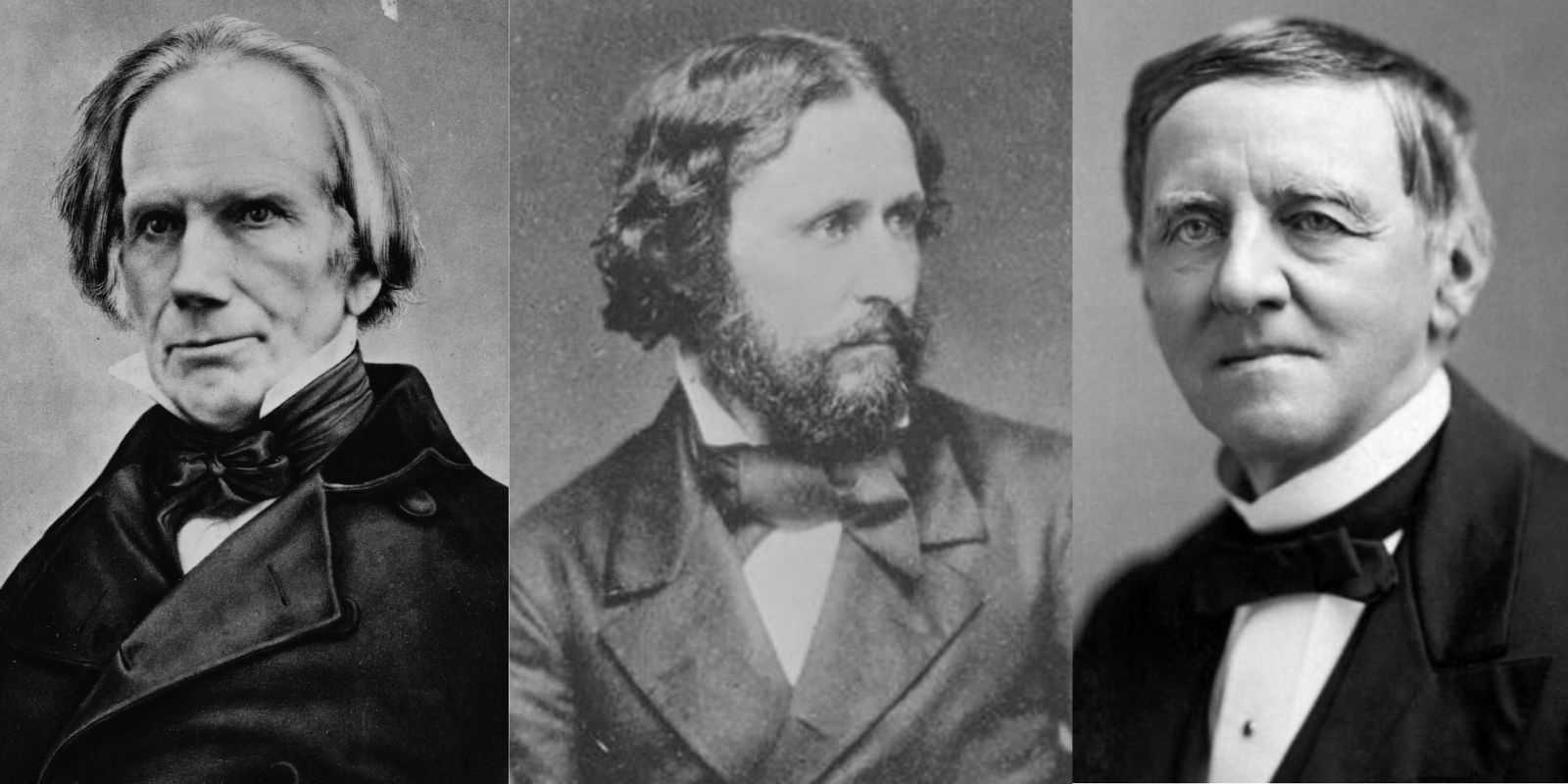
There have been 46 Presidents in the history of the United States. Whilst those who became commander-in-chief have become the stuff of legend, lesser spoken of are those men that were ‘near-presidents’ who fell short in their quest to become leader of the free world.
To be considered for this list, they must have won at least 5% of the popular vote. We will not consider candidates who would, at any point, hold the presidency.
This half of the list will focus on those from the very first presidential election up to and including 1900.
Charles Pinckey (1804, 1808)

The first presidential nominee to never reach the lofty heights of the Oval Office was Charles Pinckey in 1804 and 1808.
Prior to becoming the Federalist nominee, Pinckey had had a significant role in the American Revolution War, becoming brigadier-general. His influence being so great, he was one of the 55 delegates present at the 1787 Philadelphia Convention which saw the signing of the Constitution. Subsequently, he became a prominent political face within South Carolina.
In 1804, Pinckey lost in an unrivalled landslide, running a campaign that can best be described as apathetic. Winning 27.2% of the vote to incumbent Thomas Jefferson’s 72.8% (the largest for a single candidate), the 45% margin the largest in US history.
Jefferson had become incredibly popular, presiding over economic prosperity as well as domestic successes such as the Louisiana purchase. Meanwhile, Pinckey, chosen as a candidate to attempt to win over southern voters, was not as popular as Alexander Hamilton who likely would have been nominated had he not been killed in a dual by Vice-President Burr.
Despite the fantastical scale of his 1804 loss – only winning Connecticut and Delaware, even losing federalist stronghold New England – Pinckey was re-selected in 1808, alongside running mate Rufus King.
Although he did better in 1808, able to win states across the north-east, he still won less than 1/3 of the popular vote, earning just 47 electoral votes; opponent James Madison won 122.
Until his death in 1825, Pinckey was president-general of the Society of Cincinnati.
DeWitt Clinton (1812)

The 1812 election was the first presidential election in wartime USA, context necessary to understand the 1812 election.
During the War of 1812, a bloc of northerners opposed James Madison’s re-election, instead taking a warmth towards his Vice-President George Clinton. Yet Clinton’s death that same year scuppered those plans, to which northern Democratic-Republicans turned to George’s nephew DeWitt, who was governor of New York. Clinton too had the endorsement of some Federalists, with the party not fielding a candidate against him.
With the war the focus of the election, DeWitt’s anti-war sentiment did see him have some success. He won seven states compared to Madison’s 11, making Madison the first of only four ever presidents to have a decreased vote share in their second term.
Despite having lost in 1812, he continued as governor of New York, where author Joanne Reitano notes “Clinton’s major historical legacy was the Erie Canal. It brought him so much prestige that people thought he could have been elected president if he had not died in 1828.”
Rufus King (1816)

By 1816, the War of 1812 had ended and the Federalists had found themselves flagging, with their anti-war position undermining their popularity and Democratic-Republican Madison having implemented reforms wanted by the Federalists, questioning the need and role for the party.
There was some hesitancy towards nominating James Monroe, many feeling that the Virginia Dynasty needed to end; had Monroe been successful 4/5 presidents would have been from the state. This was overcome however and Monroe, who had the support of many past presidents, won the nomination.
Meanwhile, a demoralised Federalist Party failed to nominate anyone and ran with Rufus King, a reliable hand who had been a VP pick in 1804 and 1808 as well as garnering some support for a run in 1812.
The book Encyclopedia of American Political Parties and Elections notes how King did not campaign, seeing the result as a foregone conclusion. He wrote a letter to a friend remarking: “so certain is the result…that no pains are taken to excite the community on the subject.”
King won just three states – Connecticut, Massachusetts, and Delaware – out of 19, wining 34 ECVs.
King’s loss is significant, being the last time the Federalist Party would field a presidential candidate, leaving Monroe unopposed in 1820.
King continued a high-profile political career in the aftermath, being the last surviving Federalist in the Senate, able to hold his seat until 1825. During his last few years in Congress, he was a significant anti-slavery voice including being one of the firmest supporters of the Tallmadge amendment to emancipate Missourian slaves.
William H. Crawford (1824)

In the 1824 election, the electoral college returned a rare hung Congress where no single candidate had a majority, with one of the four main candidates being William H. Crawford of the Old Republican wing of the Democratic-Republicans.
James Monroe’s Secretary of the Treasury, the Georgian Crawford was nominated via the Democratic-Republican’s Congressional caucus (by only 66/261 congressmen), whilst supported by ex-presidents Monroe and Jefferson, having run on a states’ rights platform. However, in the end, Crawford would come third in terms of ECVs, having won Georgia and his home state of Virginia.
In reality, the race was really a two-horse race between John Quincy Adams and Andrew Jackson, with Crawford’s campaign clouded by health concerns after he had had a stroke the previous year. This had left him nearly blind and paralysed to the point of greatly hindering his campaign and run.
After his failed run, Crawford was a judge of the Georgia’s Northern Judicial Circuit from 1827 until his death. In 1828 and 1832, he considered a VP run as well as 1832 consideration of the presidency until Andrew Jackson entered.
Henry Clay (1824, 1832, 1844)

One of the most significant figures in American politics during the early-mid 19th century, Clay has been ranked by historians in 1998 of being the most qualified figure to never have been president.
Amongst some of his achievements include serving as Speaker of the House on his first day, serving as Secretary of State, effectively establishing amicus curiaes to the Supreme Court, and negotiating an 1814 settlement with the British. Perhaps his most important role however was his role in comprises such as both the Missouri Compromise and the Compromise of 1850, in the latter of which a feeble, 70+-year-old Clay proposed legislation seen by many as having delayed the Civil War by a decade.
Clay first ran for president in 1824, picking up his home state of Kentucky and two other states with the rare four-horse race election seeing the vote split with no single candidate getting a majority. Clay, who earned 13% of the popular vote backed John Quincy Adams who was elected by the House in the only time the winner of an election was not given the presidency.
In 1832, Clay returned to face Andrew Jackson – the man he had host the presidency in ‘24. Running as a National Republican, Clay was selected almost unanimously (167 votes, one abstention). Clay campaigned on his American System plan which supported high tariffs and preservation of the Bank of the United States, whilst attempting to attack Jackson over his excess power, with the President having already used seven vetoes in his four years. Jackson, nonetheless, won convincingly with Jackson winning over four times as many ECVs, with Clay winning just 49, picking up a scattering of north-eastern votes.
By 1844, Clay had made one final comeback, with that election being one dominated by the issue of annexation and slavery. The Democratic candidate was going to likely be ex-president Martin Van Buren until his anti-annexation of Texas (which would have expanded slavery and made Mexican conflict more likely) saw him finding diminished popularity. As such dark horse and VP nominee James K. Polk was chosen whilst the Whigs chose Clay. Clay was opposed to annexation, as documented in both his Raleigh and Alabama Letters although tried to campaign on other issues to avoid partisanship and regional divide. His views led the Democrats to paint a negative portrayal of Clay with the historian Sean Wilentz noting how “in the South, Democrats played racist politics and smeared Clay as a dark skin-loving abolitionist, while in the North, they defamed him as a debauched, duelling, gambling, womanizing, irreligious hypocrite whose reversal on the bank issue proved he had no principles.”
Clay did his best performance yet and nearly matched Polk on the popular vote but could not seal the victory. Although losing 170-105 ECVs and carrying 11 to Polk’s 15 states, he was able to make Polk the first to lose both in his birth and residing states as he lost both North Carolina and Tennessee.
William Wirt (1832)

In the 1832 election, former attorney general (and the longest-serving) William Wirt was chosen as a candidate through a presidential nominating convention, the first use of such, for the Anti-Masonic Party, a singularly-one-issue party against Freemasonry who had a large voice in New York, Pennsylvania, and Rhode Island.
Wirt, ironically himself a Mason, had wanted the support of the National Federalist Party by they instead put forward Clay, making Wirt’s chances of winning untenable, even if the party had moved beyond Masonry as a sectional interest.
Wirt has been described as “possibly the most reluctant and most unwilling presidential candidate ever nominated by an American party,” taking little part in actively campaigning.
However, he did have some success, able to carry the state of Vermont. This made him the first third party candidate to carry a state. He is, still to this day, the only politician from Maryland to successfully earn any ECVs. Plus, although not wholly attributable to Wirt, Andrew Jackson’s percentage decreased, one of only five presidents to have ever have their re-election with a lower percentage as he dropped from 55.5-54.2% of the vote.
Shortly after, the Anti-Mason Party formed part of the base of the Whig Party.
Hugh Lawson White (1836)

Senator for Tennessee, Hugh Lawson White was seen prior to 1836 as an Andrew Jackson loyalist. A states’ rights advocate and Constitutional strict constructionalist, White defected to the Whigs in the mid-’30s.
In 1833, the Whig Party was formed (incidentally, the Whig Party was the dominating party in the UK at the time, with Earl Grey having passed the momentous Great Reform Act). The name taken from those depicting Jackson as too powerful, the same reason White defected, comparing him to George III. That said, it should be noted that the Whigs were less a united party but more of a hodgepodge faction of anti-Jacksonists.
The 1836 election put Jackson’s popularity to the test…and he wasn’t even in it. The Democratic candidate was Martin Van Buren, Jackson’s ex-Secretary of State, seen by many as his successor-in-waiting.
The Whig pick was more complex with various Whigs put forward, including White from Tennessee. The plan, seemingly, was too flood the field, sinking the chances of any singular figure getting a majority which would rob Van Buren of the win whilst allowing the House, controlled by the Whigs, to elect a Whig leader.
This rather odd Whig strategy failed as Buren squeezed out a win with 170 ECVs and carrying 15 states to the combined 11 held by Whigs. White came in third, behind William Henry Harrison, winning 9.7% of the popular vote and carrying two states, earning 26 ECVs.
For White’s part, he campaigned against Van Buren, noting how, as a New Yorker, he may harbour abolitionist views to the sacred institution of slavery. Meanwhile, Jackson campaigned against him, although White still managed to obtain nearly 50% of the popular vote in the south.
He remained politically active until 1840 when pro-Jacksonists managed to ease him from power; he died later that year.
Lewis Cass (1848)

At the time of the 1848 election, James K. Polk was stepping down, having achieved his goals and upholding his promise of serving only one term.
Both parties then tried to bring Zachary Taylor to their party. Taylor had been a major general and become celebrated for his work in the Mexican-American War, a war started by the Democrats’s Polk but opposed by the Whigs. In the end, Taylor chose the Whigs which was odd for a few reasons. Firstly, Taylor was an apolitical figure, having never even voted, and secondly, he was a southerner, breaking the normal trend of northern Whigs.
In return, the Democrats nominated Lewis Cass, who advocated for the idea of popular sovereignty in which states could decide whether they wanted to be slave states. A northerner, Cass had previously served in the War of 1812 as well as holding political office in Michigan for nearly 20 years, becoming Secretary of War, and Ambassador to France.
The campaign trial was rather tepid. With both parties taking a vague stance on slavery as to not alienate voters regionally, the debate was naturally stifled.
In the end, Cass came short although it was a more than respectable effort, picking up 15 states: Alabama, Arkansas, Illinois, Indiana Iowa, Maine, Michigan, Mississippi, Missouri, New Hampshire, Ohio, South Carolina, Texas, Virginia, and Wisconsin. Taylor also won 15 states but 36 more ECVs.
The truth is, Cass would had likely won had it not been for the Free Soil Party serving as a spoiler. Led by former president Van Buren after annoyed at not being nominated by the Democrats, Buren – himself an anti-slavery figure (known as a ‘Barnburner’) was on the ballot in 17/29 states, aiming to prevent Cass becoming president. Although winning no ECVs, he won 10% of the popular vote, considered by many to have cost Cass the presidency, making Cass the first non-incumbent Democrat candidate to lose an election whilst losing to Taylor, the last non-Democrat or Republican to win a US election.
Cass would continue operating into old age, appointed Secretary of State by James Buchanan in 1857 when in his mid-’70s.
Winfield Scott (1852)

In 1850, elected president Zachary Taylor died, with his duties taken over by VP Millard Fillmore. Yet so reviled, so poison was Fillmore to the Whigs (William H. Seward once remarked he was a “man of hesitations and double opinions where decisions and singleness were indispensable,”) that he was not nominated in 1852, with long-standing army general Winfield Scott replacing him.
Scott would go on to lose decisively, with opponent Franklin Pierce winning 27/31 states; Scott only won Massachusetts, Vermont, Kentucky, and Tennessee.
Pierce, the last man to win a majority in ECVs and popular vote for 80 years, was chosen as the Democratic nominee on the 49th ballot as a dark horse candidate aimed as a compromise solution.
The campaign focused on the issue of slavery yet again, with both sides supporting the troubling Compromise of 1850, even if Scott, as noted by William DeGregorio, was anti-slavery. Despite being able to boast of his successful background in the War of 1812 and the Mexico-American War, Scott was notably awkward in front of a crowd and was the subject of personal attacks by the Democrats.
After his loss, Winfield continued his military career, serving as a general, for which the Duke of Wellington described him as “the greatest living general,” until 1861, having become a lieutenant general in 1855. His career would continue to blossom as “The Grand Old Man of the Army” became “Abraham Lincoln’s top soldier in the early months of the Civil War” as commented by John Eisenhower, with the Virginia-born Scott siding with the Unionists.
The Whig Party itself faired less well. This was the Whig’s worst defeat, with the party’s warring actions leading to its slump, especially after the Kansas-Nebraska Act which stoked the slavery debate to levels that would cause an internal rupture.
John C. Fremont (1856)

The 1856 election saw the debut of a new party which had grew out of the roots of the Free Soil Party (pun intended): the Republican Party.
By 1856, slavery was, inevitably, still the big issue facing the country. After the Kansas-Nebraska Act, a move which caused conflict between anti-slavery and pro-slavery forces. Tensions were high and the nation fractured, as demonstrated by the near-killing of Charles Sumner for his anti-slavery views.
As a result of such national division, the Republican Party was formed, whose main platform was one on which they refuted slavery, as well as matters such as railroad innovation and anti-polygamy. In 1856, the daring explorer, and ex-general (capturing Californian during the Mexican-American war) John C. Fremont was chosen as the nominee.
As noted by Steve Inskeep, Fremont’s wife Jessie helped in the campaign, becoming one of the first female figures in US politics, way before First Ladies became the symbols they are today. That said, the campaign trial was not pretty for Fremont, who found himself the subject of a smear campaign, which focused on his illegitimacy and accusations of his Catholicism – the latter a statement not rejected by Fremont. Even Fremont’s father voted Democrat, stating that a Republic win would split the nation, with the party “treading upon a volcano that is liable at any moment to burst forth and overwhelm the nation.”
All things considered, the result was not terrible for a first time third party, picking up 11 states and over 100 ECVs.
However, the Republicans debut was hindered by the new, progressive American (‘Know-Nothing’) Party, led by former president Millard Fillmore – even if he had never previously been affiliated with the party. Moreover, Fremont even lost his home state of California, picked up by the Democrats in a clean sweep of the deep south, where the Republicans reportedly garnered less than 1,000 votes, showing the extreme partisanship of the election, especially since the Republicans won across the northern fringe.
With the Republican win in 1860 however, 1856 would be the last occasion to date that a Democrat would succeed another after a successful full-term.
Post-1856, Fremont again had an early army role, this time in the American Civil War. Yet, after trying to expel Confederates out of Missouri in a move seen by Lincoln as premature and a step too far, he was subsequently curtailed of authority.
He was set to stand as a presidential candidate again in 1864, seeing Lincoln as too moderate, standing for the Radical Democracy Party. He stood down however to avoid splitting the vote.
His legacy continues to live large, perhaps most notably through the eponymously-named city of Fremont in California.
John C. Breckinridge (1860)

In his book The Election of 1860: A Campaign Fraught with Consequences, Michael F. Holt argues: “Without question the election of 1860 was the most consequential presidential contest in all of American history. The victory of republican candidate Abraham Lincoln quickly triggered the succession of seven Deep South states and led, six weeks after him took office on March 4th 1861, to a horrific 4 years civil war…No other American presidential election has come close to engendering such a catastrophic outcome.”
In 1860, annoyed at the nomination of Stephen A. Douglas, who had a moderate view of slavery, southern Democrats, known as ‘Fire-Eaters’, contested their own nominating convention in which they nominated John C. Breckinridge, the VP (the youngest ever) to James Buchanan – a man, incidentally, so unpopular as to warrant no calls for re-election. Jefferson Davis was even originally in consideration for the pick.
Breckinridge would naturally have an uphill battle, not only having split from the northern Democrats but also fielding a challenge from the Constitution Union Party.
The pro-slavery Breckinridge saw great success south of the Mason-Dixon Line, winning 11 states in total, nine of which were in the deep south. Picking up 72 ECVs, the second most in the election. Breckinridge was left off the ballot in four northern states whilst winner Lincoln was left off many southern state ballots, making him one of only two presidents earning no votes in a state, the first being John Quincy Adams 36 years previously.
Breckinridge however, needed votes in the north, where Lincoln was able to win an ECV majority despite only 40% of the popular vote. He even lost Kentucky to John Bell of the Constitution Union Party.
In the years afterward, Breckinridge became a major general of the Confederacy and later Secretary of War, having defected to the side during the Civil War. Friends fought for a pardon although this was not forthcoming. When President Jackson announced Confederate amnesty on Christmas Day 1868, Breckinridge returned and resettled in Kentucky. He refused to return to politics (which would have required a 2/3 supermajority vote in both chambers of Congress), comparing himself to “an extinct volcano.” He would advocate the creation of the Cincinnati Southern Railway which was initially rejected by Congress but would eventually start construction a few years’ prior to his death.
John Bell (1860)

The 1860 election also saw the involvement of the third party Constitutional Union Party. The party ran on the platform: of recognising “no political principle other than the Constitution of the country, the Union of the states, and the Enforcement of the Laws.” Its slogan was similar in message: “the Union as it is, the Constitution as it is.”
On the second ballot, John Bell was chosen above fellow candidate Sam Houston. Bell had a long political career, having been the Speaker of the House, an ex-Secretary of War, and Senator. Supported by the Whig and American (Know-Nothing) Parties, the party served as a hub for conservative unionists. Having nominated both Whigs, Bell for president and Edward Everett for Vice-President, the party became labelled as the “ghost of the old Whig Party.”
James McPherson notes how the role of the Constitutional Union Party was not necessarily to win but prevent a majority, which could lead to the House of Representatives appointing the most inoffensive candidate, which could be a Constitutional Union member.
In the election, the group were effectively the only opposition to the Southern Democrats in the south, where they won three states, with wins in the border states of Kentucky, Virginia, and Tennessee, attaining 39 ECVs. Bell finished second almost universally in all slave states won by Breckinridge. In the north, the group were merged with the Northern Democrats on ballots, yet still failed to overcome the popularity of Lincoln’s Republican Party.
Bell would die in 1869, having become reviled in the US after defecting to the Confederacy after the mass southern secession movement.
Stephen A. Douglas (1860)

A nationally-known name by 1860, the so-called “Little Giant” Stephen A. Douglas was chosen as the Democratic candidate in 1860, much to the chagrin of the southerners, annoyed by his ‘moderate’ popular sovereignty ideas.
A self-made man, Douglas had worked his way across the political landscape from serving on the Illinois Supreme Court to joining the House and then the Senate, whilst running for the Democratic nomination in 1852 and 1856. He won the nomination in 1860, by which time he was perhaps the most famous politician in the country.
In the campaign, Douglas broke with tradition and campaigned across the country; his opponents stayed at home. Douglas, seemingly resigned to his defeat in the months prior, later modified his campaign from advocating himself for the presidency to campaigning in the south against secession.
In the election, Douglas’s performance was a demonstration of the absurdity of the Electoral College. He won nearly 30% of the vote (in the election with the highest turnout up to that point) but only one state, Missouri. Despite winning nearly as much as John Bell and John C. Breckinridge in the popular vote, he won 99 less ECVs. He was, however, notably the only nominee to win votes in a slave and a free state, picking up some votes in New Jersey, which he split with Lincoln.
In the aftermath, Douglas supported the Union after the outbreak of the Civil War, having failed to prevent secession. He would work alongside Lincoln to try to ensure a victory for the union but died within a few months, dying from typhoid fever.
Today, Douglas is most remembered for the iconic 1858 Lincoln-Douglas debates. A series of seven debates across Illinois to determine who would go to the Senate, the two great orators had several one-to-one debates in a format comparable to the modern day. Focused on the issue of slavery, Douglas eventually won the Senate (albeit with Lincoln winning the popular vote); the Smithsonian notes how the talks “transformed Lincoln into a presidential contender.” Indeed, the rematch was set for 1860, when both men were national figures.
George B. McClellan (1864)

Despite his reputation today as perhaps the greatest president in US history, back in 1864, confidence in Abraham Lincoln was not high. So much so that the president thought he may not be re-nominated. Amidst high Civil War casualties and growing opposition from within his own party from the likes of Salmon Chase, things did not look good for Lincoln.
The Democrats nominated George McClellan, a successful ex-army general given the sack by Lincoln in 1862. In the early stages, McClellan was the favourite to win although his prospects dwindled in the months and weeks prior to the election for various factors.
One of the main reasons was that there was light at the end of the Civil War tunnel. The capture of Atlanta by Union forces in September 1864 proved pivotal to the election, with the north having captured one of the most crucial locations in the Confederacy and making a northern win more likely, negating the need for a truce, as the Democrats had proposed.
The Democrats had proposed such a peace truce despite McClellan’s personal position as a pro-war Democrat. The party itself was split between those wanting peace and those wanting war, with McClellan’s running mate George H. Pendleton an anti-war Democrat to balance the ticket and accommodate both sides.
Lincoln was also aided by the role of the Radical Democracy Party. This group of Republicans who felt Lincoln was too moderate was to be led by John Fremont. However, not wanting to risk splitting the vote as a spoiler candidate to allow a Democrat win, he pulled out.
In the election, Lincoln triumphed. With the core Democratic base located in the south, especially in the seceded states who did not vote in the election, Lincoln was able to pick up nearly 200 more ECVs than McClellan, who was only able to win Kentucky, New Jersey, and Vermont.
The statistics demonstrate Lincoln’s surge in popularity. 75% of soldiers voted for Lincoln whilst he became the first candidate to earn over two million votes (although many states had seceded, three new states voted for the first time: Kansas, West Virginia, and Nevada – all of whom voted Lincoln). With the re-election, he became the first elected to two terms since Andrew Jackson in 1832.
McClellan would go on to become the President of the Atlantic and Great Western Railroad from 1872 onwards, followed up a few years later to becoming Governor of New Jersey, one of the few states he had won in 1864.
Horatio Seymour (1868)

Perhaps the most important legacy of the 1864 election however was the appointment of VP Andrew Johnson. Ditching Hannibal Hamlin, Johnson – actually a Democrat – was chosen to run with Lincoln under the bipartisan National Unity ticket to broaden the group’s appeal. When Lincoln was assassinated within weeks of his second term, the infamous Johnson would become perhaps the most reviled president in history, with Richard Zuczek noting how “his subsequent intransigence and short-sightedness as president eclipsed his earlier achievements and destroyed the reputation he had struggled his entire life to build,” having pardoned Confederates, vetoed Acts to protect slaves, and dividing Congress to the point he was within one vote of impeachment. He was not renominated in 1868.
The Republicans unanimously nominated Ulysses S. Grant on the first ballot, with House Speaker Schuyler Colfax as his running mate. Meanwhile, the Democratic candidate was more surprising. Amongst early contenders were 1864 VP nominee Pendleton and Chief Justice Salmon Chase, ironically an instrumental figure in the establishment of the Republican Party. In the end, the party choose the dark horse candidate Horatio Seymour. A delegate, keynote speaker, and chairman, he was extremely insistent against his appointment, remarking: “God bless you for your kindness, but your candidate I cannot be.” He nonetheless was chosen as the party’s nominee.
The first post-Civil War election, the main issue was southern reintegration as a part of Reconstruction and the rights of former slaves.
The campaign was a personal one with both sides attacking one another. Democrats portrayed Grant as an alcoholic whilst Republicans portrayed Seymour as a southern sympathiser.
The latter point was one that hurt the Democrats campaign. The party ran what can be seen as a campaign filled with thinly-veiled racism. The Democratic Vice-Presidential nominee Francis Blair particularly tried to use race as a bulwark for support, stating calling blacks a “semi-barbarous race…who are worshipers of fetishes and polygamists.” This campaign was fronted with the no-so-subtle mantra: “This is a white man’s country, let a white man rule,” fearing Grant’s presidency would open political doors for African-Americans, hence advocating amnesty for rebels and letting southern states decide the fate of black suffrage.
Seymour had an active campaign, taking to the stump to talk in Syracuse, Buffalo, Philadelphia, Pittsburgh, Cleveland, Columbus, Detroit, Indianapolis, and Chicago. Despite this, Grant still won a landslide, winning 214 ECV, having won 26 states whilst Seymour won only eight. Grant, at 46, became the youngest president.
The Democrats were hindered naturally by the right of slaves to vote, after four million were emancipated. Grant won 300,000 more votes than Seymour whilst 500,000 slaves voted, likely overwhelmingly in favour of Grant; he would almost immediately pass the 15th Amendment once in office to prevent obstruction of suffrage based on race.
An ex-two-time Governor of New York, Seymour’s life post-nomination would see him end the Tweed Ring’s dominance over the state, where the corrupt group were able to steal billions of the state’s budget. He spent the last decade of his life in declining health, simultaneously looking after his ill wife until 1886 death.
Horace Greeley (1872)

Most presidential nominees up to 1872 had been career politicians or ex-war heroes of some sort; such was not the case in 1872. To challenge President Grant, the Liberal Republican Party nominated the Horace Greeley, the editor of The New-York Tribune and figure with no end of eccentricities from his belief in the paranormal to his veganism. The Democrats too backed Greeley, despite his decades of anti-Democrat writings in his publications.
In 1872, the Republicans main opposition was the Liberal Republican Party, which broke off from the Republicans. Proposing more classical views and opposed to the Grant administration, they believed that Civil War goals had been achieved and it was time to end Reconstructionism and the overreach of federal government.
Some had lost support for Grant, due to the widespread cronyism and corruption within his Cabinet, referred to as “Grantism” by Liberal Republican Charles Sumner. Even Vice-President Colfax had been implicated in the Credit Mobilier scandal in which politicians got kickbacks in regards to the construction of the railroads, leading to Grant making Henry Wilson his new running mate. In return, Greeley used the motto “More Honest Government.” Other Grant policies too lost him popularity, such as his plans to annex Santo Domingo in the Dominican Republic.
Greeley’s campaign had various issues which led to his loss. Firstly, his opinions, such as his opposition to slavery which would have lost him votes in the south – where Democrats normally ran roughshod – especially since the Tribune was one of the most read publications in the country, with a 200,000-strong readership by the mid-19th century. His work too advocated utopian ideals such as socialism, whilst he had defended the views of contributor Karl Marx. As noted by Larry Sabato, he too was heavily attacked by the famous cartoonish Thomas Nast in Harper’s Weekly, with cartoons such as Greeley shaking hands with John Wilkes Booth over Lincoln’s grave and bailing out Confederate leader Jefferson Davis. His appearance too was a point of ridicule: a frail, old fuddy-duddy in outdated and pensioner-clothing (an image comparable to Britain’s Michael Foot in 1983).
As Eugene H. Roseboom commented: “Never in American history have two more unfit men been offered to the country for the highest office.”
In the election, Grant won convincingly. Grant won 286 ECVs, declaring victory in 29 states whilst Greeley would have won only six. Notice the term “would” there. Indeed, with his wife dying days before the election, Greeley would actually die before the end of the month, before the Electoral College convened. His votes were subsequently redistributed; Greeley was the only ever major candidate to die before the results could be counted.
He nonetheless died beloved. Even Harper’s Weekly paid a tribute, stating his death was the most devastating to the US since Lincoln’s whilst his funeral was attended by major political figures including Grant.
Samuel J. Tilden (1876)

In 1876, Grant considered a third term but did not stand. Instead, the Republicans put forward Civil War veteran (wounded five times in the War) and Ohio Governor Rutherford B. Hayes whilst the Democrats nominated New York Governor Samuel J. Tilden – a Bourbon Democrat, being economically laissez-faire and supporting states’s rights rather than a centralised federal government. Yet, to paraphrase historian Eric Foner, both where “political mediocrities.”
The Panic of 1873, in which changes to US monetary policy in regards to coinage led to the collapse of America’s biggest bank Jay Cooke and Company, led to the beginning of what is now known as the Long Depression, with PBS notifying 14% unemployment by 1876.
The 1876 election today is regarded as the most contentious presidential election – certainly prior to 2000 – for its controversial result.
In the early stages, all signs pointed to a win for Democrat Tilden. In response, Hayes conceded defeat both to the press and in his diary, going to bed believing he had lost.
Tilden sat on 184 ECVs, one short of a victory when Hayes ‘won’ the remaining states. However, it is extremely questionable who won where. The Democrats utilised the Mississippi Plan in which black voters were duped out of free voting, by the Red Shirts and the White League; even the KKK played a role in trying to ensure a Democrat win, the party championing white supremacy. Elsewhere, intimidation, violence, lynching and other tricks were widespread. Due to illiteracy, black voters could be tricked into misplacing their ballots whilst some figures such as Tilden’s nephew tried to pay off returning boards. Some reports note how ‘repeaters’ would shave their beards to pass as different people and vote multiple times. To quote Lew Wallace, writer of Ben-Hur, “nothing is so common as the resort to perjury, unless its violence.”
The contentious result saw Hayes win 185 ECVs; Tilden won 184 – the closest result in US history. The hotly contested results were problematised further by the absence of a Vice-President to verify the results after the death of Henry Wilson. A 15-man commission was set up in an unprecedented event, comprised of five Senators, five Representatives, and five Supreme Court justices. Voting 8-7 on partisan lines, the commission upheld the 20 disputed votes needed to win. Ironically, since the last election, the Democrats had advocated for Colorado to vote for the first time, although it would cost them as the state gave its votes to Hayes.
The result remained controversial. The concept of “Tilden or Blood” became a popular adage whilst a shot was fired at Hayes’s residence. In the election with the highest ever turnout at over 80%, many saw it unfair that Tilden, who won over 51% of the popular vote (the highest of any non-winner) to Hayes’s total below 48% (the lowest of any winner) was not crowned the president. With a civil war brewing, a resolution was reached in the Compromise of 1877 when it was agreed Hayes could become the president as long as the military were withdrawn from the south to end the Reconstruction Era.
Winfield Scott Hancock (1880)

Hayes upheld his promise that he would serve only one term, stepping down in 1880. In the aftermath, the Republicans were split between the Stalwarts and the Half-Breeds who disagreed over patronage. The nomination process, the longest in Republican history, eventually saw dark horse candidate James A. Garfield chosen, even if Ulysses S. Grant staged an attempted revival, the first ex-president to restage renomination for the same party.
The Democrats meanwhile chose military hero Winfield Scott, who had fought in the Mexican-American War, Seminole War, and earned the nickname “Superb” for his work in the Civil War.
The two major party candidates disagreed on very little in the campaign, especially since Hancock was a Unionist Civil War hero so Republicans could not ‘wave the bloody shirt’. The major issue was on tariffs; the Republicans wanted a high tariff to help northern business whilst Democrats wanted to reduce it, “for revenue only.” Pro-business forces flocked towards Garfield whilst Hancock undermined his position by mistakenly referring to the matter a “local question”, making him look politically inexperienced.
The lack of an issue is not to say there were no campaigns. Grant had made a series of scathing attacks on Hancock, referring to his as illicit in corruption and vain and power-hungry, desiring the media spotlight – comments secretly recorded without Grant’s knowledge. Moreover, a fraudulent letter from Garfield’s office, called the Morey Letter, was distributed on 100,000 fliers in the west coast, claiming that Garfield wanted to maintain vast Chinese immigration to ply the nation with cheap labour. Despite being a forgery, it may have cost Garfield California, which Hancock won by 20 votes. Both Garfield and Hancock did not actively campaign but some believe VP nominee Chester A. Arthur’s speeches in New York helped win the state, crucial to Republican victory.
The results were compared to Waterloo by Hancock’s wife. Indeed, he fell short with 155 ECVs to Garfield 214. These results do not communicate how closely knit the race was however, with just 2,000 votes separating the two, the closest in US history; both won 19 states (with Hancock losing his own state of Pennsylvania in an election result dividing the north and south).
Hancock left politics, disgusted at the “miserable devils [that] worry me to death,” having only dedicated three hours a day, three days a week to politics. He did however go to Garfield’s inauguration. Hancock would continue to serve the Atlantic Division, dying at his post on Governor’s Island, New York. In his last years, he too was elected to the president of a new group: the National Rifle Association.
James G. Blaine (1884)

The 1884 election can be seen as a political outlier. The first time the Democrats had won an election in the post-Civil War era, 1884 winner Grover Cleveland (who won again in 1892) would be the only Democratic presidential election winner from 1856 up until 1912.
The most significant state to the result of 1884 was New York. Cleveland, an ex-Governor of New York, narrowly won the state by just over 1,000 votes. Republican challenger James G. Blaine perhaps lost for a number of reasons. He lost Irish support when not defending Catholics against the comment that Democrats were the party of “rum, Romanism, and rebellion”, faced opposition from the Prohibition Party, and did not have a large campaigned back by figures such as President Arthur.
Blaine, the ex-Speaker of the House and Secretary of State, he fell short in his candidacy in 1876 and 1880. In 1884, he won the nomination over President Arthur, who himself had taken over from Garfield (whom Blaine was with when he was assassinated), who was shot months into his term.
For Blaine, the campaign was an ugly one. The campaign mostly focussed on the personality of the individuals, with the Democrats exploiting Blaine’s corrupt past. The Mulligan Letters from a decade earlier had led to the idea that Blaine had, in the words of one report, “prostituted his high office for personal gain” by giving congressional benefits to railroad industries. He was not only facing accusations from the Democrats but opposition too from the so-called Mugwumps, anti-Blaine Republicans. Cleveland too faced attacks, including birthing a child out of wedlock, yet was able to survive the slur due to his telegram telling his campaign managers to “tell the truth.”
Blaine remained active in politics, playing the role of a political commentator. By 1888, he still had popular support from Republicans such as Theodore Roosevelt but decided to not run. He would however return to his old job as Secretary of State under Benjamin Harrison. According to biographer David Muzzey, he was still popular by 1892; although in contention for nomination, he came second.
James B. Weaver (1892)

In 1892, Grover Cleveland became the first – and, as of writing, only – president to re-enter the White House after a landslide victory over Benjamin Harrison. The first election where two incumbents had been defeated in a row, it was Cleveland’s third popular vote win in a row. A rematch of the 1888 battle, signs of voter lethargy and disillusionment with the two candidates could be seen through the blossoming Populist Party.
Also known as the People’s Party, the party had its roots in both the Farmers’ Alliance and Greenback Party, the latter of which 1892 nominee James B. Weaver had previously ran for president for in 1880. The party embarked on a progressive platform including a graduated income tax and nationalisation of industries such as telegraphs and railroads. The party’s strong progressive sentiment was compared by vice-presidential nominee James G. Field to the revolutionary impulse of the 1776 American Revolution. In the party’s own words: “We believe that the power of the government, in other words the people, should be expanded.”
The nominee James B. Weaver was an ex-Union general, who had been a part of major general Sherman’s March in 1864, which saw the capture of Georgia in the Confederacy. Perhaps feeling this would harm him in the south, the party decided to nominate ex-slaveowner and Confederate fighter James G. Field. A bizarre ticket, if ever there were one!
The Populist Party’s 1892 breakthrough saw the emergence of the first third party in the post-Civil War era to win any ECVs. The party won four (mostly western) states outright and picked up votes in both North Dakota an Oregon to collate 22 ECVs. They won 8.5% of the popular vote with over one million ballots cast in their favour.
In the words of the political historian Richard Hofstadter, the party was “a striking case of the exertion of broad influence by relatively small force through third party action.”
For his part, Weaver died in 1912, years before he could see Populist Party policies, such as the direct election of Senators would come to fruition. In the decade previously, he had defected to the Democrats after the end of the People’s Party’s lifespan, supporting William Jennings Bryan for president. Talking of which…
William Jennings Bryan (1896, 1900, 1908)

In 1896, Grover Cleveland was to step down, having served two, albeit non-consecutive, terms.
At the 1896 Democratic National Convention, the party nominated William Jennings Bryan. His famous ‘Cross of Gold’ speech catipulted him from dark horse to front runner; in the speech, he advocated a free silver monetary policy, to which the convention broke into half-an-hour of adulation where Jennings was celebrated on the shoulders of the delegates. The St. Louis Post-Dispatch referred to the speech as one in which Bryan “immortalized himself.” Bryan, at just 36, became the youngest ever candidate nominated by a major political party.
He too earned the backing of the Populist and newly-created Silver Party. Although Bryan’s running mate was the conservative Arthur Sewall, the Populists decided to nominate Tom Watson for VP.
Bryan embarked on what has been described as the “most strenuous campaign conducted up to that time.” In three months, he travelled 18,000 miles, making 500 speeches within 100 days (on one day, he even made 36 speeches!). Campaigning across 27 states, he is believed to have reached an audience of five million citizens.
In the end however, the Republicans triumphed. William McKinley, who had five times as much funding as Bryan to spend on billboards and newspaper ads, would win 271-176 ECVs. Bryan still won 22 states compared to McKinley’s 23, although had 600,000 votes less. Although 600,000 votes may sound slim (for context, 2020 saw Joe Biden have more popular votes by a margin of seven million), it was notable due to the even smaller gaps in preceding years.
In the rematch in 1900, Bryan fared less well. With the nation’s economy booming and acquiring greater Latin American territory, Bryan failed to get off the ground. Bryan repeated his vast campaigning attempts from 1896, with biographer Paolo E. Coletta noting he would typically speak for several hours a day, speaking over 60,000 words a day at an average of 175 words per minute.
It was to no avail however. McKinley’s results were greater than the previous election, becoming the first president re-elected at consecutive elections in nearly three decades. Bryan won across the south and a smattering of western states but was beaten convincingly, even losing home state Nebraska.
Like Lincoln in 1865 however, McKinley’s tenure would be cut short just months in when anarchist Leon Czolgosz would fatally shoot the president in 1901. Ironically, during the 1900 campaign, adviser and Senator Mark Hanna had told McKinley his only duty was “stay alive” because he was the only obstacle between “that madman and the White House”, that madman being Vice-President Theodore Roosevelt.
To be continued in Part II.
GRIFFIN KAYE.
Leave a Reply